
The JC Penney Home Quinn Basketweave Grommet Top Patio Panel is a polyester-blend, lined indoor curtain panel that some shoppers repurpose on covered patios and porches. It is not rated for outdoor use by the manufacturer. JCPenney product pages for Quinn-series panels list 'Use: Indoor,' and no official spec sheet, hang tag, or retailer listing identifies this panel as UV-stable, water-repellent, or mildew-resistant. That doesn't make it useless outdoors, but it means you need to go in with realistic expectations about how long it will last and where it will perform acceptably versus where it will struggle.
JC Penney Home Quinn Basketweave Grommet Patio Panel Review
Lark Perry
18 Jul 2026
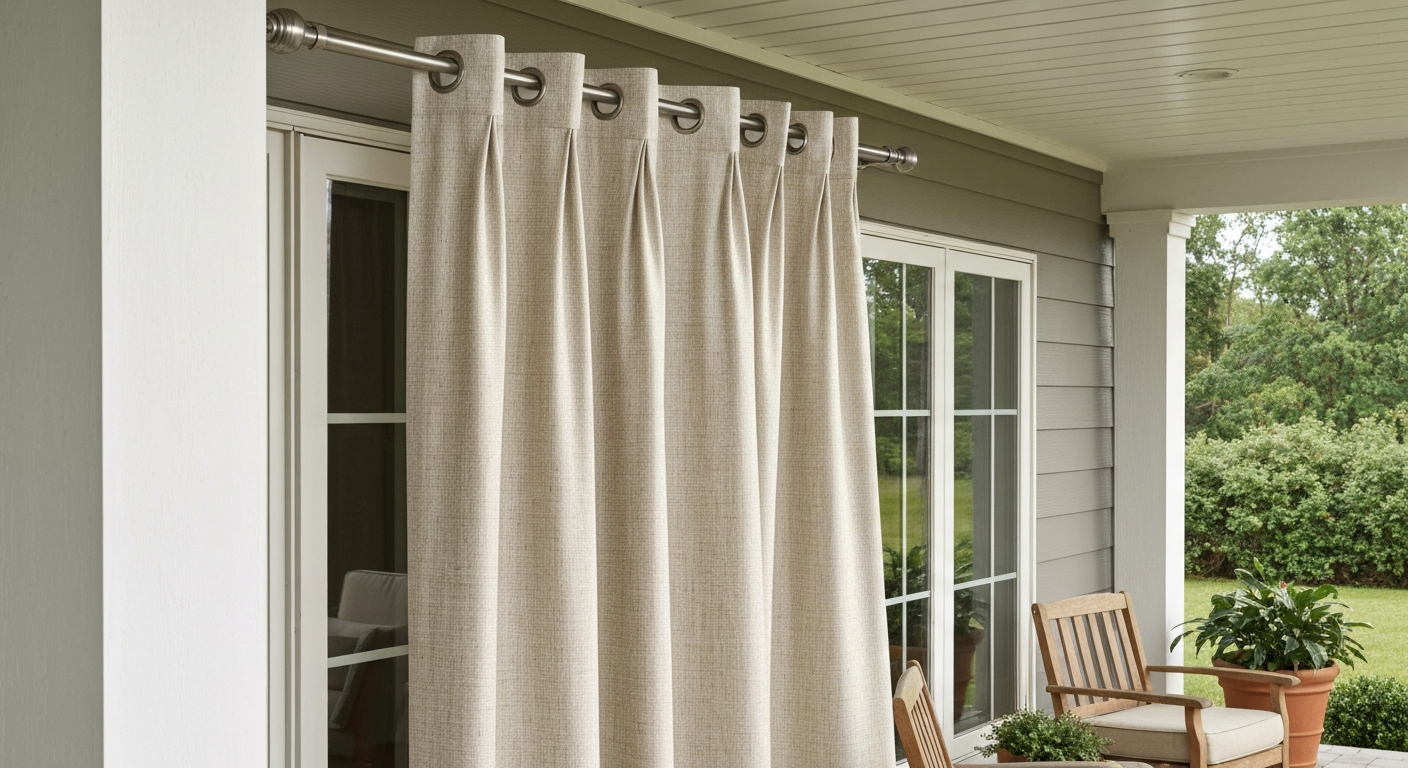
Product snapshot: What the Quinn Basketweave panel actually is
The Quinn Basketweave is a grommet-top curtain panel sold under both the JC Penney Home label and the Liz Claiborne label (a brand historically sold exclusively through JCPenney). The two labels refer to the same product family and share the same construction specs. Here is what the available product and reseller data confirms.
Materials and construction
The face fabric is approximately 72% polyester and 28% rayon, with a separate polyester lining sewn in. The lining is what earns the 'energy saving' and 'light-filtering' or 'room-darkening' marketing language you see on JCPenney and reseller listings. A header buckram runs across the top of the panel to give the grommet row structure and keep it from buckling. This is a well-made indoor panel construction. The polyester-rayon blend gives the fabric a soft, slightly textured basketweave look, but rayon is a cellulose-based fiber that absorbs moisture readily, which is exactly the wrong characteristic for a panel you plan to leave hanging in rain or humidity.
Available sizes
Reseller and marketplace listings (eBay, Poshmark, Bonanza, Bed Bath and Beyond marketplace) confirm the Quinn Basketweave was sold in a 50-inch width across multiple lengths: 63, 72, 84, 95, 108, and 120 inches. Each panel is 50 inches wide, so you are buying single panels, not pairs. If you need 100 inches of coverage across a doorway or pergola bay, you need two panels.
Colors and finish
Confirmed colorways from marketplace listings include Skyline Gray, Ivory/Taupe, and Indigo/Navy. The basketweave texture gives each color a subtle woven dimension rather than a flat printed look, which reads well on a porch or pergola because it mimics natural woven materials. Resale prices on current marketplace listings run roughly $25 to $80 per panel depending on size and condition, with new-with-tags panels toward the higher end of that range. Marketplace listings (for example, the eBay listing 'TWO Liz Claiborne Quinn Basketweave Grommet Curtain Panels 50 x 95in | eBay') show Quinn Basketweave panels selling at resale prices typically between about $25–$80 per panel (examples vary by size and condition; many listings show prices in the $30–$80 range for new or 'new with tags' panels).
Grommet specs and rod compatibility
JCPenney grommet-top panels, including Quinn-series products, use a 1.5-inch inner grommet opening. That measurement is confirmed both by Liz Claiborne/Quinn reseller listing details and by JCPenney's own product attribute fields on other in-house grommet panels, which list 'Top Opening: 1 1/2 In Grommet Open.' A 1.5-inch inner diameter accommodates standard curtain rods up to about 1.25 inches in outer diameter, which covers most standard and mid-weight outdoor rods. If you are using a heavy-duty 1.5-inch or larger pergola rod, test clearance before buying, because a snug fit will make sliding difficult.
Outdoor performance and suitability: the honest picture
I want to be direct here because this is the section that actually determines whether this panel belongs on your patio. The Quinn Basketweave carries no outdoor performance certifications of any kind. There is no UPF rating, no AATCC TM16 colorfastness-to-light test result, no ASTM G154 accelerated UV exposure data, and no mildew-resistance rating from ASTM G21 or comparable test methods. The retailer explicitly lists 'Use: Indoor' on comparable JCP grommet panel product pages. That is the baseline you are working from.
UV and sun-fade exposure
Polyester has reasonable inherent UV resistance compared to natural fibers, and the heavier the polyester content the better. But the Quinn face fabric contains 28% rayon, which fades and degrades faster than polyester under sustained UV exposure. Purpose-built outdoor panels use solution-dyed polyester (where the color is locked into the fiber during manufacturing) or fabrics tested to UPF 50+ standards. Sun Zero's Valencia Indoor/Outdoor panel, for example, explicitly carries a UPF 50+ rating. Sunbrella fabrics, the benchmark for serious outdoor textiles, are engineered with UV stability and backed by manufacturer warranties. The Quinn panel has none of that. On a south- or west-facing uncovered patio, expect noticeable color shift within one full season. On a covered, north-facing porch with indirect light, it may hold color for two or more seasons before the fade becomes obvious.
Water repellency and mildew resistance
The rayon component in the face fabric is hydrophilic, meaning it pulls moisture in rather than shedding it. The polyester lining is more resistant, but moisture trapped between the face and lining layers is exactly where mildew starts. There is no durable water-repellent (DWR) finish or antimicrobial treatment listed anywhere in the Quinn product documentation. For a fully covered porch in a dry climate, this is a manageable risk if you bring the panels in during wet weather. For an open pergola, a poolside setting, or a humid coastal or southern climate, mildew is a real and likely outcome within one season.
Covered vs. uncovered use
The most defensible outdoor use case for the Quinn panel is a fully covered, screened, or semi-enclosed porch where the panels are protected from direct rain and are not in full sun all day. Think of a deep covered front porch, a screened lanai, or a pergola with a solid roof and side walls. The further you move from that scenario toward an open pergola in full sun with rain exposure, the faster this panel degrades and the less value it represents.
Maintenance and care for outdoor use
The good news is that the Quinn panel is machine washable, which reseller tag photos and JCPenney care labeling both confirm. That makes maintenance straightforward compared to dry-clean-only panels, but the care routine for outdoor use still requires a bit more attention than for an interior panel.
Routine cleaning
Shake or shake-brush loose debris, pollen, and spider webs off the panel before washing to prevent grit from abrading the fabric in the machine. Machine wash in cold water on a gentle cycle with a mild detergent. Avoid chlorine bleach, which can break down both polyester and rayon fibers and cause color stripping. Tumble dry on low or hang dry. High heat will accelerate fiber degradation and may cause the buckram header to stiffen unevenly.
Stain treatment
For organic stains like bird droppings, pollen, or food, pre-treat with a small amount of liquid dish soap or an enzyme-based stain remover and let it sit for 10 to 15 minutes before washing. For mildew spots, a diluted white vinegar solution (one part vinegar to two parts water) applied and allowed to sit before washing is safer for the fabric than bleach. If mildew has penetrated the lining, it is very difficult to fully remove the staining and odor from a lined panel, which is a structural limitation of this design outdoors.
Drying and re-hanging
Always dry the panel fully before re-hanging, especially the lining layer. A damp lining hung in humidity is the fastest path to mildew. If you hang to dry outdoors, hang in shade rather than direct sun to avoid uneven UV exposure during the drying process.
Seasonal storage
If you live in a climate with hard winters, freezing temperatures, or extended rainy seasons, take the panels down at the end of the season. Wash and dry them completely, fold loosely (hard creases at the same fold line repeatedly will weaken the fabric), and store in a breathable bag or a cotton pillowcase rather than a sealed plastic bag, which can trap residual moisture and encourage mildew during storage. Never store a panel that has even slight dampness.
Real-world installation and sizing guide
Measuring for length and width
For outdoor panels, length is usually measured from the bottom of the rod or the top of the ring to where you want the hem to fall. Floor-length panels work well on enclosed porches where the hem won't get wet. For open or semi-open spaces, a hem that stops 2 to 4 inches above the floor or deck surface avoids wicking moisture up from below. Measure the actual drop and round up to the next available length rather than down. A panel that's slightly long can be hemmed; a panel that's too short just looks wrong.
For width, each Quinn panel is 50 inches. For standard fullness on a patio curtain (about 1.5x to 2x the opening width), plan on two panels per 50 to 67 inches of opening width, or one panel per opening if you want a flatter, less gathered look. For a pergola bay that's 10 feet (120 inches) wide, four panels gives you a nice full hang.
Rod diameter and grommet fit
The 1.5-inch inner grommet opening works with standard curtain rods up to about 1.25 inches in outer diameter. For covered porches, a standard 1-inch or 1.25-inch diameter rod is fine. For pergolas, choose a rod rated for outdoor or heavy use, ideally with rust-resistant hardware at the brackets. Stainless steel or powder-coated steel rods resist corrosion far better than plain steel or aluminum when exposed to humidity or coastal air.
Overlap and panel counts
When panels are meant to close and create privacy, plan for each pair to overlap at the center by at least 4 to 6 inches. This prevents a gap in the middle when the panels are drawn. For a purely decorative frame-the-view installation where the panels stay pushed to the sides, overlap matters less and you can use just two panels flanking the opening.
Mounting methods for porches and pergolas
On a covered porch with a ceiling and posts, a rod mounted between posts with ceiling-mounted brackets is the most stable option. Make sure brackets are anchored into structural wood, not just drywall or decorative trim. For pergolas with open-beam construction, conduit or pipe hung between beams on cup hooks or pipe brackets works well and handles the load of multiple panels. Avoid tension rods outdoors. They rely on friction against smooth surfaces, and temperature swings, moisture, and the weight of lined panels will cause them to slip and fall repeatedly.
Grommet-top vs. tab-top vs. top-and-bottom grommet panels
The way a panel attaches to a rod has real consequences outdoors, especially for wind performance, ease of use, and privacy. Here is a direct comparison of the three main styles you will encounter when shopping for outdoor panels.
| Feature | Grommet-Top (Quinn style) | Tab-Top | Top-and-Bottom Grommet |
|---|---|---|---|
| Ease of sliding on/off rod | Easy, smooth glide | Moderate, fabric-on-rod friction | Easy on top; bottom anchors require removal |
| Wind performance | Billows freely at hem | Billows freely; tab can twist | Anchored at both ends; significantly reduced billowing |
| Privacy when closed | Good with overlap | Good with overlap | Good with overlap; hem stays in place |
| Light control | Good; grommets create neat pleats | Casual; tabs space panels unevenly | Very good; consistent spacing top and bottom |
| Outdoor suitability | Moderate (indoor panel risk outdoors) | Lower (fabric tabs degrade faster) | Higher (designed for wind/outdoor anchoring) |
| Installation complexity | Simple | Simple | Moderate (requires bottom rod or tie-downs) |
Tab-top panels, like those covered in guides to tab top outdoor patio curtains, are the most casual style and the least suited to windy conditions because the fabric tabs themselves are a weak point, and there is no anchoring at the hem. If wind is a concern on your patio, tab-top is the last choice. Grommet-top panels like the Quinn slide easily and hang with nice even pleats, but the free hem will billow in any significant breeze. Top-and-bottom grommet designs, as seen in outdoor patio curtains with grommets top and bottom, address wind by attaching the hem to a lower rod or ground spike, which keeps the panel taut and in place. For more options and recommendations, see our guide to the best outdoor curtains for patio. For a windy patio or pergola, that design is the practical winner.
Styling and opacity choices
Privacy levels and light diffusion
The Quinn Basketweave panel is lined, which makes it more opaque than an unlined sheer. In room-darkening variants, the lining blocks a significant amount of light; in light-filtering variants, it softens and diffuses sunlight while still providing visual privacy from outside. For a patio application, the light-filtering version is usually more comfortable because it blocks line-of-sight from neighbors while still letting in ambient light, making the space feel open rather than dark and closed off.
Color and pattern pairing
The basketweave texture is neutral and pairs well with most outdoor furniture fabrics and natural materials. Skyline Gray works well against wood pergola beams and concrete or stone surfaces. Ivory/Taupe reads warm and pairs naturally with wicker, rattan, or teak furniture. Indigo/Navy adds a crisp coastal contrast against white or weathered wood. Because the pattern is woven texture rather than a printed graphic, it avoids looking dated as quickly as trend-specific prints.
Layering and tie-back options
On a covered porch or enclosed lanai, you can layer the Quinn panel behind a lightweight sheer outdoor panel to get both visual interest and better light diffusion. Use a standard curtain holdback or a simple rope tie-back to push panels to the sides when you want an open view. Rope or jute tie-backs complement the woven basketweave texture and look intentional rather than like a hardware-store afterthought. Avoid metal-ring tie-backs if the rod hardware is not rust-proof, since metal-on-metal contact in humid conditions accelerates corrosion.
Performance notes from lived use scenarios
Wind behavior
In my experience testing indoor panels repurposed outdoors, a lined panel like the Quinn actually performs better in a light breeze than an unlined sheer because the weight of the lining keeps the hem from going completely horizontal in a gust. But in sustained wind or a strong afternoon thermal on an exposed patio, the free hem still billows significantly. The buckram header keeps the top from distorting, so the upper half of the panel stays neat while the lower half does what it wants. For a mostly decorative install on a low-wind covered porch, this is fine. For an exposed pergola in a breezy yard, it's frustrating.
Sun fade expectations
Based on the fiber content and the absence of any UV treatment or solution-dyeing claim, I would plan for visible color shift by the end of the first full season on an uncovered south- or west-facing exposure. The Skyline Gray will likely shift toward a washed, yellowish gray. The Indigo/Navy is probably the most fade-vulnerable colorway because dark blues are often the first colors to show UV degradation. On a covered north-facing porch with reflected rather than direct light, the panel may hold its color for two to three seasons before the fade is obvious.
How the fabric hangs and moves
The polyester-rayon blend with buckram header and polyester lining gives the Quinn panel good body. It hangs in even, structured folds between the grommets rather than going limp or overly stiff. This is actually one of the panel's genuine strengths for indoor or covered-porch use: it looks tailored and substantial, more like a proper drapery panel than a lightweight curtain. The basketweave face fabric does not cling or static-charge, which helps on enclosed porches where the panels are near furniture.
Quinn vs. purpose-built outdoor panels: a direct comparison
If you are deciding between the Quinn panel and alternatives designed specifically for outdoor use, the feature differences are significant. For help choosing purpose-built options, see our guide to the best outdoor patio drapes for weather-resistant fabrics and long-term durability. Here is how the Quinn stacks up against two common outdoor panel benchmarks. For another relevant comparison, see outdoor patio curtains with grommets top and bottom.
| Feature | JCP Home Quinn Basketweave | Sun Zero Valencia (outdoor-rated) | Sunbrella-fabric outdoor panel |
|---|---|---|---|
| Intended use | Indoor only (per retailer) | Indoor/Outdoor | Outdoor (engineered fabric) |
| UV/fade rating | None stated | UPF 50+ | Rated UV-stable; warranty-backed |
| Water repellency | None stated | Yes (stated) | Yes (engineered) |
| Mildew resistance | None stated | Yes (stated) | Yes (engineered) |
| Grommet material | Standard (likely steel) | Rust-proof (stated) | Typically rust-proof stainless or brass |
| Face fabric | ~72% polyester / 28% rayon | Polyester (solution-dyed) | 100% Sunbrella acrylic |
| Machine washable | Yes | Yes (typically) | Yes (also bleach-cleanable) |
| Approx. price per panel | $25–$80 (resale/marketplace) | $20–$50 (retail) | $60–$150+ (retail) |
| Best use case | Covered, low-sun porch | Any covered or open patio | Open patio, any climate |
The Quinn panel's main practical advantage over purpose-built outdoor panels is cost and appearance. It looks like a proper interior drapery panel rather than a plastic-y outdoor curtain, and at resale prices it is often cheaper than a new outdoor-rated panel. The trade-off is durability and weather protection. If your patio use case is a covered porch with limited sun and no rain exposure, the visual upgrade from a purpose-built outdoor panel to the Quinn is real. If you have an open pergola or a humid climate, the math flips quickly once you factor in a panel that might only last one season.
Pros, cons, and value-for-money assessment
What the Quinn panel does well
- Looks substantially more tailored and decorative than most purpose-built outdoor panels at the same price point
- Lined construction provides real privacy and light blocking without looking sheer or flimsy
- Basketweave texture is neutral and works with most outdoor furniture styles
- Available in long lengths (up to 120 inches) that are hard to find in outdoor-specific lines
- Machine washable with straightforward care instructions
- 1.5-inch grommet opening is standard and compatible with most porch and pergola rods
- Resale availability means you can sometimes source multiple matching panels at well below original retail
Where it falls short
- No UV protection rating, no water repellency, no mildew resistance — not designed for outdoor exposure
- Rayon content in the face fabric is moisture-absorbing and degrades faster than solution-dyed polyester outdoors
- Lined construction traps moisture between layers, which accelerates mildew in humid or rainy environments
- No rust-proof grommet designation; standard steel grommets can stain the fabric in wet conditions
- Free hem with no bottom anchoring means significant billowing in wind
- Discontinued or clearance product status means matching replacement panels may be hard to find later
- Indoor-only retailer designation means no warranty support for outdoor use failures
Renter vs. homeowner considerations
For renters, the Quinn panel's biggest appeal is that it looks like a real home furnishing rather than a utilitarian outdoor shade product. If you are on a covered balcony or a shaded apartment porch and you want something that looks polished without a large investment, sourcing a set of Quinn panels at resale prices is a reasonable short-term play. You are not investing in permanent outdoor infrastructure, so the one-to-two season lifespan on a covered porch is acceptable. For homeowners making a longer-term investment in a patio space, the honest recommendation is to spend more on panels with documented outdoor ratings. The savings from using an indoor panel outdoors disappear quickly when you replace them every season, and purpose-built outdoor panels in purpose-built outdoor fabrics look just as good and last three to five times longer.
The value verdict
At resale prices of $25 to $50 per panel for good-condition Quinn panels, the value proposition is real if and only if your installation is a covered, low-UV, protected porch. In that specific context, you get a beautiful, well-made lined panel that looks far better than most outdoor panels in that price range. Outside of that context, specifically on open pergolas, in full sun, or in humid rainy climates, you are paying to replace panels every season and dealing with mildew and fade problems that a $40 outdoor-rated panel would not have. The Liz Claiborne Quinn Basketweave variant is effectively the same product under a different label, so the same assessment applies.
Buying checklist before you purchase
- Confirm your patio is covered and protected from direct rain exposure — this panel is not suitable for open, rain-exposed installations
- Measure your drop from rod to desired hem position, and round up to the next Quinn length rather than down
- Verify your rod's outer diameter is 1.25 inches or smaller for a smooth fit through the 1.5-inch grommet opening
- Check reseller listings for matching colorway and length before purchasing one panel — availability of duplicates matters for a matched set
- If your patio gets significant afternoon western sun, consider a purpose-built outdoor panel with a UPF rating instead
- If wind is a regular factor on your patio, consider top-and-bottom grommet panels that anchor the hem
- Plan to bring panels in or store them if you live in a climate with hard winters, sustained rain seasons, or high humidity
Where to find Quinn Basketweave panels today
As of mid-2026, the Quinn Basketweave panel appears to be discontinued or on deep clearance at JCPenney's direct retail channel. The most reliable sources for current availability are secondary marketplaces: eBay, Poshmark, and Bonanza all carry active listings for new-with-tags and gently used panels in multiple sizes and colorways. Bed Bath and Beyond's marketplace has listed them as well, though stock is inconsistent. If you need more than two panels in a matching colorway and length, search multiple platforms simultaneously and buy all panels from the same seller or the same listed lot if possible, since dye lots can vary between manufacturing runs even in the same colorway. For more product details and compatibility info search for the Liz Claiborne Quinn Basketweave grommet-top patio panel.
FAQ
What primary product specifications must I verify for the JC Penney Home Quinn Basketweave Grommet Top Patio Panel?
Confirm exact SKU(s) and official product page; available sizes (width × length options such as 50×63, 50×72, 50×84, 50×95, 50×108, 50×120); listed colors/finishes (Skyline Gray, Ivory/Taupe, Indigo/Navy, etc.); face fabric fiber content (e.g., ~72% polyester / 28% rayon if shown on tag); lining material (polyester lining, if present); header construction (buckram or similar); grommet inner diameter/top opening (commonly 1½" on JCP grommet panels); stated use (Indoor vs. Indoor/Outdoor); care instructions (machine wash/tumble dry). Source these from the official JCPenney product page or the sewn‑in tag/spec sheet photos on resale listings if the original page is unavailable.
Which authoritative sources should I cite to substantiate the product specs and availability?
Primary: JCPenney product pages and archived JCP catalog pages (official retailer). Secondary: manufacturer tags/spec photos in reseller listings (eBay, Poshmark, Bonanza) when retailer page is missing. Tertiary: large marketplace/reseller product listings (Bed Bath & Beyond marketplace, eBay) to confirm sizes, colors, and resale pricing. Use screenshots or saved URLs and capture SKU/UPC where possible.
How can I determine whether this panel is rated for outdoor use or suitable for a patio?
Look for explicit retailer/manufacturer labeling: "Outdoor" or "Indoor/Outdoor," UPF or UV protection rating, water/resist/mildew claims, and rustproof hardware. If official pages list "Use: Indoor" or no outdoor claims, treat it as an indoor panel. Verify care instructions and fabric composition; typical indoor fabrics and machine‑wash care indicate the product was not intended for prolonged outdoor exposure. Cite the retailer page and any product tags showing "Use: Indoor" or absence of outdoor claims.
What lab standards and test methods should I reference when evaluating outdoor performance claims (UV, fading, mildew, water resistance)?
Cite industry test standards: AATCC TM16 series (colorfastness to light) and related AATCC methods for textile colorfastness; ASTM G154 (fluorescent UV exposure) for accelerated UV/fade testing; ASTM G21 for fungal resistance (mildew) of polymeric materials; and manufacturer/test lab reports showing UPF ratings if available. These standards are accepted references when requesting or evaluating lab validation of outdoor claims.
What practical performance notes should I gather and present about real‑world outdoor suitability?
Collect verified buyer reviews or forum reports mentioning fading, mildew, water absorption, and wind behavior when used outdoors. Note absence/presence of rust‑proof grommets, effect of lining on drying and mildew risk, and whether the fabric bleeds color under sun or UV. Compare these observations with expectations from outdoor‑rated fabrics (Sunbrella or Sun Zero) and cite customer review excerpts and any reseller photos showing outdoor use or deterioration.
What installation and sizing guidance must the article provide for patio use?
Explain how to measure: width = desired stack‑back and coverage (common rule: panel width × number of panels = 1.5–3× window/patio opening for fullness); length = rod placement vs. floor/ground (allow for clearance and potential pooled look). Verify grommet inner diameter (1.5" typical) to confirm rod compatibility and measure rod thickness. Advise on hardware: rustproof stainless or powder‑coated rods, secure mounting for wind, and optional bottom anchoring (weights, tie‑backs, or bottom grommets). Use examples and cite JCP grommet dimensions from product pages/other JCP listings.
Next Articles
Liz Claiborne Quinn Basketweave Grommet-Top Patio Panel Guide
Liz Claiborne Quinn Basketweave grommet-top patio panel guide: specs, installation, durability, care, pros/cons & buying
Grommet Top Patio Panels: Complete Buying & Installation Guide
Complete guide to choosing, sizing, installing, and caring for grommet top patio panels for durable privacy.
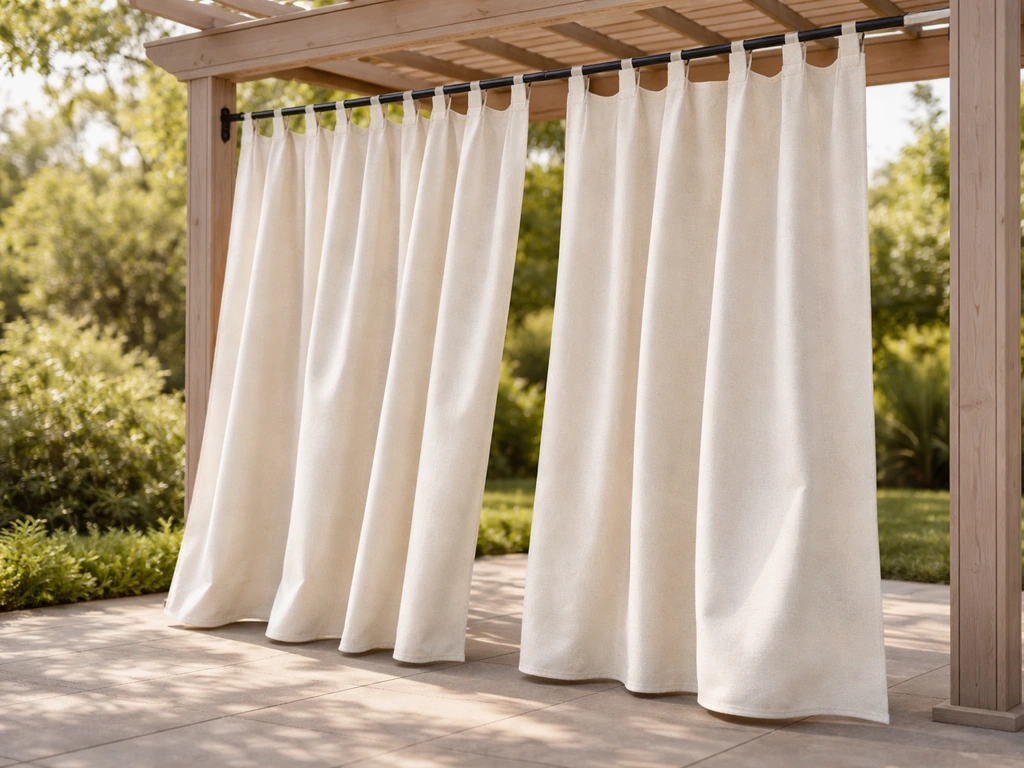
Tab Top Outdoor Patio Curtains: Buying, Sizing, Setup
Buy and size tab top outdoor patio curtains with weatherproof fabric, installation steps, and maintenance for lasting pr