
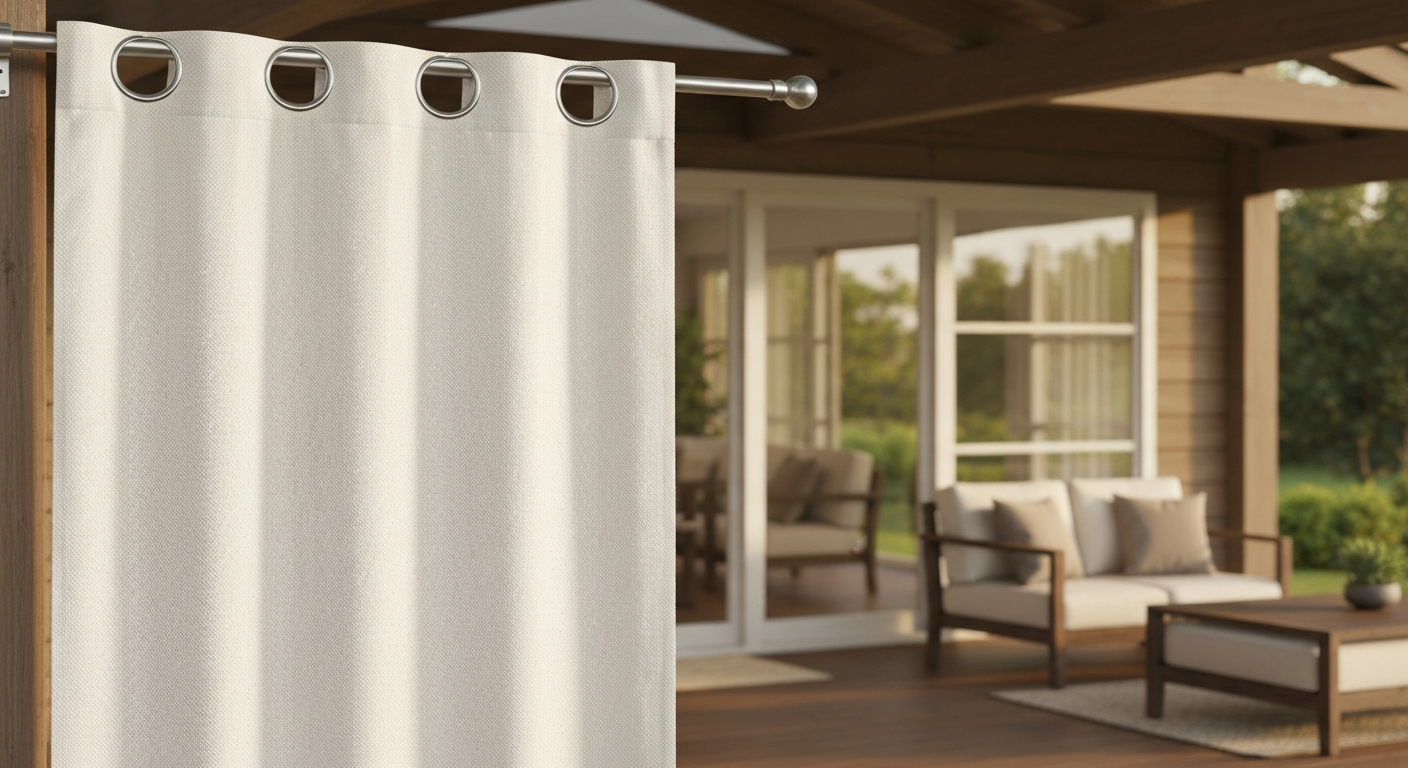
The Liz Claiborne Quinn Basketweave Grommet-Top Patio Panel is a lined, light-filtering outdoor curtain panel originally sold through JCPenney and JCPenney Home. It comes in a 50-inch width with length options of 63, 72, 84, and 95 inches, features silver-tone metal grommets with roughly a 1.5-inch inner opening, and is made from a blended face fabric (commonly listed as 72% polyester, 28% rayon) backed by a polyester lining. The panel is sold individually, not as a pair. As of mid-2026, the Quinn Basketweave line is largely discontinued at the primary retailer and available mainly through secondary marketplaces like eBay, Bonanza, and Poshmark, where single panels run from about $29 to $80 and two-panel bundles list closer to $80 to $160. The product is commonly listed as the JCPenney Home Quinn Basketweave Grommet-Top Patio Panel in resale and archive listings.
Liz Claiborne Quinn Basketweave Grommet-Top Patio Panel Guide
What exactly is the Quinn Basketweave Grommet-Top Patio Panel?
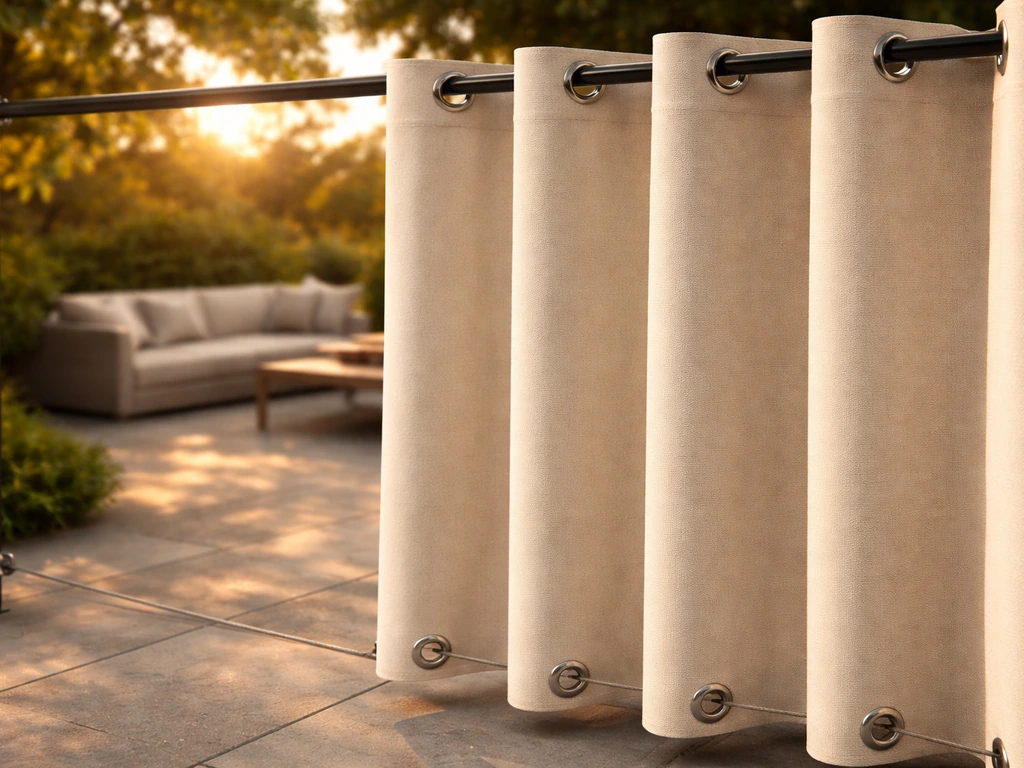
This panel goes by several names depending on where you find it listed. You may see it called the JCPenney Home Quinn Basketweave Grommet-Top Curtain Panel, the Liz Claiborne Quinn Basketweave Patio Drape, or simply the Quinn grommet curtain. All of these refer to the same product. The 'basketweave' in the name describes the woven jacquard-style texture on the face fabric, which gives the panel a subtle, structured look that works well on patios, screened porches, and covered pergolas. The grommet-top header style means the rod slides directly through large metal rings sewn into the top of the panel, creating uniform, evenly spaced folds when hung.
The panel was positioned as a light-filtering option, meaning it diffuses direct sunlight without fully blocking it. It is lined, which adds body and helps it hang with more weight and drape than an unlined panel. While it was marketed as suitable for patio use, it is not made from solution-dyed acrylic (the material used in Sunbrella and similar performance outdoor fabrics), so its long-term UV and mildew resistance will not match dedicated outdoor performance fabrics. More on that in the durability section below.
Key specs and materials
Here is what reseller listings and reproduced product labels consistently report for the Quinn Basketweave panel. Because the original JCPenney product pages are largely offline, I am drawing from secondary marketplace listings that reproduce the original product spec language. If you are buying from a reseller, always cross-check the physical sewn-in label on the panel to confirm these details, since listings can occasionally mislabel stock.
| Spec | Reported Detail | Notes / What to Verify |
|---|---|---|
| Face fabric | 72% polyester, 28% rayon (blended) | Check sewn-in label; composition affects UV and moisture performance |
| Lining | Polyester lining | Adds body and light-filtering; not blackout |
| Header style | Grommet top | Silver/steel-tone metal grommets |
| Grommet inner diameter | Approx. 1.5" (some sources list 1.6") | Fits rods up to approx. 1.5" diameter |
| Panel width | 50 inches (sold individually) | Plan for 2x fullness: one panel per ~25" of rod space |
| Available lengths | 63", 72", 84", 95" | Verify length before purchasing from resale listings |
| Light control | Light-filtering (not blackout) | Diffuses sun, does not fully block it |
| Care | Machine wash, tumble dry | Check label; heat settings matter for polyester/rayon blends |
| Color options seen | Ivory, taupe, indigo/navy, skyline gray | Availability varies by resale listing |
| Availability | Discontinued at primary retailer | Secondary marketplaces only as of 2026 |
One thing worth flagging: because official technical datasheets for the Quinn Basketweave face fabric are no longer publicly available from the manufacturer, detailed specs like yarn weight, weave density, and lab-tested UV colorfastness scores are not verifiable from publicly accessible documents. If you are planning to use these panels in a fully exposed, high-UV environment and longevity is a priority, ask the reseller for the sewn-in label specs or consider requesting a fabric sample before committing to a larger purchase.
Sizes, measurements, and figuring out how many panels you need
The Quinn Basketweave panel comes in one width (50 inches) and four length options: 63, 72, 84, and 95 inches. Each panel is sold individually, so your panel count matters. For a full, gathered look, most decorators recommend 2 to 2.5 times the width of the rod or opening. That means for a standard 8-foot (96-inch) patio post span, you would want at least 3 to 4 panels across. For a purely functional privacy or shade installation where you just want flat coverage, 2 panels per 8-foot span is the minimum.
How to measure for your patio
- Measure the width of the opening or post span where you plan to hang the rod. Add 6 to 12 inches on each side (12 to 24 inches total) so the panels stack off to the sides and do not block the opening when drawn back.
- Divide the total rod length by 50 inches (panel width) and multiply by 2 for standard fullness. Round up to a whole panel count.
- For length, measure from the bottom of the rod to your desired hem drop. If you want the panels to graze the floor or deck surface, add 1 inch. For a pooling look, add 3 to 6 inches. For clearance above a deck rail, measure to about 1 inch above the surface.
- Choose the closest standard length: 63" for windows or short patio headers, 84" for standard 8-foot ceilings or mid-height pergola beams, 95" for taller structures.
- If your exact measurement falls between sizes, size up, not down. You can always add a hem; you cannot add fabric.
A practical example: I have a covered patio with two 8-foot post spans. I wanted panels that hang from a rod mounted about 84 inches above the deck. Two panels per span (4 panels total) at 50 inches wide each gives me 200 inches of fabric across 96 inches of rod, which works out to just over 2x fullness. That is enough to look gathered without being too bunched. The 84-inch length drops to just above the deck surface, which is cleaner than pooling fabric outdoors where it can catch debris.
Grommet-top features and how to hang these panels
The Quinn Basketweave uses a grommet-top header, which is one of the more practical choices for outdoor curtain installations. The grommets are reported as silver/steel-tone metal with an inner diameter of approximately 1.5 inches (some listings say 1.6 inches, which is the common mass-market standard). That inner diameter fits curtain rods up to about 1.5 inches in diameter, which covers most standard and heavy-duty outdoor rods.
Rod and hardware compatibility
For outdoor use, I strongly recommend a stainless steel or powder-coated aluminum rod rather than a standard chrome or nickel-plated rod. Outdoor humidity and rain will cause cheaper metal rods to corrode over a season or two, and corroded rods leave rust stains on fabric. Look for rods rated for outdoor or wet locations. A 1-inch diameter rod slides through the grommets smoothly and leaves enough room to move the panels without binding. If you use a rod thicker than 1.5 inches, the grommets will be too tight and the fabric will bunch awkwardly.
Installation steps
- Mount your rod brackets 4 to 6 inches above the top of the opening or beam, and extend the rod 6 to 12 inches beyond each side of the opening. This reduces light gaps at the edges and allows panels to stack clear of the opening.
- For spans longer than 60 inches, add a center support bracket to prevent the rod from bowing under the weight of multiple panels.
- Thread the panels onto the rod before mounting it, alternating grommet rings so each ring faces the same direction. This creates uniform, consistent folds.
- Once hung, space the folds evenly by hand. Grommet panels naturally create a ripple-fold look when pulled to center.
- Let the panels hang freely for 24 to 48 hours. Most wrinkles from shipping and storage will relax out with gravity and heat.
Top grommets vs. top-and-bottom grommets
The Quinn Basketweave uses grommets at the top only. That is fine for sheltered or low-wind installations, but if your patio gets regular afternoon wind, top-only grommet panels will billow and flap. Panels with grommets at both the top and bottom allow you to anchor the lower edge to a second rod or weighted cable, which significantly reduces movement. If wind is a regular issue on your patio, you may want to compare the Quinn Basketweave to panels designed with top-and-bottom grommet systems. That said, for a covered patio or pergola with partial wind protection, the single grommet-top design works well and is much easier to open and close.
Outdoor performance and durability: what to realistically expect
This is where I want to be direct, because outdoor fabric performance is a topic where marketing language often oversells and reality underdelivers. The Quinn Basketweave is a polyester/rayon blend with a polyester lining. It is not made from solution-dyed acrylic like Sunbrella, which is the industry gold standard for outdoor curtains. In solution-dyed acrylic, the color is locked into each fiber during manufacturing, which gives it exceptional UV and fade resistance (Sunbrella carries explicit multi-year outdoor warranties because of this). Polyester/rayon blends are surface-dyed, which means UV exposure breaks down the dye on the fiber surface over time.
UV and fade resistance
No publicly available AATCC colorfastness test data (the standard lab test for UV/fade resistance, specifically AATCC TM16) exists for the Quinn Basketweave fabric. What I can tell you from real-world experience with similar polyester/rayon patio panels is that in a fully exposed, south-facing installation with direct daily sun, noticeable fading typically appears within one to two seasons. In a covered or partially shaded patio, the same panels can last three or more seasons without significant color change. If your patio gets full afternoon sun with no overhead cover, a polyester/rayon blend is a compromise, not a long-term solution. For a shaded pergola or covered porch, it is a reasonable and cost-effective choice.
Water and spot resistance
The Quinn Basketweave is listed as light-filtering, not waterproof or water-repellent. The polyester component does offer some natural water resistance, but rain will eventually wet through the panel, especially the rayon content, which absorbs moisture readily. Rayon is also prone to shrinkage and texture distortion when wet repeatedly over time. For a covered patio that gets occasional splash-back or light rain exposure, these panels hold up adequately. For an installation that gets direct rain, plan to bring the panels in during storms or switch to a panel with a durable water repellent (DWR) finish.
Privacy and shade performance
The basketweave texture and polyester lining give these panels decent privacy performance at a normal viewing angle, especially when panels overlap at center or are drawn fully closed. Direct backlighting (strong afternoon sun directly behind the panel) will reduce privacy somewhat, as the light-filtering fabric allows silhouettes to be seen from outside. For shade, the panels block some direct sun and reduce glare effectively when fully closed, but they are not a shade sail or solid canopy. Think of them as a soft privacy screen and glare reducer, not a primary sun-blocking solution.
Care, cleaning, and storing these panels
The Quinn Basketweave panels are reported as machine washable with tumble dry, which is a genuine practical advantage over dry-clean-only patio panels. That said, polyester/rayon blends require a bit of care to stay in good shape. Always check the sewn-in label first since the label overrides any printed spec you find online.
- Machine wash in cold water on a gentle or delicate cycle. Hot water can cause rayon to shrink and polyester to set wrinkles permanently.
- Use a mild detergent without bleach or optical brighteners, which can break down UV-protective finishes and alter color.
- Tumble dry on low heat or air dry. High heat is the most common cause of polyester/rayon shrinkage and texture distortion.
- Remove from the dryer while slightly damp and rehang immediately to let gravity pull out residual wrinkles.
- Do not iron on high heat. If wrinkles remain after drying, use a steamer or iron on the lowest synthetic setting with a pressing cloth between the iron and the fabric.
- For spot cleaning without a full wash, blot stains with a clean cloth dampened with cold water and a drop of mild dish soap. Do not rub, which spreads stains and can abrade the weave texture.
- For offseason storage, wash and fully dry the panels before folding. Store in a breathable cotton or fabric storage bag, not an airtight plastic bag, to prevent trapped moisture from causing mildew. Keep in a cool, dry location away from direct light.
Troubleshooting: wrinkles, stains, fading, and hardware issues
Wrinkles won't relax after hanging
If a panel still looks creased after 48 hours of hanging, lightly mist it with water from a spray bottle and smooth the folds by hand. Installation guides such as Window Drapery Single Curtain Rod Installation Guide, The Home Depot (installation & measurement guidance) recommend mounting the rod several inches wider than the opening and 4–6" above the frame, using brackets every 3–5 feet for heavy panels, and letting newly hung panels hang 24–48 hours to release creases Window Drapery Single Curtain Rod Installation Guide — The Home Depot (installation & measurement guidance). The weight of the damp fabric usually pulls creases flat as it dries. A handheld garment steamer is the fastest fix and is safe for polyester/rayon blends. Hold the steamer about 2 to 3 inches from the fabric and work downward in sections.
Stains from pollen, food, or outdoor grime
Act fast. The longer a stain sits on a woven fabric like basketweave, the deeper it works into the texture. Blot (never rub) with a clean white cloth and cold water. For oily food stains, apply a small amount of dish soap to the cloth before blotting. For tannin stains (bird droppings, tree sap, berries), a diluted white vinegar solution can help break down the tannins before rinsing. For persistent stains, a full machine wash on cold gentle is more effective than extended spot treatment.
Fading that has already started
Once a polyester/rayon blend has faded from UV exposure, you cannot reverse it. You can slow further fading by moving the panels to a more shaded location, adding an umbrella or shade sail overhead, or applying a UV-protectant fabric spray (sold as fade-block or UV shield sprays). These sprays add a temporary UV-blocking barrier to the fabric surface and can extend the life of the color by a season, though they need to be reapplied after washing. Prevention is far more effective than treatment.
Grommet or rod hardware problems
If a grommet is pulling loose from the fabric, that usually indicates the panel has been put under stress from wind without proper anchoring, or the rod is too heavy for the grommet count. You can find grommet repair kits at fabric and craft stores that let you replace a single grommet without sewing. If the rod is binding inside the grommets and panels are hard to slide, the rod may be too thick (try to stay at or below 1.5 inches) or the rod finish has corroded and become rough. A light wipe with a dry cloth and a thin coat of paste wax on the rod surface can restore smooth movement.
Styling ideas and patio use cases
The Quinn Basketweave has a neutral, textured look that pairs naturally with both contemporary and transitional patio furniture styles. The basketweave pattern reads as subtle structure rather than bold print, which means it works as a background element rather than competing with patterned cushions or statement furniture. Here is how I think about using these panels in different patio setups.
Privacy screening
For a fence-line or between-post installation where the goal is visual separation from a neighbor or street, hang panels so they overlap by 4 to 6 inches at center when closed. The lined construction provides solid coverage at eye level from a normal viewing angle. For corner installations, adding a third rod and panel set on the adjacent side creates a near-room effect with three soft walls.
Shade and glare reduction
On a west-facing patio, drawing the panels to roughly half-closed during the late afternoon reduces direct glare on dining or seating areas without completely blocking airflow. The light-filtering construction diffuses rather than blocks light, which keeps the space feeling open while cutting harsh sun angles. Pair with a patio umbrella for overhead shade and use the curtain panels for lateral sun control.
Pairing with furniture, speakers, and lighting
Neutral-toned Quinn panels (ivory, taupe, gray) work well behind a lounge seating arrangement with accent cushions doing the color work. For outdoor speaker placement, mount wall or post speakers above the rod line so the panels do not muffle sound when closed. Pole-mounted or post-cap speakers at 7 to 8 feet above the deck are ideal because they project over the panel top rather than through it. For ambient lighting, string lights run along the rod itself or just above it and shine through the light-filtering fabric for a warm glow effect at night. Clip-on lanterns at the grommet rings are another easy option that does not require additional hardware.
Decorative layering
If you want a layered look, combine the Quinn Basketweave panels (as a stationary or semi-stationary outer layer) with a sheer outdoor voile panel on a closer rod for a two-layer installation. The sheer provides airflow and softens the space when the heavier panel is drawn back, while the basketweave panel adds privacy and body when fully closed.
How the Quinn Basketweave compares to similar patio panel options
Shopping for outdoor patio panels means weighing fabric performance, header style, durability, and price. The Quinn Basketweave fits a specific niche: a mid-range, lined, light-filtering grommet-top panel with a decorative textured face. For more on header styles and compatibility, see our guide to grommet top patio panels. Here is how it stacks up against the most common alternatives.
| Panel Type | Fabric | Header | UV/Fade Resistance | Water Resistance | Wind Stability | Price Range (approx.) |
|---|---|---|---|---|---|---|
| Quinn Basketweave (Liz Claiborne) | 72% polyester, 28% rayon blend | Grommet top | Moderate (surface-dyed) | Limited (no DWR) | Moderate (top only) | $29–$80/panel (resale) |
| Sunbrella grommet panels | 100% solution-dyed acrylic | Grommet top | Excellent (warranty-backed) | Good (DWR available) | Moderate (top only) | $80–$200+/panel |
| NICETOWN outdoor panels | Coated/triple-weave polyester | Grommet top + bottom | Moderate | Moderate | Better (top+bottom anchored) | $20–$50/panel |
| Tab-top outdoor curtains | Varies (poly, acrylic) | Tab top | Varies | Varies | Lower (tabs shift) | $15–$60/panel |
| JCPenney Home Quinn Basketweave | Same as above | Grommet top | Moderate | Limited | Moderate | Discontinued; resale only |
My honest recommendation: if you are hanging panels in a covered, shaded patio or screened porch where UV and rain exposure are minimal, the Quinn Basketweave is a solid, budget-friendly choice with a polished look. If your patio is fully exposed with direct afternoon sun and no overhead cover, invest in a solution-dyed acrylic panel or at minimum a polyester panel with a documented UV-protective coating. For a broader selection and side-by-side comparisons, see our guide to the best outdoor curtains for patio to compare Sunbrella and other high-performance options. The Quinn Basketweave is not the right tool for a fully exposed, harsh-weather installation. For more on durable, UV-resistant options and to compare brands, see our guide to the best outdoor patio drapes. Tab-top panels are a looser-fitting alternative that some prefer for a more casual aesthetic, but grommet tops are generally more durable for regular opening and closing since the load is distributed across metal rings rather than fabric tabs. If you prefer that casual look, look for tab top outdoor patio curtains as a looser-fitting alternative to grommet tops.
Pros, cons, and whether this panel is worth it
What works well
- Polished, neutral basketweave texture that looks more elevated than plain polyester panels at the same price point
- Lined construction adds body, improves drape, and provides better privacy and light filtering than unlined panels
- Grommet-top header is durable, easy to install, and slides smoothly on standard rods
- Multiple length options (63"/72"/84"/95") cover most patio ceiling heights and pergola beams
- Machine washable, which is a genuine practical advantage for outdoor use
- Silver-tone grommets have a versatile finish that pairs with most rod finishes
- Resale availability means you can sometimes find new-in-package panels at well below original retail
Real limitations to know before buying
- Discontinued at the primary retailer; buying from resale means no warranty, limited return options, and potential for mislabeled listings
- Polyester/rayon blend will fade faster than solution-dyed acrylic in fully exposed, high-UV installations
- Rayon content absorbs moisture and can shrink or distort texture with repeated wet/dry cycles
- Top-only grommets offer no lower anchoring, making panels prone to wind billow in exposed locations
- No publicly available AATCC UV colorfastness test data means fade-resistance performance is based on material comparison, not verified lab data
- Sold as single panels, so full coverage requires purchasing multiple units, which adds up quickly at resale prices
Who this panel is best for
The Quinn Basketweave Grommet-Top Patio Panel makes the most sense for someone furnishing a covered patio, screened porch, or pergola with partial overhead protection, who wants a decorative, tailored look without paying Sunbrella prices. It also makes sense if you already own Quinn Basketweave panels from a previous purchase and need to add panels to complete a look. For anyone starting fresh with a fully exposed patio, I would point you toward a purpose-made outdoor curtain with documented UV resistance instead. Before finalizing any purchase, verify the panel length, color, and fabric composition directly with the resale seller and check the sewn-in label when the panels arrive. Product specs reproduced in resale listings are generally reliable but not guaranteed.
FAQ
What is the single most important authoritative fact to verify before writing a product guide for the Liz Claiborne Quinn Basketweave Grommet-Top Patio Panel?
Confirm the product’s current, manufacturer-published specifications (fiber content, lining, available sizes, grommet inner diameter, sold-as single or pair) by citing the retailer/manufacturer product page or the sewn-in product label; if an official product page is unavailable, reproduce reseller product-page specs but flag them as secondary and recommend readers verify label/UPC on purchase.
Which retailer/manufacturer pages and types of sources should be cited for facts and specs?
Primary sources: original retailer product pages (JCPenney/JCPenney Home), manufacturer technical sheets if available. Secondary but useful sources: active reseller listings (eBay, Bonanza, Poshmark) that reproduce label specs and product images, and archived product pages. For performance claims, cite industry test standards (AATCC) and authoritative fabric brands/technical sheets (Sunbrella) for comparison.
What product specs are necessary to include in the guide?
At minimum: nominal panel width and available length options, fabric face composition and lining composition, grommet outer/inner diameter or stated rod compatibility, grommet spacing or count per panel, weight if listed, whether sold individually or in pairs, care instructions listed on label (machine wash/tumble dry), and any listed light-filtering or energy-saving claims. Flag any items not verifiable from a primary source.
Which typical sizes and measurements should the guide list for this panel?
List the commonly found ready-made sizes for the Quinn Basketweave: 50" nominal width per panel and lengths typically 63", 72", 84", 95" (note: exact offered lengths vary by retailer). State grommet inner diameter commonly reported (~1.5"–1.6" inner dia) and recommend verifying the sewn-in label or product listing for the specific panel purchased.
What grommet-top installation guidance must be covered for homeowners/renters?
Cover rod compatibility (fits rods up to ~1.5" diameter given reported ~1.6" inner grommet), how to measure rod length and mount brackets (rod wider than opening, 4–6" above frame), recommended bracket spacing (every 3–5 feet for heavier panels), hanging tips (slide panels on before placing rod in brackets), and top vs top-and-bottom grommet approaches: single top grommets are simplest; top+bottom grommets or tiebacks reduce wind flapping. Cite Home Depot/hardware guidance for bracket spacing and PatioLane/Sunbrella notes for outdoor anchoring.
What outdoor performance and durability details must be included and what tests or benchmarks should be referenced?
Include fiber-specific UV/colorfastness expectations, water/wicking behavior, mildew resistance, and abrasion expectations. Reference AATCC test methods for colorfastness to light (xenon-arc or outdoor exposure) and note that solution-dyed acrylic (Sunbrella) is the benchmark for outdoor fade and mildew resistance. If Quinn is listed as a polyester/rayon blend (per reseller listings), explain that such blends typically perform worse long-term outdoors than solution-dyed acrylic and recommend confirming label/specs for outdoor use and warranty.
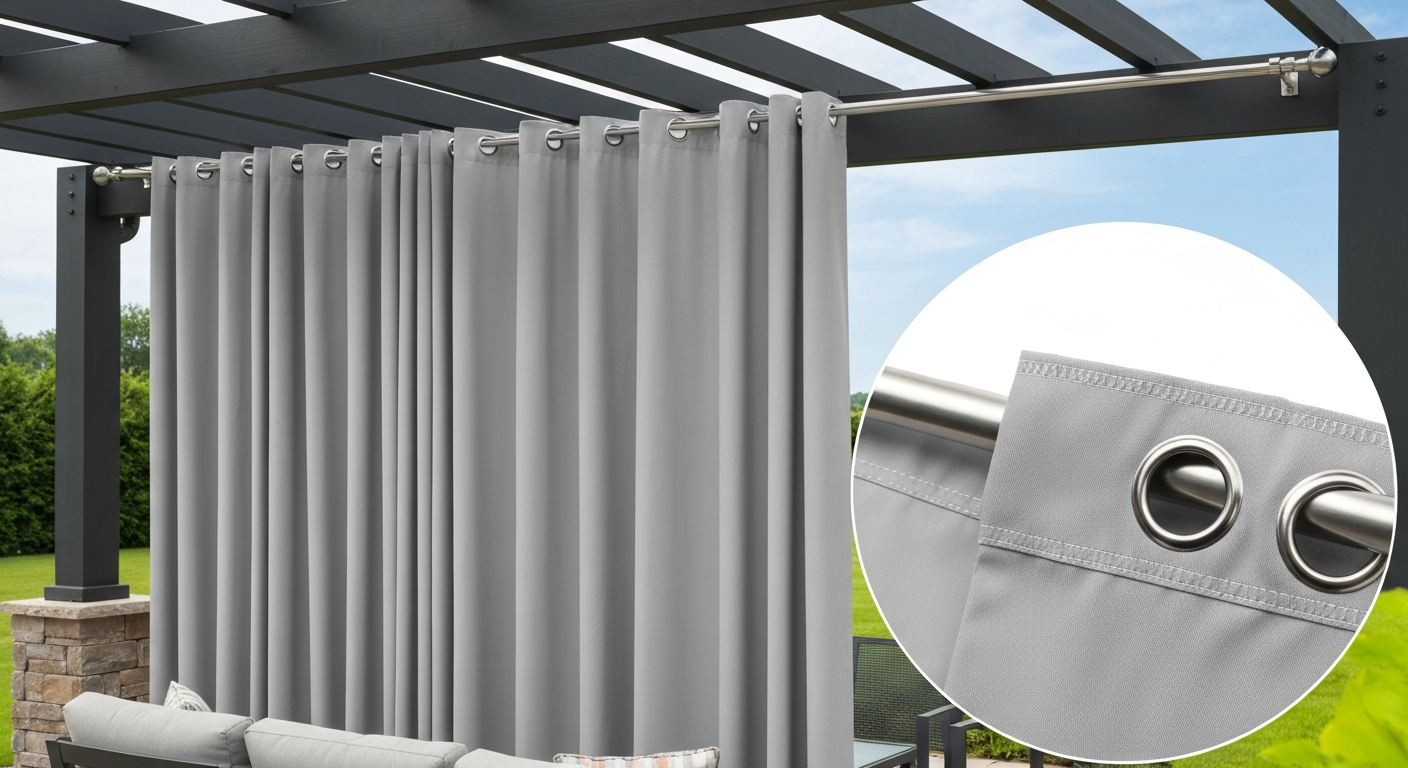
Complete guide to choosing, sizing, installing, and caring for grommet top patio panels for durable privacy.
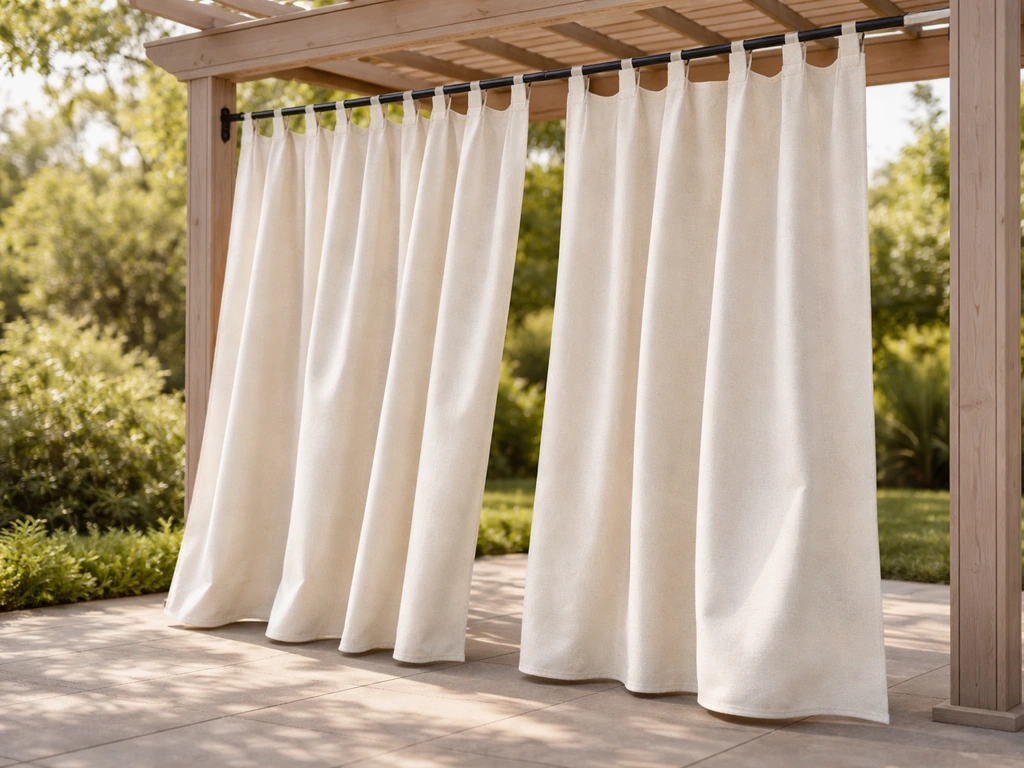
Buy and size tab top outdoor patio curtains with weatherproof fabric, installation steps, and maintenance for lasting pr
Buying guide for outdoor patio curtains with grommets top and bottom, including sizing, installation, weatherproofing, a