
No patio storage box sold today is truly waterproof in the way a sealed dry bag or submarine hatch is waterproof. What you can find are boxes that are highly water-resistant, with smart lid geometry, tight tolerances, and quality hinges that keep rain and splashing water out of your stuff in almost all real-world conditions. Knowing that distinction upfront saves you from buying a box based on marketing language and ending up with soggy cushions after the first thunderstorm. If you want the best outdoor patio storage for year-round protection, focus on lid design, materials, and drainage placement before you buy patio storage box.
Best Waterproof Patio Storage Box: How to Choose Wisely

Lark Perry
24 Jun 2026
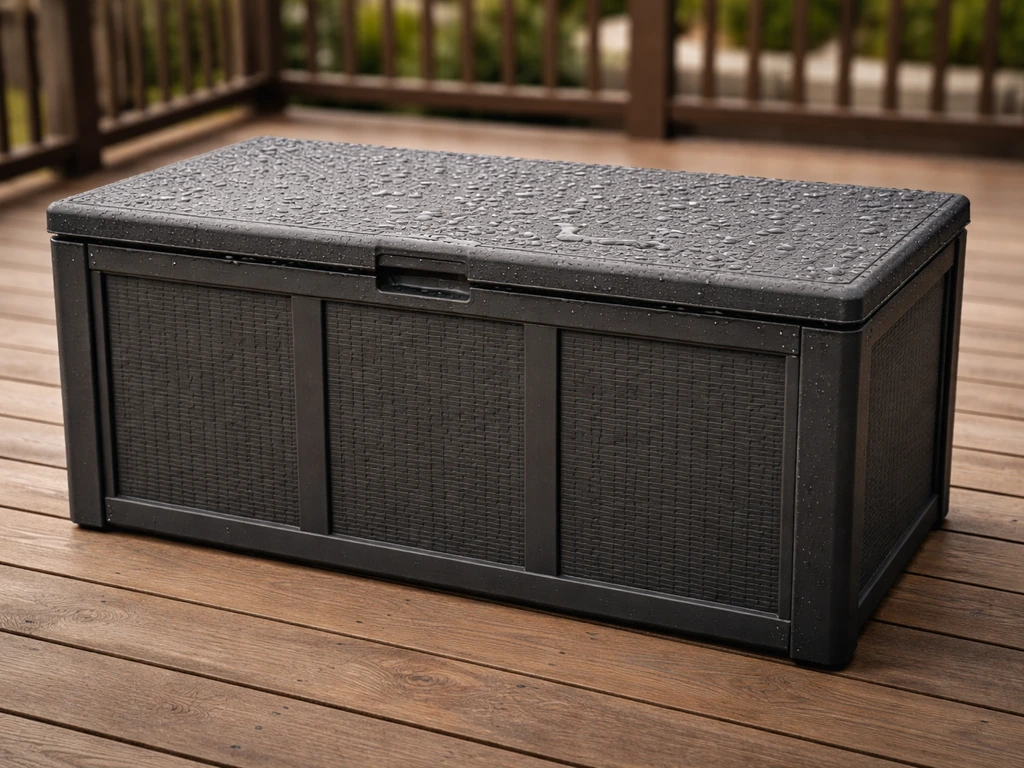
What 'waterproof' actually means for a patio storage box
Manufacturers use the word 'waterproof' loosely, and honestly, most independent reviewers have caught them out on it. Suncast, for example, explicitly states in its product manuals that its outdoor storage units are 'water resistant, not waterproof.' Rubbermaid's large resin deck boxes get the same feedback in buyer reviews: small gaps at the base-to-panel seams let wind-driven rain sneak in during heavy storms. Buyer reviews for the Rubbermaid 134 Gal. XL resin deck box similarly note small gaps that can let wind-driven rain get in during heavy storms Rubbermaid's large resin deck boxes get the same feedback in buyer reviews. This is industry-wide, not a brand-specific failure.
The more useful framework is the IP (Ingress Protection) rating system used in electronics, even though deck box manufacturers don't publish IP ratings. An IPX4 rating means protection against splashing water from any direction. Most well-built resin deck boxes perform around that level in practice. What they can't claim is IPX7 or IPX8 territory, which involves submersion. If your box sits on a flooding patio during a hurricane, water is getting in. Plan accordingly.
The design approach that works best in real testing is a lid with a deep overhang or lip that physically prevents water from wicking inward, rather than relying on a rubber compression gasket. The Lifetime 60012, for instance, has a pronounced lid lip that reviewers confirm keeps the interior dry even in sustained rain, and it achieves this without a gasket. Gaskets sound better on paper, but they degrade faster, crack in UV exposure, and can hold standing water against the seal line. Geometry beats gaskets for long-term, low-maintenance performance.
What to look for in a truly waterproof patio storage box
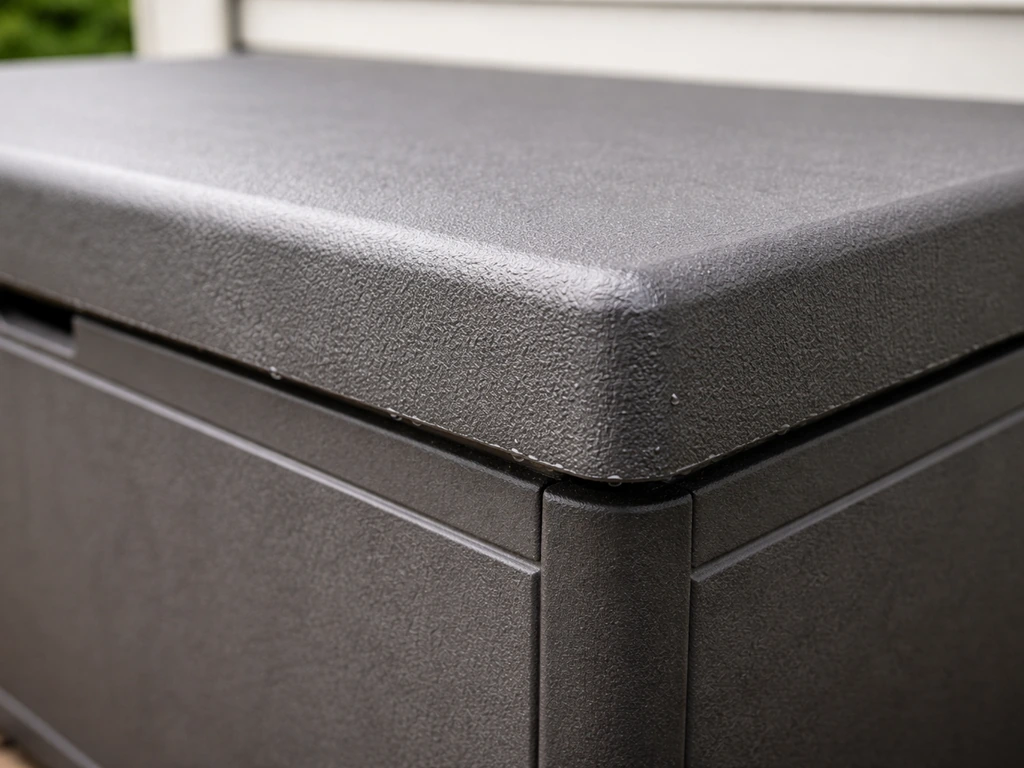
Here is what actually separates a box that keeps your gear dry from one that just looks like it will. Focus on these specifics when you're reading product pages or standing in a store.
- Lid overlap: The lid should extend down over the body by at least half an inch on all sides. Flush-fit lids with no overhang are a red flag.
- Hinge quality: Stainless steel or UV-stabilized polymer hinges matter. Cheap metal hinges rust and seize up, which warps the lid and breaks the seal geometry.
- Base construction: A single-piece molded base or a base with a raised interior floor keeps puddle water from wicking up into stored items. Avoid boxes where the floor sits flush with the ground.
- Corner and seam fit: Press the corners of the body together in the store. Any flex or visible gap at the panel joints will become a leak point under wind-driven rain.
- Lid gas piston or slow-close mechanism: A lid that slams shut can crack the body rim over time, compromising fit. Pneumatic or hydraulic lid supports extend the functional lifespan of the seal.
- Drainage: Some boxes have small drainage holes in the base. These are a sign the manufacturer knows water can get in and has engineered an exit route, which is actually a mark of honesty and practical design.
Sizing it right: cushions, tools, and seasonal gear
Capacity is listed in gallons, and it's the most misunderstood spec on the product page. A 100-gallon box sounds massive until you try to fit a full set of four deep-seat cushions into it and realize they barely fit because the interior height is only 18 inches. A patio cushion set needs extra room and the right interior shape, so choosing the best deck box for patio cushions often comes down to depth and fit deep-seat cushions. Cushions need depth, not just volume. A shallow, wide box with 120 gallons of capacity will handle a full outdoor sectional's worth of cushions far better than a tall, narrow 120-gallon box.
| Storage need | Recommended capacity | Key dimension to check |
|---|---|---|
| 2-seat bench cushions | 50–70 gallons | Interior width (min. 40 inches) |
| 4-chair deep-seat cushions | 100–120 gallons | Interior depth/height (min. 18 inches) |
| 6-chair sectional cushion set | 150+ gallons | Interior width (min. 50 inches) |
| Garden tools, hoses, small gear | 70–100 gallons | Interior height (min. 22 inches) |
| Seasonal décor, pool toys | 100–150 gallons | Overall footprint vs. patio space |
For tools, hoses, and hard goods, height matters more than width. A 24-inch interior height lets you stand a leaf blower upright or coil a 50-foot hose without forcing it. Seasonal items like inflatable decorations, pool noodles, or folded tarps are bulky but compressible, so almost any large-capacity box works. The real mistake people make is buying on total gallons and ignoring the internal shape. Always check the listed interior dimensions, not just the headline capacity number.
If cushion storage is your main goal, it's worth looking at guides specifically focused on that use case, since cushion depth, compression, and mildew risk each add requirements that general-purpose storage boxes don't always meet. If you want the best outdoor storage for patio cushions, prioritize lid design and venting so moisture does not build up patio storage box.
Materials and construction: what holds up and what doesn't
Resin and HDPE
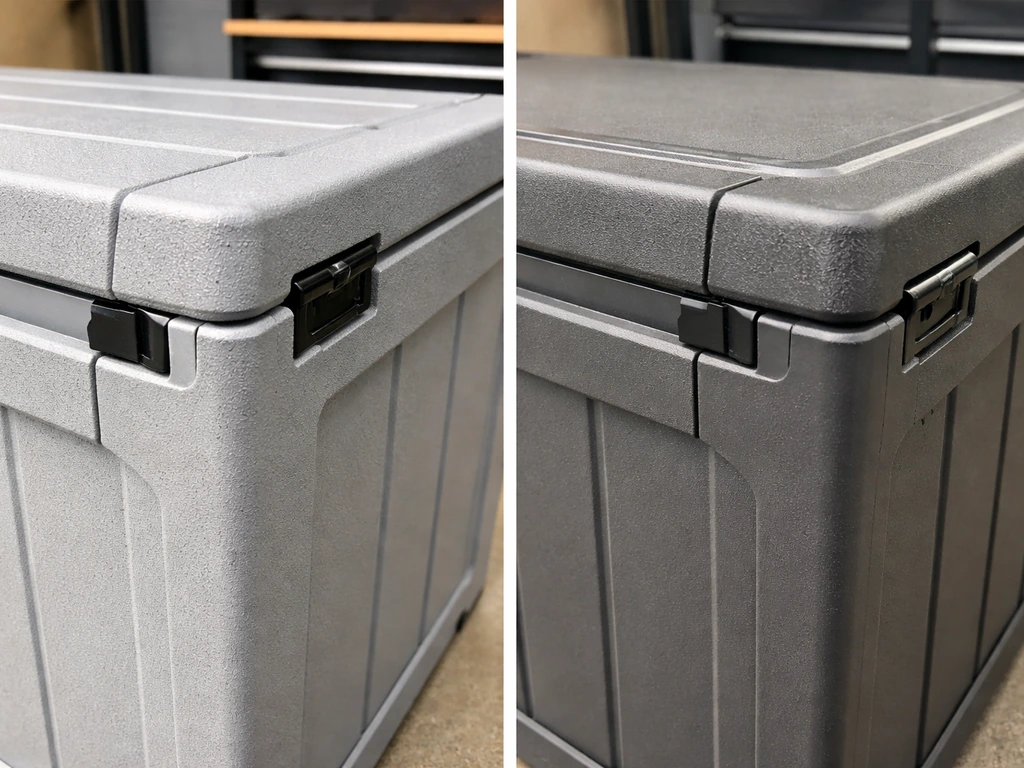
High-density polyethylene (HDPE) and polypropylene resin are the dominant materials for good reason. They don't rust, don't rot, are UV-stabilized to resist fading and brittleness, and can be molded into tight tolerances that hold their shape for years. The best resin boxes are double-walled, which adds rigidity and insulation against temperature swings that can cause single-wall panels to warp and gap. If a product just says 'resin' without specifying double-wall construction, probe the panel thickness with your hand: it should feel solid and resist flex under pressure.
Metal (steel and aluminum)
Galvanized or powder-coated steel boxes are extremely sturdy and hold their shape better than resin in high heat. The trade-off is rust risk at any chips or scratches in the coating, and condensation buildup on the interior walls in humid climates. If you live somewhere with salt air or heavy humidity, metal boxes require more maintenance. Aluminum is rust-proof but more expensive and less common in the deck box category. For most patio uses, resin outperforms metal on the low-maintenance front.
Wood and wood composites
Natural teak or cedar deck boxes look beautiful and can last decades with proper care, but 'proper care' means annual oiling or sealing, and they will never match resin for water resistance at the seams and joints. Wood composites (WPC) are more durable than solid wood in wet conditions, but the waterproofing is only as good as the joinery and any applied sealant. If aesthetics are your priority and you're willing to maintain it, wood is a valid choice. If you want set-and-forget waterproofing, stick with resin.
| Material | Water resistance | Maintenance level | Typical lifespan | Best for |
|---|---|---|---|---|
| Double-wall resin/HDPE | Very good | Low (wipe down annually) | 10–20 years | Most patio setups, cushion storage |
| Powder-coated steel | Good (until coating chips) | Medium (inspect/touch up coatings) | 8–15 years | High-security use, heavy tool storage |
| Aluminum | Excellent | Low | 15–25 years | Coastal/salt-air environments |
| Teak/cedar wood | Moderate | High (annual oil/seal) | 10–30 years | Aesthetic-focused, covered patios |
| Wood composite (WPC) | Good | Medium | 10–15 years | Matching wood deck aesthetics |
The real limits of weatherproofing: rain, standing water, humidity, and mildew
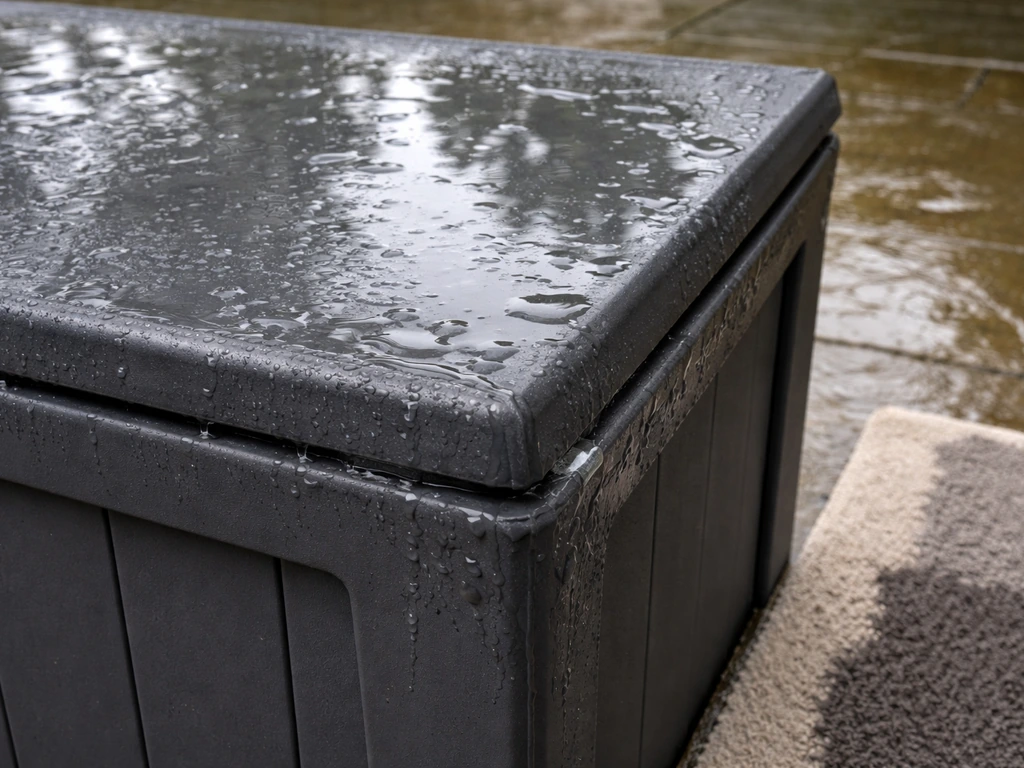
Even the best-performing deck box has a scenario where water wins. Standing water on the lid surface can eventually find micro-gaps at hinge points if your box is left in a persistent pool of water. Wind-driven sideways rain at 40+ mph will exploit any lip gap or panel flex. If you're in a region that gets tropical storms or heavy sustained rain, no deck box gives you 100% protection without you doing your part on placement and prep.
There's also a problem that the opposite direction creates: humidity and trapped moisture. You store cushions that feel dry, but they contain residual moisture. You close the lid. The interior heats up in the afternoon sun, moisture vaporizes, condenses on the walls overnight, and within two weeks you've got mildew on your cushion fabric. This is the most common complaint in real-world reviews, and it's not the box's fault. It's a usage issue.
One design feature that directly addresses this is a built-in vent. Small vents (typically screened to keep insects out) allow humidity to equalize without letting rain in. If you're storing fabric cushions, a vented box is not optional. It's the most important feature to look for after lid fit. Some manufacturers offer it as a selling point; others skip it entirely. Check the spec sheet before buying.
One quirky failure mode worth knowing about: when you lift the lid after heavy rain, water that pooled in the lid recess or on top drips back into the box. This has nothing to do with the box's seal quality during the rain. It's just physics and lid design. Boxes with a slightly pitched or domed lid shed rain better and reduce this annoyance significantly.
Feature checklist before you buy
Use this as a quick pass-or-fail list when comparing models. You don't need every feature, but the non-negotiables depend on your situation.
| Feature | Why it matters | Non-negotiable if... |
|---|---|---|
| Deep lid overhang | Prevents rain ingress without relying on gaskets | You get more than 20 inches of rain per year |
| Vents (screened) | Prevents mildew on stored fabrics | You're storing cushions or any fabric item |
| Lockable hasp or built-in lock | Security for tools, equipment, valuables | Box is in a shared or semi-public space |
| Lid support pistons | Keeps lid open hands-free, protects rim integrity | Box is over 60 gallons (heavy lids are dangerous) |
| Raised interior floor or drainage holes | Keeps contents above any moisture that enters | Box is in a low-lying or flood-prone area |
| UV-stabilized material | Prevents cracking, fading, and warping over time | Box gets more than 6 hours of direct sun daily |
| Carrying handles | Practicality for moving the box seasonally | You store the box indoors during winter |
| Reinforced lid for bench seating | Safety and versatility (box doubles as seating) | You want to use it as extra seating or a side table |
How to compare top models and find the right one for your situation
The market for deck boxes and patio storage is well-covered by a handful of reliable brands: Lifetime, Keter, Suncast, Rubbermaid, and Duramax lead the resin category. Within those brands, performance varies significantly between product lines, not just between brands. A Keter Brightwood performs better in rain exposure than a base-level Keter Unity, for example. Always read reviews specifically for water ingress complaints, not just overall ratings.
Here is a practical 'best for' breakdown to match common buyer scenarios:
- Best for cushion storage: Look for 100+ gallons with a wide interior (50 inches or more), screened vents, and a lid that opens flat. The Keter Brightwood and Lifetime 60012 are frequently cited in this category for good reason.
- Best for small spaces or balconies: A 50–70 gallon box with a compact footprint (under 48 inches wide) and a lid strong enough to double as a bench seat adds function without consuming space. The Keter Eden and Suncast Tremont line fit this need.
- Best for heavy-weather or coastal exposure: Double-wall HDPE construction with a pronounced lid lip, UV inhibitors, and rust-proof hardware throughout. Avoid any metal fastener contact points. Duramax and Lifetime's commercial-grade boxes hold up best here.
- Best budget pick: Rubbermaid's mid-size resin boxes offer solid lid geometry and simple one-piece base construction at a lower price point, though the lid support pistons on budget models sometimes fail within two years. Budget in a $15 lid support replacement.
- Best for tools and hard gear: A taller box (22+ inches interior height) with a reinforced bottom and a lockable hasp. Metal boxes from Suncast's BMS series or resin boxes with anchor kit compatibility work well if security is a concern.
Before you commit, cross-reference the box you're considering against what other buyers have actually stored in it. A 100-gallon box that reviewers consistently use for gardening tools will have different interior proportions than one that reviewers use for deep-seat cushions, even at the same listed capacity. This matters more than any spec sheet number.
Setup, placement, and year-round maintenance
Placement makes or breaks waterproofing
Where you put the box matters as much as what box you buy. Place it on a level, well-draining surface. Avoid low spots on your patio where water naturally pools after rain. If your patio slopes, orient the box so the front (lid opening side) faces slightly uphill. This keeps water from running toward the lid seam. Avoid placing the box directly against a wall or fence where reflected moisture, mold, and limited airflow will accelerate wear on the back panels.
Grounding and anchoring
A large empty or lightly loaded deck box can become a projectile in high wind. Most quality boxes include anchor kit compatibility, which lets you run a strap or bolt through a ground-level hole into a deck board or concrete anchor. If you're in a region with strong seasonal wind events, anchor kits are a 15-minute setup that can prevent a very expensive problem. An unanchored 150-gallon box can travel 20 feet in a 50 mph gust.
Keeping the inside dry all season
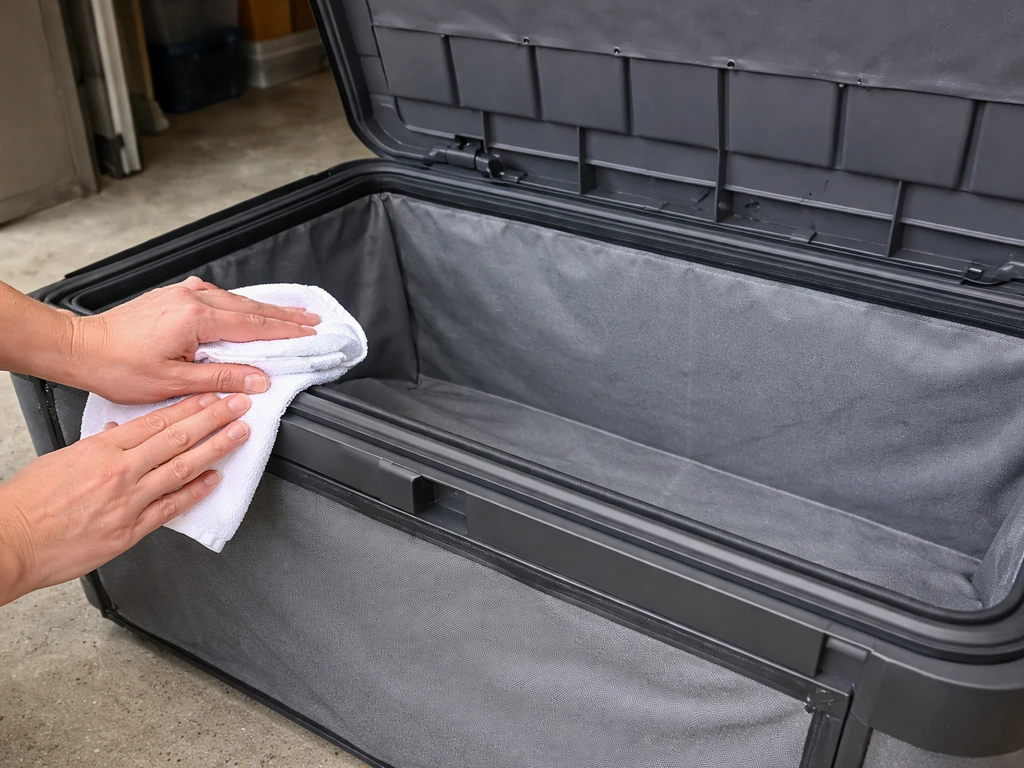
Before you load cushions in at the start of summer, wipe the interior with a dry cloth and check for any winter condensation residue. Lay a breathable mat or old towel on the interior floor to act as a moisture buffer for stored fabrics. Never store wet or even damp cushions. If cushions have been in rain, let them air-dry for at least 24 hours before closing them into the box. A small desiccant pack or two inside the box dramatically cuts interior humidity during humid months. With those basics in mind, you can also narrow down the best deck boxes & patio storage options for your climate and how you’ll use them.
Annual maintenance to keep seals performing
- Empty the box completely once a year, ideally at season change, and wipe the interior with a mild soap and water solution. Rinse with clean water and let it air-dry with the lid open before reloading.
- Inspect the lid hinge points and any moving hardware for rust, cracking, or deformation. Replace failed lid support pistons immediately; a sagging lid creates a gap that defeats the overhang seal.
- Check corner seams and panel joints for any hairline cracks, especially if your box is in full sun. UV degradation shows up first at stress points. A crack at a corner seam is a water ingress point.
- If your box has screened vents, clear any debris blocking them. A clogged vent defeats the purpose and creates the same mildew risk as no vent at all.
- For wood or wood composite boxes, reapply sealant or oil at least once a year, before the wet season, not after water damage is already visible.
When to bring things inside instead
Even the best waterproof patio storage box is not a substitute for indoor storage when a serious storm is coming. If you are building a go-bag plan for storms, you should also think about bug out patio products and how to keep critical items dry fast. Before a named storm, hurricane, or extended multi-day rain event, move cushions and anything moisture-sensitive indoors. A deck box handles routine weather, but it was not engineered for extreme sustained conditions. Knowing this limit and planning around it will keep your box (and its contents) in good shape for a decade or more.
FAQ
Is a vent required if I’m storing patio cushions in a waterproof patio storage box?
Look for venting that is specifically designed for fabric storage (typically small, screened vents near the upper side walls or lid area). If a box has no vent feature, it can still keep out rain, but it will trap humidity inside, which is what drives mildew growth on cushions.
What should I do differently after a heavy rain before putting cushions back in my storage box?
Yes, for two reasons: you may trap residual moisture inside, and standing water in the lid recess can drip back into the box when you open it. Even with good rain performance, you should dry cushions thoroughly and let the box sit open for a short period after heavy storms to reduce internal condensation.
How do I confirm the capacity is really enough for my patio cushions or tools?
Do not rely on the headline gallon number. Use the listed interior dimensions (especially interior height and the shape of the base) to match your items. A taller interior lets you store upright tools and fit bulky items without compressing them, while a shallow-but-wide box often fits cushion sets better.
How can I tell if a resin deck box is built tightly enough to stay water-resistant over time?
If you see flex in the panels when you press or push, skip the model. Double-walled resin generally holds tolerances better, which helps lid alignment stay consistent over time. Loose lid fit increases the chance of sideways rain finding gaps later.
Do I need to anchor a waterproof patio storage box, and what happens if I don’t?
If the box is unanchored, high wind can lift it or move it, which breaks the “lid facing uphill” strategy and can expose seams to runoff. Check whether it supports anchor kits (strap or bolt through a base hole) and anchor it if you live in gusty areas.
Can I use a waterproof patio storage box during flooding or when rainwater pools on my patio?
No. A deck box is meant for rain and occasional splashing, not submersion. For places that flood, treat the box as water-resistant only, plan to elevate contents if possible, and move moisture-sensitive items indoors when flooding risk is real.
Will a water-resistant patio storage box prevent condensation and mildew in humid regions?
Typically, yes. Most boxes will handle normal dew and routine drizzle if they have good lid fit, but you can get condensation buildup in humid climates when the interior warms then cools overnight. A vented box, a moisture buffer like a breathable mat, and desiccant packs can make a noticeable difference.
Why do some deck boxes drip water back into the interior after rain?
Choose a pitched or domed lid profile, especially if you’re in a wet climate. Flat or poorly shaped lid recesses are more likely to hold pooled water, and that water can drip back inside when you open the lid after rain.
What feature checklist should I use if I’m deciding between cushion storage versus tool or hose storage?
Start by checking the panel and lid seam design, then look for a vent and interior moisture control measures. If your goal is fabric storage, prioritize lid lip geometry plus venting, then confirm you can dry and buffer cushions. For hard goods only, focus more on interior height and drainage placement.
What should I look for in reviews to avoid buying the wrong model even if it has good overall ratings?
It helps to read review comments specifically about water ingress or wet contents, not just star ratings. Also compare the reviewer’s use case (cushions versus tools), because interior proportions and stacking height affect how well the box protects even when two models share the same gallon rating.
Next Articles
Best Deck Boxes & Patio Storage: How to Choose Size, Materials
Choose the right deck box or patio storage: size, placement, materials, weather protection, and budget picks for real us
Bug Out Patio Products: How to Stop Bugs Fast
Quick fixes and product picks to stop patio bugs fast with repellent, traps, mesh barriers, and placement tips.
Best Sunbrella Patio Cushions: Top Picks, Guide & Maintenance
Find the best Sunbrella patio cushions: durable, fade‑resistant picks, buying tips, care, and top recommendations.