
The best outdoor patio storage for most people is a resin deck box in the 100 to 150 gallon range. It handles cushions, tools, and BBQ gear without taking over your patio, resists UV fading and moisture better than wood or metal at a similar price, and costs between $80 and $250 depending on size and brand. If you need more capacity or want to lock away gear securely, a resin vertical storage cabinet or small shed bumps you up a level without requiring tools or a permit. The right choice depends on what you're storing, how often you need it, how much patio space you have, and how bad your weather gets, so the sections below walk through each factor before getting to specific recommendations.
Best Outdoor Patio Storage: Buying Guide for Sheds, Boxes

Lark Perry
10 Jul 2026
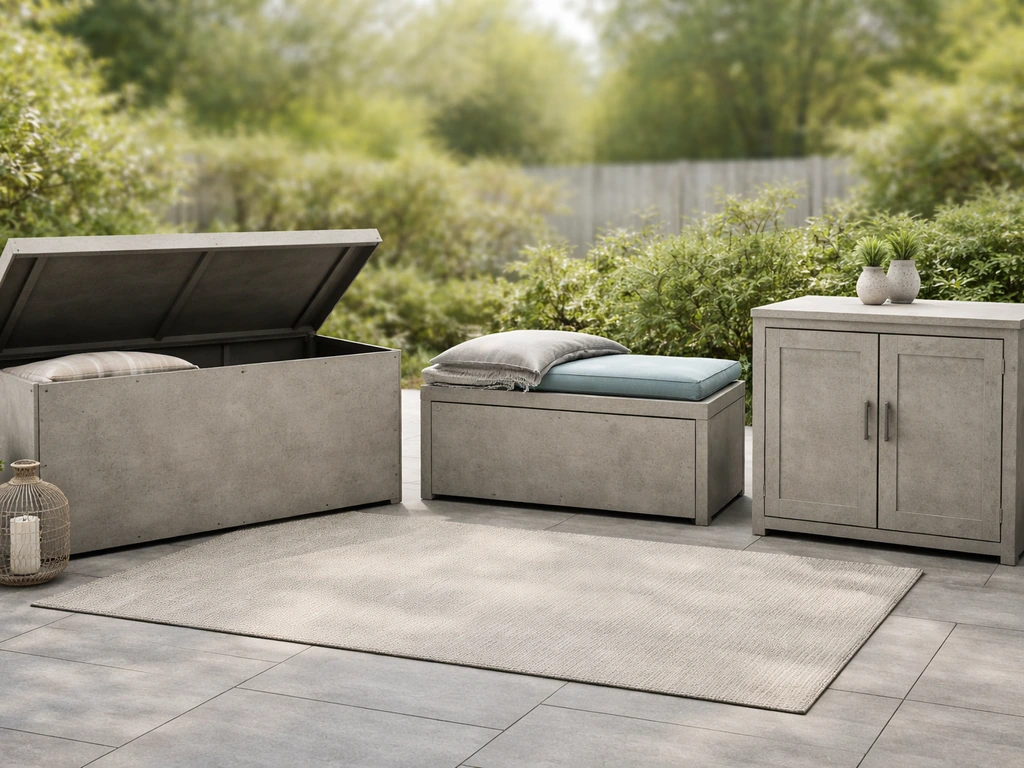
What patio storage you actually need
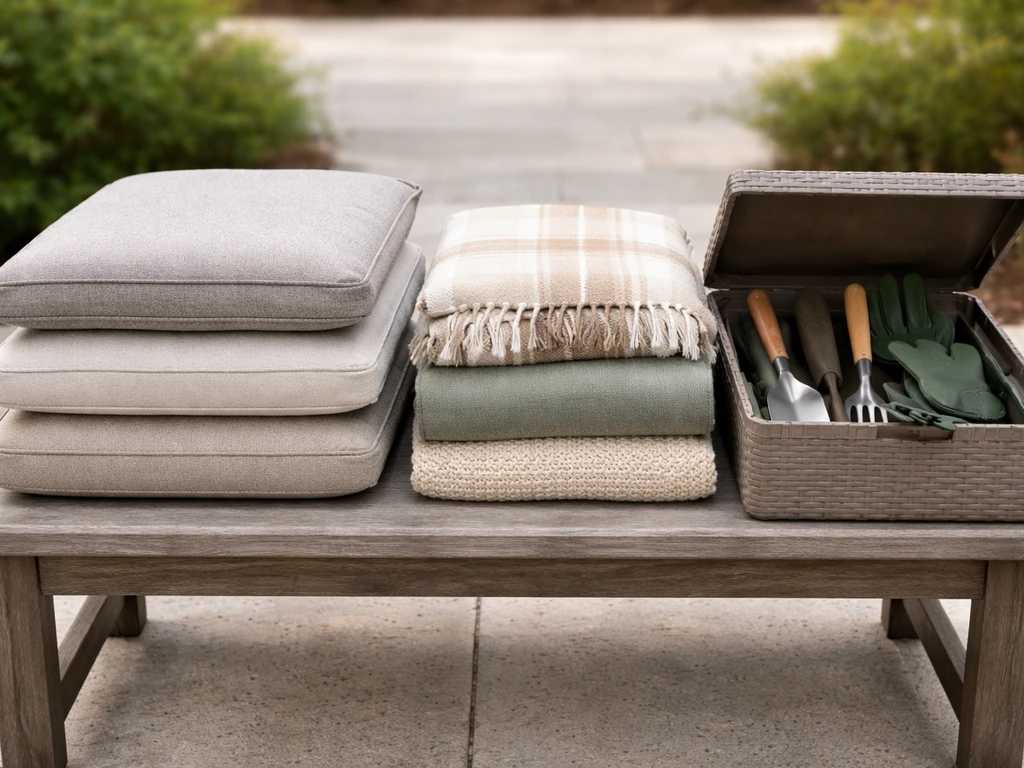
Before you buy anything, spend five minutes thinking about three things: what you're storing, how often you need it, and how you'll access it. These three factors determine whether you need a bench, a deck box, a cabinet, or a shed. Getting this wrong is the most common reason people end up with storage that frustrates them every time they go outside.
Cushions, throw pillows, and outdoor blankets are the most common items people store on a patio, and they need the most cubic footage because they're bulky and compressible only to a point. A standard set of six chair cushions plus two loveseat cushions typically needs 80 to 100 gallons of space on its own. Add a few pool floats and that number climbs fast. For cushion-heavy storage, you want a wide, low box with a full-opening lid rather than a tall cabinet with shelves, because cushions don't stack neatly on narrow shelves.
Gardening tools, hoses, spray bottles, and fertilizers are better in a vertical cabinet or small shed with shelves, because they're oddly shaped and you don't want to dig through a pile to find the pruning shears. Pool chemicals, BBQ accessories, cleaning supplies, and seasonal items like holiday lights also do better with shelves or hooks. If you're storing a mix of both categories, two separate smaller units often works better than one giant one.
Access frequency matters too. If you grab cushions every time you sit outside, a bench with lift-up storage makes more sense than a box in the corner, because you'll use the seat anyway and the storage is always right there. If you're storing things you only pull out once a month, a cabinet that requires unlatching and opening a door is fine. For daily-use items like BBQ tools or a water can, open shelving or a hook panel might beat any enclosed unit.
The main storage types and when each one makes sense
Deck boxes
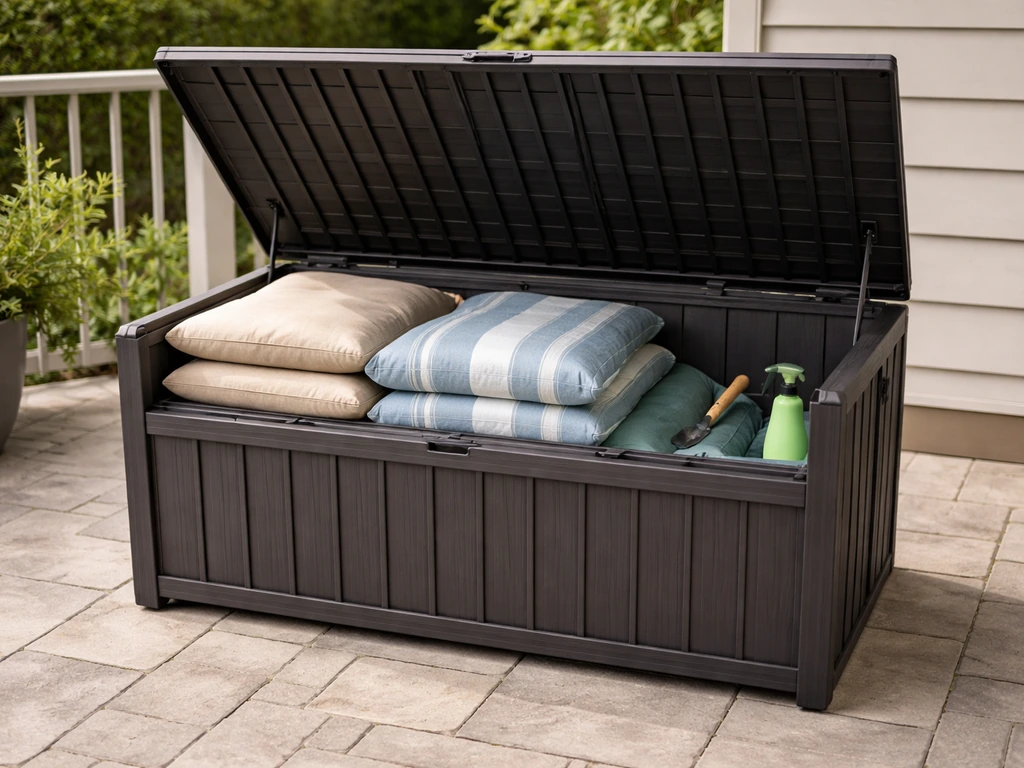
A deck box is the most versatile patio storage you can buy. It's essentially a large lidded bin that can double as extra seating when the lid is rated for weight. Good Housekeeping's 2026 roundup names the Keter Signature Resin Deck Box as the best overall pick, and that reputation is well-earned. Resin deck boxes from brands like Keter, Suncast, and Rubbermaid are available from about 50 gallons up to 230 gallons, resist weather reasonably well, and need almost no maintenance. If you're primarily storing cushions, this is the category to shop first. There's a deeper dive into cushion-specific deck box picks available if that's your main use case.
Storage benches
A storage bench does double duty as seating and a storage box. Capacities typically run 50 to 100 gallons, which is enough for a partial cushion set or a collection of smaller items. The tradeoff is lid design: bench lids often have slower-opening hinges to prevent them from slamming, which means gas strut assist matters more here than on a standalone box. If your patio seating is already sorted, a bench adds less value. But for a small balcony where every piece of furniture needs to pull double duty, it's a smart pick.
Outdoor storage cabinets
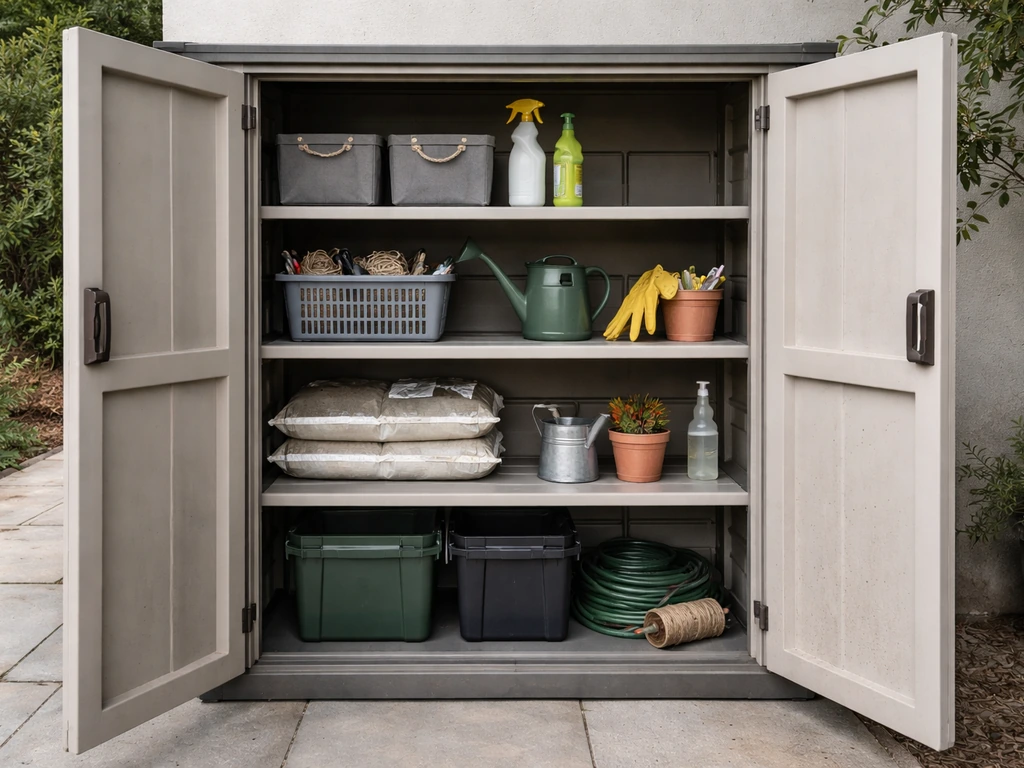
Outdoor storage cabinets look like a lockable pantry or locker for your patio. They're usually 2 to 4 feet wide and 5 to 6 feet tall, with adjustable shelves inside. The Suncast BMS1250 vertical shed is a good example: it's pad-lockable, holds a few hundred gallons of gear with its shelving configuration, and takes up a small footprint. These work best when you're storing tools, cleaning supplies, small equipment, or anything that benefits from organization rather than just bulk capacity. They're also the right call when security is a concern, since most include a padlock hasp that a flat deck box lid can't offer.
Small outdoor sheds
A small patio shed (think 4x4 or 4x6 footprint) is the right answer when your storage needs outgrow a single deck box or cabinet. You can fit bikes, a lawn mower, all your cushions, and a full tool kit. The downsides are cost (typically $300 to $1,000+), assembly time (usually 2 to 4 hours with two people), and space. On a small balcony or tight patio, a shed is often not realistic. On a larger yard-facing patio, it's the most cost-efficient storage per cubic foot you'll find.
Vertical tool storage and specialty organizers
Wall-mounted tool racks, hose reels with cabinet enclosures, and narrow vertical organizers fill the gap when you need to organize specific items without committing to a full box or shed. These are especially useful on a small patio where floor space is at a premium. A narrow vertical resin cabinet that's only 12 inches deep but 6 feet tall can hold a surprising amount of long-handled tools in a very tight footprint.
Which material actually lasts outdoors
| Material | Weather Resistance | UV Resistance | Rust/Rot Risk | Maintenance | Best For |
|---|---|---|---|---|---|
| Resin/Polypropylene | Excellent | Good (UV-inhibited) | None | Very low, occasional rinse | Cushions, general gear, wet climates |
| Galvanized/Powder-Coated Steel | Good if coated | Excellent | Moderate (scratches expose metal) | Low, inspect for chips annually | Tools, dry/mild climates, security |
| Cedar/Teak Wood | Good if sealed | Fair (grays without treatment) | Rot-resistant but not immune | Moderate, oil or seal yearly | Aesthetics, dry climates |
| Wicker-Style (resin wicker) | Fair | Moderate | None (if resin core) | Low, rinse with hose | Light items, decorative use |
| Fabric/Cover Systems | Fair-Good | Varies by fabric | None | Moderate, clean and store off-season | Temporary, budget setups |
Resin wins for most patio storage situations because it doesn't rust, doesn't rot, won't splinter, and cleans up with a garden hose. High-quality resin (polypropylene or HDPE) is also impact-resistant enough to survive being kicked, dropped, or hit by patio furniture in a windstorm. The main knock on resin is that cheaper versions can crack in extreme cold or become brittle after years of UV exposure, so look for products that specifically advertise UV-resistant or UV-inhibited resin.
Wood looks better, especially cedar or teak, and blends into a traditional patio design more naturally. But wood needs annual sealing or oiling to stay water-resistant, and even treated wood will eventually gray, crack, or warp if you're in a wet or humid climate and neglect maintenance. If aesthetics are a priority and you're willing to do the upkeep, wood is a reasonable choice. If you just want something that works without annual attention, resin is the smarter pick.
Steel and aluminum cabinets are durable and look sharp, but pay close attention to the coating. Powder-coated galvanized steel holds up well in mild climates, but any scratch or dent that breaks the coating is a rust starting point, especially near a pool or in a coastal environment with salt air. For pure security (cutting resistance, weight), metal edges out resin. For coastal or poolside use, either go with a quality coated steel unit and inspect it annually, or stick with resin and supplement with a padlock.
The ventilation issue that most listings ignore
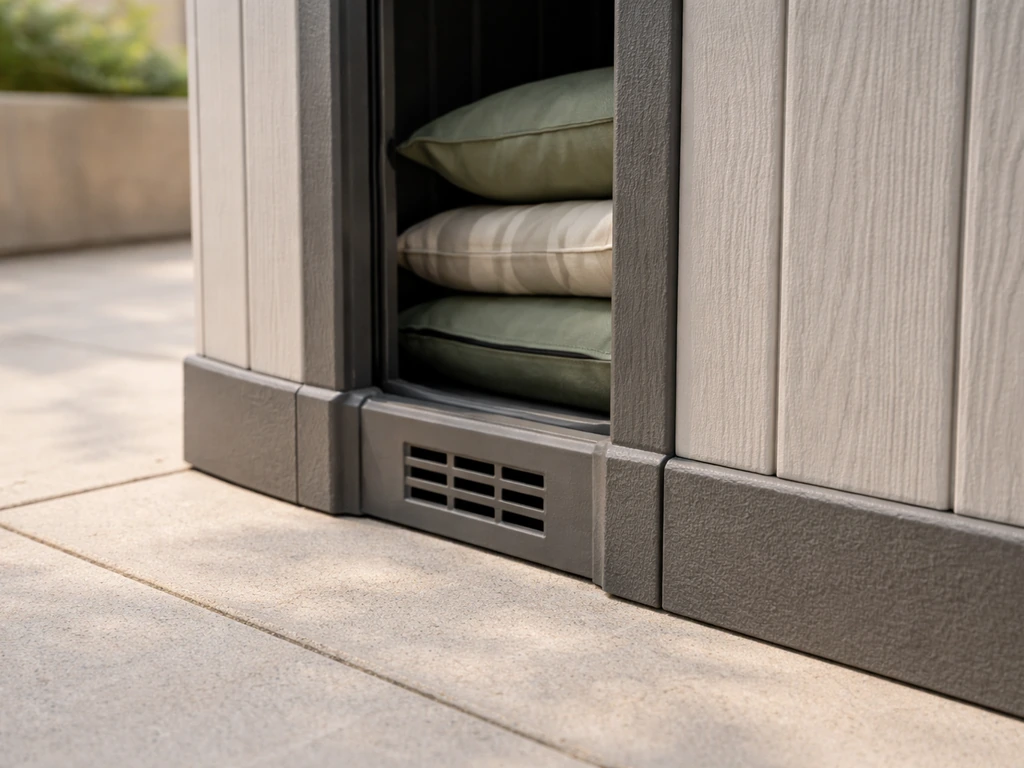
Ventilation is one of the most overlooked specs in patio storage, and it matters a lot if you're storing cushions or anything fabric. Cushions retain moisture after rain or even a dewy morning, and if you close them into an airtight box, you're creating the perfect environment for mold and mildew. Keter specifically builds ventilation into their deck boxes for this reason, and it genuinely makes a difference. When you're comparing units, look for small vent slots near the base or along the sides, and avoid boxes that describe themselves as completely sealed if cushions are your main cargo. Waterproof for the exterior is good. Airtight for the interior is a problem.
Weatherproofing, waterproofing, and security
Waterproof vs. water-resistant
Most outdoor storage products are water-resistant, not truly waterproof. The difference matters. Water-resistant means rain won't pool on top or immediately seep through the lid. Waterproof would mean even standing water or submersion wouldn't penetrate, which almost no deck box or cabinet achieves or needs. What you actually want is a tight-fitting lid with a slight lip or overlap that prevents rain from driving in, a floor design that doesn't allow ground moisture to wick up, and materials that don't absorb water at the surface. Check the lid fit when you're shopping. A lid that rattles or sits unevenly is a red flag.
UV protection
UV damage is the slow killer of patio storage. A resin box that looks great in year one can become chalky, brittle, and faded by year three if it's in full sun all day without UV inhibitors in the plastic. In a dry, sunny climate like Arizona or southern California, this matters even more. Prioritize products that specifically list UV-stabilized or UV-inhibited resin in the spec sheet. For wood storage in sunny spots, use a UV-protective sealant annually. Metal is generally fine for UV but can heat up significantly in direct sun, which can damage anything heat-sensitive stored inside.
Lock options and security
Most mid-range and higher deck boxes and cabinets include a padlock hasp but don't include the lock itself. That's actually fine because it lets you choose your own lock quality. A weatherproof combination padlock or a keyed outdoor padlock runs $15 to $40 and is worth adding if you're storing anything valuable, if your patio is in a shared building or accessible common area, or if you live in a neighborhood where theft is a concern. Keter deck boxes note this lock-ready feature across multiple models, and Suncast's vertical shed line specifically includes padlock capability. For higher theft risk, a heavy steel cabinet bolted to a wall or floor beats any resin box regardless of how good the lock is.
Condensation inside the box
Condensation forms when warm humid air hits a cooler surface inside an enclosed space. In a deck box left in the sun all day, the interior temperature can spike and then drop rapidly at night, creating condensation on the interior walls that drips onto your cushions or gear. The fix is twofold: choose a box with ventilation slots so air can move, and when possible, let cushions air out before stowing them after a warm day. If you're in a very humid climate, a small desiccant pack inside the box doesn't hurt. This is a bigger issue in the southeastern U.S. or any high-humidity zone than in drier climates.
Getting the size and placement right
How to measure for fit
For cushions specifically, the most reliable method is to stack them the way you'd actually put them in the box, then measure the pile's length, width, and height. Add 1 to 2 inches to each dimension to account for box walls and lid clearance. That gives you the minimum interior dimensions you need. Then find products with interior measurements that meet those numbers. Don't rely on exterior dimensions from a product listing, which are always larger than interior. Keter and most quality brands publish interior dimensions; if a listing only shows exterior, assume several inches of wall thickness.
For capacity in gallons: Keter suggests the 100 to 230 gallon range covers most cushion storage needs, with 100 to 120 gallons working for a moderate set of furniture cushions and 150 gallons and up for larger sets or when you're mixing in other gear. If you're also storing tools, pool supplies, or BBQ accessories, shop at the higher end or plan on two units.
Placement for drainage and airflow
Where you put your storage unit affects how long both the unit and its contents last. Place it on a level surface so the lid seals evenly and water doesn't pool in one corner of the floor. If your patio slopes slightly for drainage, that's fine, but avoid placing a box at the bottom of a slope where runoff collects. Leave at least two to three inches of clearance behind a cabinet or shed to allow air circulation and prevent moisture from accumulating against the back wall. On a wood deck, consider placing the unit on rubber feet or a small pallet-style riser to let air flow underneath and prevent moisture from trapping between the box base and the deck boards. Many resin units come with built-in floor venting or raised base ribs, which helps but isn't always enough on its own.
High-wind and small-space considerations
In high-wind areas, an empty or lightly loaded deck box can become a projectile. Fill it to at least a quarter of its capacity, or anchor it to a wall, deck railing, or post with a cable or bungee tie-down. Most vertical cabinets and sheds should be anchored to a wall regardless of wind, both for stability and safety. On a small balcony where every square foot counts, measure your available floor space first and work backward to find the largest unit that fits with clearance for the lid to open fully without hitting a wall or railing.
Maintenance and seasonal care
Resin and plastic units need almost nothing: rinse them off with a hose two or three times a year, wipe the lid seal if your model has one, and check that hinges and gas struts are working. If a hinge stiffens, a spray of silicone lubricant fixes it. Every spring, do a five-minute inspection of the lid fit, the floor for any cracks or warping, and the lock hasp for rust if you're using one.
Wood storage needs more attention. Seal or oil it once a year before the wet season hits, and inspect for soft spots or splits. If water is pooling on the wood surface rather than beading off, the sealer has worn off and it's time to reapply. Sand lightly before resealing to get proper adhesion.
Metal cabinets should be wiped down and inspected for any paint chips or scratches that expose bare metal. Touch those up with rust-inhibiting spray paint before winter. In a coastal environment, rinse salt spray off regularly and consider applying a thin coat of protective wax once a year.
Seasonal storage prep matters as much as the unit itself. Before closing up for winter, pull everything out, let it air dry completely, and consider tossing a few desiccant packs inside before sealing. In climates with hard freezes, resin can become more brittle and prone to cracking from an impact, so avoid slamming the lid in extreme cold. If the patio storage unit is in a spot that will be buried in snow, move it to a covered area or lay a breathable waterproof cover over it.
Best picks by scenario and budget
Here's how to match the right product type and budget to your actual situation. These aren't exhaustive reviews, but they give you a clear shortlist framework to shop from.
| Scenario | Best Type | Capacity Target | Budget Range | Key Features to Prioritize |
|---|---|---|---|---|
| Small balcony, cushions only | Resin deck box or storage bench | 50–100 gallons | $80–$150 | Compact footprint, gas struts, lid doubles as seat |
| Medium patio, cushions + BBQ gear | Resin deck box (large) | 120–150 gallons | $150–$250 | UV-inhibited resin, ventilation, padlock hasp |
| Larger yard patio, full mix of items | Large deck box + vertical cabinet, or small shed | 150+ gallons total | $250–$600 | Separate zones for soft goods vs. tools |
| Wet/humid climate (PNW, Southeast) | Resin with ventilation slots | Any | $150–$300 | Vented base, mold-resistant resin, avoid wood |
| Dry/sunny climate (Southwest) | UV-stabilized resin or powder-coated metal | Any | $150–$350 | UV inhibitors critical, ventilation less urgent |
| High theft risk, shared space | Steel cabinet or resin box with padlock | Varies | $200–$500 | Padlock hasp, heavy construction, consider wall anchor |
| Budget-first, basic protection | Entry-level resin deck box (Suncast, Rubbermaid) | 70–100 gallons | $80–$130 | Tight-fitting lid, basic ventilation, durable hinges |
For the budget-conscious buyer, the Suncast and Rubbermaid resin deck boxes consistently show up in value picks across expert roundups, with Suncast getting specific credit for lid design. The Keter Signature Resin Deck Box earns its best-overall reputation by hitting the sweet spot of build quality, size options, and weather resistance without crossing into premium pricing. If you’re shopping for the best outdoor storage for patio cushions, a resin deck box like this is a practical choice because it protects fabric from moisture while staying weather-resistant Keter Signature Resin Deck Box. For security-focused buyers, move to Suncast's vertical shed line (like the BMS1250), which is pad-lockable and keeps a smaller footprint than a full shed.
If cushion storage is your specific focus, it's worth cross-referencing dedicated guides on the best outdoor storage for patio cushions and the best deck boxes for patio cushions, which go deeper on lid opening clearance, interior width minimums, and fabric-safe interiors. If you are also comparing options for different patio layouts, a bug out patio products guide can help you choose storage that is practical in storms and quick to access. If you want to understand the full deck box category with model-by-model comparisons, the best deck boxes and patio storage guide covers that territory in more depth.
Quick checklist before you buy
- Measure your items stacked as they'll be stored, then add 1 to 2 inches per dimension for clearance and wall thickness.
- Confirm interior dimensions, not just exterior, from the product spec sheet.
- Check that the resin is listed as UV-stabilized or UV-inhibited if the unit will sit in full sun.
- Look for ventilation slots if you're storing cushions or anything fabric.
- Verify the lid opens fully without hitting nearby walls, railings, or furniture.
- Confirm a padlock hasp is included if security matters, and budget $15 to $40 for a weatherproof lock.
- Check that the base has raised ribs, feet, or drainage holes so moisture doesn't pool underneath.
- If you're in a windy location, confirm the unit can be anchored or that you'll add tie-downs.
- Factor in assembly requirements: most resin units are minimal, but sheds and some cabinets can take 2 to 4 hours.
- Plan your placement before it arrives: level surface, a few inches from walls, away from drainage runoff paths.
FAQ
What size “best outdoor patio storage” should I buy if I’m not sure what fits yet?
Use interior dimensions, then plan a buffer. Measure your largest cushion or item, add 1 to 2 inches in height and width for lid clearance and walls, and make sure the unit’s listed interior measurements meet or exceed your numbers. If a listing only shows exterior dimensions, assume the usable space is smaller by the wall thickness.
Are patio storage units truly waterproof, or should I plan for leaks?
Most are water-resistant, not waterproof. Even with a tight lid, heavy rain driven by wind can seep in at seams or if the lid sits unevenly. Prioritize a model with a slight lip or overlap, a stable base that prevents rattling, and a non-absorbing floor design that limits ground moisture wicking.
Can I store cushions and fabric inside a deck box without ruining them?
Yes, but you need airflow and not storing them damp. Look for ventilation openings near the base or sides, then air out cushions before closing the lid after a warm, humid day. If your climate is very humid, a small desiccant pack can help reduce musty smells.
Why do some deck boxes develop a musty smell even when the lid looks closed?
Condensation is the common culprit, warm humid air hits a cooler interior, then drips onto fabrics. Ventilation slots plus fully drying items before stowing usually solve it. If you still notice dampness, keep the lid closed less often, and avoid storing wet items immediately after rain.
What’s the biggest mistake people make when choosing between a deck box and a vertical cabinet?
They choose based on appearance or general capacity instead of item shape and access frequency. Cushions usually need wide, low clearance with a full lid opening, while long-handled, oddly shaped tools do better on shelves where you can grab items without digging through piles.
Do I really need to anchor patio storage in windy areas?
If it’s empty or lightly loaded, anchoring matters. Deck boxes can slide or lift, and that creates both safety and theft risk. Fill the unit to at least a quarter capacity, and anchor cabinets and sheds to a wall (or use a proper cable or tie-down) to prevent shifting.
What lock setup should I use, since many units have a lock hasp but no lock?
Pick a weatherproof padlock that matches the hasp style and give it a tight fit so it can’t be pried or rattled. If your patio is in a shared or high-theft area, use a higher-quality lock and consider bolting a heavier metal cabinet rather than relying on a padlock alone.
How do I protect resin patio storage from cracking in cold weather?
Avoid slamming the lid when it is very cold, and choose resin that is explicitly UV-stabilized and rated for weather extremes (not just “resistant”). In climates with hard freezes, store the unit in a covered area if possible, or use a breathable cover instead of one that traps moisture.
Is rubber, tile, or uneven patio flooring a problem for deck boxes?
Yes, uneven spots can prevent the lid from sealing evenly, which increases rain intrusion. Place the unit on a level surface, and if your patio slopes, avoid setting the box at the lowest point where runoff collects. If needed, use a level base board or riser designed for outdoor use.
How often should I clean and inspect patio storage?
Do a quick spring inspection (lid fit, cracks, hinge function, and any lock hasp corrosion). Then rinse resin a couple of times per year and wipe any lid seal area if your model has one. For metal, check for chipped coating and touch up scratches before rust starts.
Can I store pool chemicals in the same unit as cushions or BBQ tools?
It’s better not to mix incompatible items. Pool chemicals and cleaning supplies can off-gas or leak, which can damage fabrics and create odors. If you’re storing chemicals, use a dedicated cabinet or shed compartment with shelving so you can keep them separated from cushions and absorbent items.
Next Articles
Best Outdoor Storage for Patio Cushions: How to Choose
Compare storage box, deck chest, covers, bins and sheds to protect patio cushions from rain, mildew, pests and UV.
Best Waterproof Patio Storage Box: How to Choose Wisely
Buying guide to pick the best waterproof patio storage box, compare materials, features, and prevent mildew and leaks.
Best Deck Boxes & Patio Storage: How to Choose Size, Materials
Choose the right deck box or patio storage: size, placement, materials, weather protection, and budget picks for real us