
For most patios, a resin deck box in the 100 to 150-gallon range is the sweet spot for storing patio cushions. You get enough interior volume to fit a full set of chair and loveseat cushions without overpaying for a box you'll only half-fill, and modern UV-stabilized resin holds up outdoors far better than wood or untreated metal. That said, the right box depends on how many cushions you have, whether you're dealing with moisture and mildew pressure in your climate, and whether you need to lock it. This guide walks through all of that with actual numbers, not guesswork.
Best Deck Box for Patio Cushions: Size, Materials & Picks

Lark Perry
5 Aug 2026
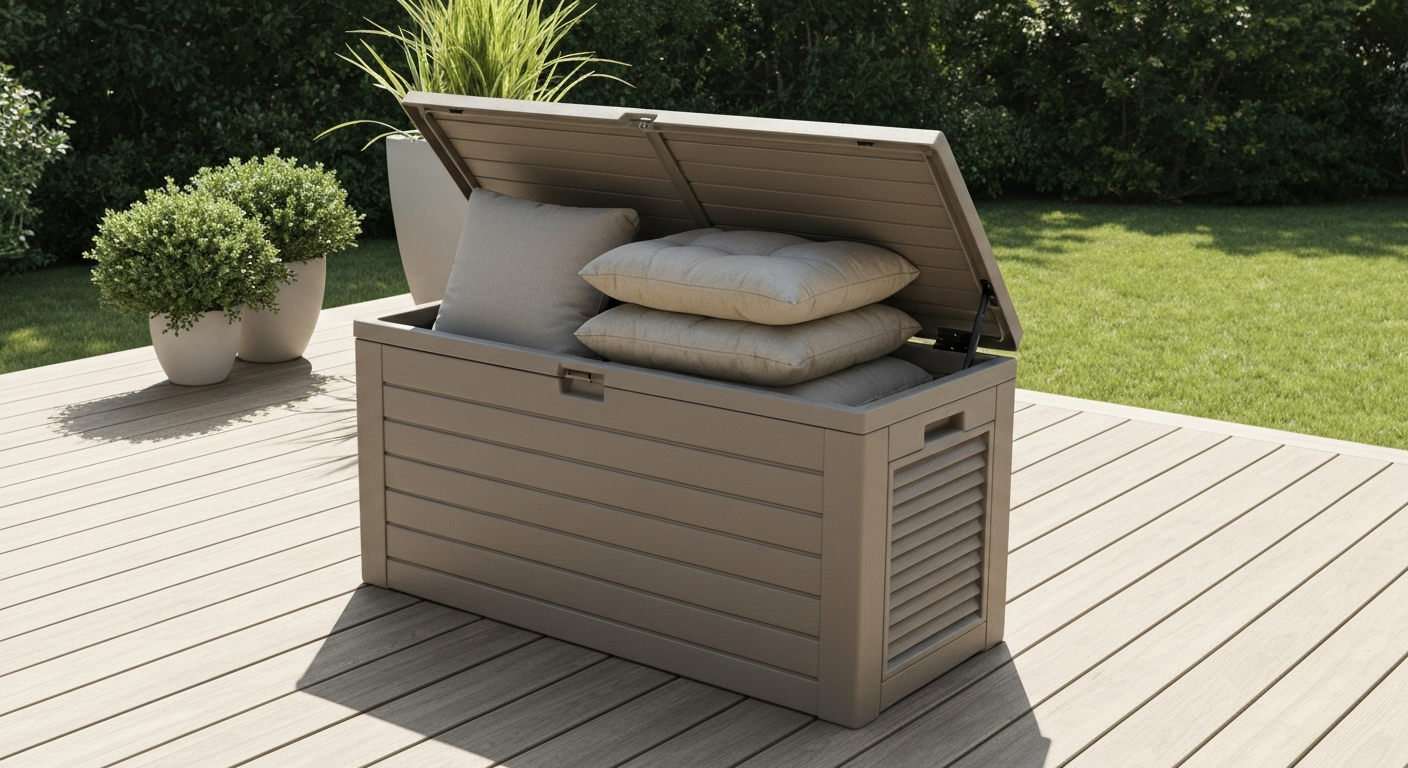
What this guide covers and who it's for
If you've ever pulled your patio cushions out of storage at the start of the season and found them moldy, misshapen, or just damp and sad, this guide is for you. I've been through that more than once, and the fix usually wasn't expensive. It was picking the right box in the first place and setting it up correctly. Whether you're a homeowner with a full outdoor sofa set, a renter who needs a no-drill, no-permanent-hardware solution, or someone who just wants a bench that doubles as storage, this article gives you a practical framework for choosing, sizing, and maintaining a deck box built specifically around cushion storage.
This guide covers sizing and volume math for cushions, material trade-offs, waterproofing versus ventilation, UV and weather durability, pest and security features, budget tiers, renter-friendly options, and seasonal care. Related topics like the best waterproof patio storage boxes and the broader category of outdoor patio storage are worth exploring alongside this if you're also storing non-cushion items like tools, toys, or pool gear. For more options and product picks, see our roundup of the best outdoor patio storage. For product-focused recommendations, see our roundup of the best deck boxes & patio storage to compare top models and capacities.
Why cushion-specific storage actually matters
Patio cushions are among the most expensive and easily damaged things you'll store outdoors. A quality outdoor sofa cushion set can run $200 to $600 or more, and most of the damage that shortens their lifespan happens in storage, not in use. The three main culprits are moisture (mildew and mold), UV exposure, and compression damage from improper stacking or overstuffed boxes.
Mold and mildew are the biggest risks. EPA guidance is clear: the key to preventing mold growth is moisture control. If cushions go into storage even slightly damp, and the box traps that moisture with no ventilation, you can have visible mildew within days in a warm, humid climate. That's not just cosmetic. Mold degrades fabric fibers and foam fill over time, and some mold species can cause real health issues when you bring those cushions back out. Beyond mold, prolonged UV exposure fades fabric and breaks down foam, and a box that keeps cushions out of direct sun between uses meaningfully extends their life. A deck box isn't just a container: it's the primary protective layer between your cushions and everything the outdoor environment throws at them.
How to measure your cushions before you buy anything
This is the step most people skip, and it's the reason so many deck boxes end up being either too small or bought at the wrong shape. Before you look at a single product listing, measure every cushion you plan to store. Use the packed, uncompressed dimensions: length, width, and height (or thickness) for each piece.
The volume calculation you need
Multiply length × width × height in inches to get cubic inches, then divide by 231 to convert to US gallons (since 1 US gallon equals exactly 231 cubic inches). Do that for each cushion and add them all up. That's your minimum required interior volume. But then add a 20 to 30 percent buffer: cushions compress a little under their own weight, but you also need room to actually lift them in and out without wrestling with the lid. A number that comes out to 80 gallons of cushion volume means you want a box with at least 95 to 105 gallons of interior capacity.
As a concrete example: a typical deep-seat outdoor sofa cushion runs about 28" L × 28" W × 5" H. That's 3,920 cubic inches, or about 17 gallons per seat cushion. A three-seat sofa's seat cushions alone use roughly 51 gallons before you add back cushions, chair pads, or throw pillows. Add those and you're quickly at 80 to 100+ gallons for a full patio set. That math is why 90 to 150-gallon boxes dominate this category.
Interior dimensions matter more than volume alone
Gallon ratings are useful for quick comparisons, but the interior footprint of the box determines whether your cushions actually fit. A box rated at 120 gallons with a narrow opening or a stepped interior may not accept a 28-inch-wide cushion flat. Always check the interior length and width, not just the exterior or the headline capacity number. For large sofa back cushions that may run 60 inches or longer, you'll need a box with an interior length to match. Many manufacturers list interior dimensions separately from exterior, and it's worth calling customer service if the listing is vague.
Choosing the right capacity: stacking and fitting your cushions
Once you have your total volume estimate, think about how you'll stack the cushions. Seat cushions laid flat stack efficiently. Back cushions are often thicker and more awkward. A good rule of thumb is to lay seat cushions flat on the bottom, then stand back cushions on edge (leaning against the interior wall) if the box is deep enough. This arrangement often lets you fit more in the same volume than random stacking would.
Medium boxes in the 90 to 120-gallon range are the most popular size for a reason: they cover most patio chair and small-loveseat sets, they're light enough to move (typically 25 to 35 lb empty for resin models), and they don't dominate a deck visually. For a full sectional or large outdoor sofa setup, step up to the 130 to 150-gallon class. The Keter Westwood at 150 gallons (570 L) with an exterior of 61" L × 28.3" W × 25.2" H is a good ceiling for most residential patios. Anything larger starts to look more like a storage shed.
Materials compared: resin, wood, metal, and composite
The material your deck box is made from is the single biggest driver of long-term durability and maintenance burden. Each material has real advantages and real weaknesses for cushion storage specifically.
| Material | Best For | Durability | Water Resistance | UV Resistance | Maintenance | Typical Cost |
|---|---|---|---|---|---|---|
| Resin / HDPE | Most buyers; cushion storage primary use | Good to excellent with quality formulation | Water-resistant to near-waterproof depending on lid seal | Good if UV stabilizers (HALS/absorbers) are included in resin mix | Very low; wipe clean | $80–$200 |
| Wood (teak, cedar) | Aesthetics-first buyers; shaded patios | Excellent if sealed regularly; poor if neglected | Poor unsealed; moderate if sealed annually | Fades/grays without sealant; stable with maintenance | High; annual sealing required | $200–$600+ |
| Galvanized / powder-coated metal | Heavy-duty security; pest exclusion | Excellent structurally; hinges and seams can corrode | Moderate; seams and drain holes matter | Fair to good with quality powder coat | Low-medium; monitor for rust at fasteners | $150–$400 |
| Composite / resin-wood blend | Aesthetics with lower maintenance than wood | Good; varies by manufacturer | Good; typically water-resistant | Good; pigments help UV resistance | Low; occasional cleaning | $150–$350 |
Why most buyers land on resin
Resin and HDPE deck boxes dominate the market for good reason. They're lightweight, require almost no maintenance, and don't rust. The quality variable is the UV stabilizer package built into the resin during manufacturing. Better boxes use a combination of HALS (hindered amine light stabilizers) and UV absorbers like benzotriazoles, plus antioxidants. That combination substantially extends how long the plastic retains its mechanical properties and color outdoors. Academic materials research confirms that formulated HDPE with these additive systems can survive thousands of hours of accelerated UV exposure where unformulated plastic fails in hundreds. The 2026 peer‑reviewed study 'Synergistic additives approach for enhanced HDPE durability in marine aquaculture applications, Next Materials / ScienceDirect (2026 research article)' shows HDPE formulated with benzotriazole UV absorbers, HALS, antioxidants and pigments/carbon black can extend retention of mechanical properties in accelerated UV testing from hundreds to thousands of hours Synergistic additives approach for enhanced HDPE durability in marine aquaculture applications — Next Materials / ScienceDirect (2026 research article). The practical implication: a $150 Keter or Lifetime box with UV-rated resin will outlast a $60 thin-wall generic box by several years in a sunny location.
Wood looks beautiful and performs well on a shaded covered patio, but it demands annual sealing. Skip one season and you're looking at gray, cracked wood and a lid that no longer seats properly. For cushion storage, that means water intrusion right when you least want it. Metal is excellent for security and pest exclusion (more on that below) but the Achilles heel is corrosion at hinges and fasteners. ASTM B117 salt spray testing is the industry benchmark for screening metal corrosion resistance, but salt-spray hours don't map cleanly to real-world years. The takeaway: even powder-coated metal boxes need periodic inspection at the seams and hardware.
Waterproofing and drainage: what the specs actually mean
This is where marketing language gets slippery. Almost every deck box on the market is described as 'waterproof' or 'weather-resistant,' but those terms mean very different things in practice. Understanding the distinction can save your cushions.
'Water-resistant' means the box will handle light rain without immediately soaking the interior. It does not mean the box is sealed against heavy or prolonged rain, driving wind-driven rain, or standing water. Most resin deck boxes, including otherwise excellent models like the Keter Westwood, are water-resistant rather than truly waterproof. Real-world consumer reviews confirm this: multiple owners report water intrusion after sustained heavy rain, particularly where the lid meets the body. That gap between lid and box rim is almost always the entry point.
Truly waterproof boxes use a gasket or compression seal around the lid perimeter, similar to a weatherstripping seal. These are less common in the deck box category and tend to be pricier. If you're in a climate with frequent heavy rain or your box location gets direct rain (no roof overhang above it), a gasket-sealed lid is worth the premium. For most covered patios or areas with moderate rainfall, a well-designed water-resistant lid with an overlapping lip performs adequately when cushions are stored dry.
Drainage holes: helpful or a liability?
Some deck boxes include small drainage holes in the bottom panel. This is useful if water does get inside (from condensation or intrusion) because it lets it drain out rather than pool. The trade-off is that drainage holes are also entry points for insects if they're not screened. If your box has drainage holes, check whether they're covered with a mesh screen. If not, a small piece of fine-mesh screen material cut to fit and held in place with a bit of waterproof sealant solves the problem in about five minutes.
Ventilation and mildew prevention
Here's a real tension in deck box design: waterproofing and ventilation work against each other. A tightly sealed, gasket-lined box keeps rain out but also traps any moisture your cushions brought in with them. A box with passive vents breathes better but lets in more ambient humidity. Understanding which matters more for your situation is the key to preventing mildew.
The EPA guidance is unambiguous: mildew prevention comes down to moisture control. If you store cushions that are even slightly damp, no amount of waterproofing will prevent mold growth inside the box. In that scenario, ventilation is more protective than a tight seal. On the other hand, if you're disciplined about storing only dry cushions and your box is in a location that gets heavy rain, a tighter lid seal makes more sense.
Practical ventilation features to look for
- Passive side vents: small louvered openings near the top of the box sides that allow warm, moist air to escape without letting significant rain in. Look for vents placed high enough that rain splash won't reach them.
- Raised floor or feet: a floor that sits slightly above the ground level prevents condensation pooling under the contents. Many quality resin boxes have molded feet or a slightly domed interior floor.
- Lid gap airflow: some boxes have a slight gap at the rear lid hinge that provides passive airflow without compromising rain resistance significantly.
- Split-lid design: models like the Suncast 120-gallon split-lid allow partial opening and contribute to incidental ventilation when you access the box regularly.
Desiccants and moisture-control accessories
For poorly ventilated boxes or high-humidity climates, passive desiccants are a practical supplement. Calcium chloride tubs (sold under the DampRid brand and similar) work well in enclosed small spaces and absorb significant moisture before needing replacement. Silica gel packets are another option: they adsorb water vapor on a large internal surface area and can be recharged in an oven rather than thrown away. Sizing is typically done by enclosure volume and target relative humidity, with suppliers providing guidelines in grams of desiccant per cubic foot. For a 100-gallon box (roughly 13 cubic feet), a 200 to 300-gram silica gel insert or a medium DampRid tub is a reasonable starting point. These are not a fix for a leaking box, but they make a real difference in a marginally damp environment. According to CDC and EPA mold guidance, the goal is to keep storage areas dry and to ensure stored items are already dry before they go in.
Pest protection and lockability
Cushions in a deck box are attractive nesting material for mice, squirrels, and insects. A box that protects against rain but not pests is only doing half the job. This comes up more often than people expect, particularly in suburban and rural settings, and the damage from a rodent nesting in your cushions over winter is expensive and unpleasant.
What to look for in a pest-resistant box
- Tight lid-to-body fit: a lid that seats firmly with minimal gap along the front and sides is the first line of defense against insects and small rodents.
- No unscreened drainage holes: as mentioned above, any bottom drainage hole should be covered with fine mesh.
- Metal construction or metal-reinforced panels: rodents can chew through thin-wall resin given time and motivation. Thicker-wall resin (dual-wall HDPE like Lifetime's construction) is more resistant than single-wall designs. Metal boxes stop gnawing entirely.
- Locking lid or hasp: a lid that positively latches closed (not just rests closed under gravity) is harder for both wildlife and children to open accidentally.
- Padlock compatibility: a hasp loop that accepts a standard padlock adds a meaningful barrier. Look for a reinforced metal hasp rather than a molded-in plastic loop, which can be pried or snapped.
Security and tamper resistance
Most deck boxes are not designed as security containers, and even a padlocked resin box can be defeated with a crowbar in seconds. If you're storing anything valuable alongside your cushions (outdoor speakers, tools, pool chemicals), consider a heavier metal storage box with a proper locking mechanism. For cushion storage only, a basic padlock-compatible hasp is generally sufficient to deter casual opportunism and keep wildlife out. If you're a renter and want to secure the box itself to a deck or fence without drilling, heavy-duty cable locks looped through the hasp and around a post are a no-damage option.
UV and long-term weather resistance
UV degradation is the slow killer of outdoor plastic storage. Over several seasons, unprotected resin becomes brittle and chalky, lids warp, and structural panels crack or sag. The difference between a $60 box and a $140 box is often entirely in the UV stabilizer package and wall thickness, not the shape or features.
Testing methods like ASTM G154 (fluorescent UV with condensation cycles) and ASTM G155 (xenon-arc weathering) are used to rank-order materials in labs, but accelerated hours don't convert directly to field years. The practical consumer guidance is: buy from brands that list UV protection as a specification (not just a marketing claim), favor thicker-wall dual-wall HDPE over thin single-wall injection-molded boxes, and check warranty length as a proxy for manufacturer confidence. The Lifetime 130-gallon box with dual-wall HDPE and a 10-year limited warranty on some models is a good example of a product where the warranty signals genuine UV durability investment.
Product categories and who each one suits
Rather than recommending a single 'best' box, here are the categories I'd point different buyers toward, based on the criteria above.
| Category | Best Example / Type | Capacity | Key Strength | Best For |
|---|---|---|---|---|
| Large-capacity resin | Keter Westwood 150-gal | 150 gal / 570 L | Fits full sectional sets; hydraulic lid; UV-resistant resin; 660 lb lid load | Full patio sets, sectionals, mixed cushion storage |
| Heavy-duty HDPE | Lifetime 130-gal Heavy-Duty | 130 gal | Dual-wall HDPE; steel hinges; anti-slam lid; long warranty | High-sun locations, families, buyers prioritizing durability |
| Split-lid medium | Suncast 120-gal Split-Lid | ~120 gal | Split lid for easy access; multi-wall resin; wide footprint | Smaller patio sets; easy daily access; budget-conscious buyers |
| Budget / mass retail | Rubbermaid XL 121-gal class | 121–134 gal | Lowest price entry point; widely available | Renters; budget-first buyers; covered/protected locations |
| Storage bench / dual-use | Various resin bench boxes | 50–80 gal typically | Seating + storage in one; smaller footprint | Small patios, renters, balconies, limited space |
Renter-friendly and space-saving options
If you rent, the ideal deck box is one you can take with you when you move. Resin boxes assemble tool-free or with minimal hardware and disassemble the same way. Storage benches double as seating and take up less visual space on a small balcony or patio. Avoid permanent anchoring solutions if you're renting. For smaller patios or balconies where space is tight, look at the bench-style storage boxes in the 50 to 80-gallon range: they typically accommodate seat cushions for a small bistro set and provide a usable perch at the same time. These are a great complement to a full deck box writeup on best outdoor storage for patio cushions if you're comparing options in that size tier.
Placement and installation on your patio or deck
Where you put the box matters almost as much as which box you pick. Place it on a level surface so the lid seals evenly. On a wood deck, make sure the box feet or base don't trap moisture against the decking: this causes deck rot over time. A pressure-treated or composite deck tile underneath the box creates a small air gap and extends the life of both the deck and the box base. Avoid placing the box directly under a roof drip edge where it catches concentrated roof runoff during storms, even if the box is theoretically waterproof.
If direct sun is unavoidable, orient the box so the lid hinge faces the sun: this puts the seal side of the lid in shade most of the day, which reduces thermal expansion stress on the lid-body seal and slows UV degradation at that joint. In practice this is a minor optimization, but it's free.
Maintenance, cleaning, and seasonal care
Resin deck boxes need almost nothing: a wipe-down with mild soap and water once or twice a year keeps them looking clean. Don't use bleach-heavy cleaners on colored resin; they accelerate fading. If you find mildew inside the box (usually visible as gray or black spotting on the interior walls or on the cushion storage surface), CDC and EPA guidance recommends cleaning hard surfaces with detergent and water, then drying thoroughly. For the cushions themselves, if mildew has set in, assess whether they can be cleaned and fully dried: porous foam-filled cushions that have absorbed significant mold growth may need to be discarded rather than salvaged.
At the start and end of each season, do a quick inspection: check the lid seal or gasket for cracking, look at metal hinges for surface rust, and verify drainage holes are clear and screened. On wood boxes, this is the time to apply sealant before the next wet season. Taking 20 minutes twice a year adds years to both the box and the cushions inside.
Budget and cost-benefit trade-offs
Most deck boxes sell for $50 to $200, with the majority of useful cushion-storage options sitting between $80 and $170. The $50 to $80 range gets you thin-wall single-layer resin with minimal UV stabilization: fine for a sheltered patio in a mild climate, but likely to fail within three to five years in full sun in a hot region. The $100 to $170 range covers most of the name-brand options (Keter, Suncast, Lifetime) with quality resin, better hardware, and meaningful warranties. Above $200 you're mostly paying for aesthetics (wood, composite, premium finishes) or heavy-duty metal construction for security.
If your cushion set cost $300 or more to replace, spending $130 on a quality deck box is a straightforward return on investment. The boxes most likely to fail prematurely (and let your cushions get damaged in the process) are the cheapest thin-wall options placed in full sun without any UV protection. The upgrade cost from a $60 generic to a $130 name-brand is recovered the first time you don't have to replace a set of cushions.
Seasonal and emergency storage considerations
For seasonal storage (putting cushions away for winter or during hurricane season), the standards go up. A box that's 'good enough' for day-to-day overnight storage may not be adequate for a six-month hibernation in cold, wet conditions. For extended seasonal storage, prioritize: dry cushions before packing, add a desiccant pack for humidity control, verify the lid seal is intact, and if possible move the box to a covered location (garage, shed, covered porch) for the off-season.
In hurricane-prone or extreme-weather areas, a deck box left outdoors during a storm is a potential projectile. Either anchor the box with a cable lock or bungee tie to a fixed structure, or bring it inside the garage. The Keter Westwood's listed 660 lb lid load is a structural rating, not a wind resistance rating: a lightweight resin box can be launched by 80+ mph winds regardless of how much weight it can support sitting still. If your region has significant storm risk, the bug-out and emergency patio prep considerations covered in related patio preparedness content are worth reviewing alongside this guide. For supplies tailored to rapid evacuation and storm readiness, see bug out patio products.
Quick-reference buying checklist
- Measure every cushion (L × W × H in inches), calculate total cubic inches, divide by 231 for gallons, then add 20 to 30 percent buffer.
- Verify interior length and width (not just gallon rating) against your largest single cushion.
- Choose material based on your maintenance tolerance: resin for low-maintenance, wood only if you'll seal it annually, metal if security is a priority.
- Check for UV-stabilized resin and a multi-year warranty as proxies for long-term durability.
- Decide between water-resistant (adequate for most covered patios) and gasket-sealed waterproof (needed for exposed locations with heavy rain).
- Look for passive vents or a raised floor if you're in a humid climate or can't guarantee cushions go in bone-dry.
- Confirm the lid latches positively and check for padlock-compatible hasp if security or pest exclusion matters.
- Add a desiccant insert for any climate with high summer humidity or for extended off-season storage.
- Place on a level surface with a small air gap beneath, away from roof drip edges, and inspect seals and hardware twice a year.
FAQ
Why choose a cushion-specific deck box instead of a generic storage container?
Cushion-specific deck boxes prioritize weatherproofing, ventilation, and capacity shaped for bulky soft items. They reduce mildew risk by balancing water resistance with airflow or moisture-control accessories, provide seat‑rated lids for dual use, and often include features such as piston‑assist hinges, reinforced bottoms, and lockability. Generic bins may lack UV‑stable materials, adequate internal volume, or ways to control humidity and can trap moisture that promotes mildew.
What evidence‑based criteria should I use when buying the best deck box for patio cushions?
Prioritize these criteria: true interior capacity (gallons or cubic feet) vs. cushion volume; material and UV additives (HDPE/resin with UV stabilizers or composite/wood with proper finishes); waterproofing level (sealed seams, raised bottoms, lid overlap, gasket if present); ventilation options and ability to add desiccants or vents; structural strength (reinforced/dual‑wall panels, metal hinges, lid load rating); corrosion resistance for metal parts (coated stainless/galvanized or ASTM‑B117‑resistant finishes); lockability/pest protection; warranty and brand track record; real‑world reviews for assembly and long‑term durability.
How do I measure my cushions and calculate the deck box capacity I need?
Measure each cushion’s packed length × width × thickness in inches. Multiply to get cubic inches, divide by 1,728 to convert to cubic feet. Sum cubic feet for all cushions, then multiply total cubic feet by 7.48052 to convert to US gallons (or multiply cubic inches total by 1/231 to get gallons directly). Add 10–20% extra space for airflow and ease of placement. Example: two cushions 24"×24"×4" = (24×24×4)=2304 in³ each → 4608 in³ total → 4608/231≈19.94 gallons. Choose a box with at least ~25 gallons capacity to allow breathing room.
What product categories and use‑cases should I consider?
Waterproof/resin large boxes (120–150+ gal) — best for multiple/large cushions and seat use; Heavy‑duty HDPE or dual‑wall boxes — for durability, frequent access, and heavier loads; Budget plastic boxes (50–90 gal) — for small cushions or short‑term storage; Metal/composite/cedar boxes — for aesthetic integration and sturdiness (ensure corrosion protection or sealed wood); Multi‑use storage benches — combine seating plus storage for small patios or renter spaces; Lockable, secure boxes with steel components — for theft‑sensitive locations or shared backyards.
How much capacity do common deck boxes hold and what cushions do they fit?
Typical market sizes: medium ≈90–120 gal (fits 2–4 chair cushions or several seat cushions), large ≈120–150 gal (fits multiple lounge cushions, several deep‑seat cushions or sets), oversized 150+ gal (fits large sofa or sectional cushions). Manufacturers list interior gallon capacity and external dimensions—match measured cushion gallons to the box’s interior gallons, remembering shape constraints; long narrow cushions may need longer boxes even if total gallons match.
Which materials resist weathering and UV best for outdoor cushion storage?
Formulated HDPE/resin with UV absorbers and HALS additives offers good outdoor retention; look for manufacturer statements about UV stabilization. Composite or pressure‑treated/finished woods (cedar, teak) resist rot if sealed and kept off wet ground. Metal can be durable if powder‑coated or stainless; watch for hardware corrosion and choose ASTM‑B117‑tested finishes where detailed. Avoid thin single‑wall injection plastics that flex or embrittle quickly under sun exposure.
Next Articles
Best Outdoor Patio Storage: Buying Guide for Sheds, Boxes
Buying guide for the best outdoor patio storage, comparing sheds, boxes, and weatherproof options for tools and cushions
Best Outdoor Storage for Patio Cushions: How to Choose
Compare storage box, deck chest, covers, bins and sheds to protect patio cushions from rain, mildew, pests and UV.
Best Waterproof Patio Storage Box: How to Choose Wisely
Buying guide to pick the best waterproof patio storage box, compare materials, features, and prevent mildew and leaks.