
You need a cover sized to your swing's canopy width (left-to-right) and canopy depth (front-to-back), made from UV-resistant, water-repellent fabric with an elastic hem or drawcord plus click-close straps for wind security and at least one mesh vent to stop condensation from rotting your cushions. Get those three things right and you'll have a cover that actually stays on, sheds water, and lasts more than one season.
Patio Swing Top Cover Guide: Measure, Choose, Install

Lark Perry
4 Jul 2026
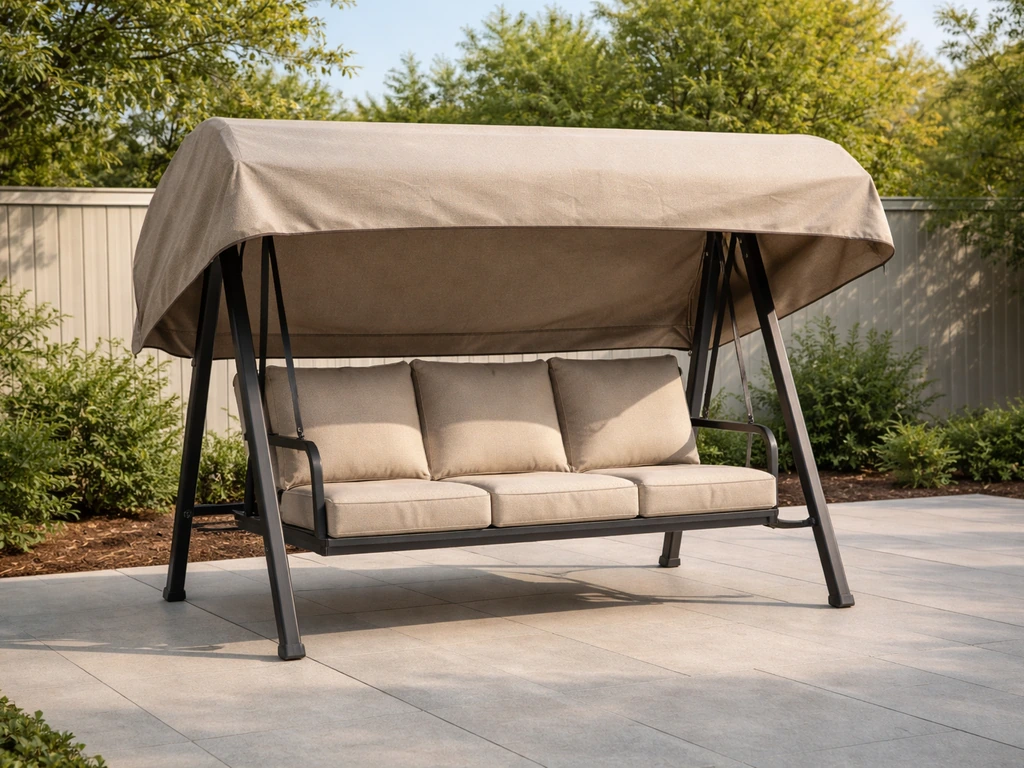
What your swing top cover is actually protecting against
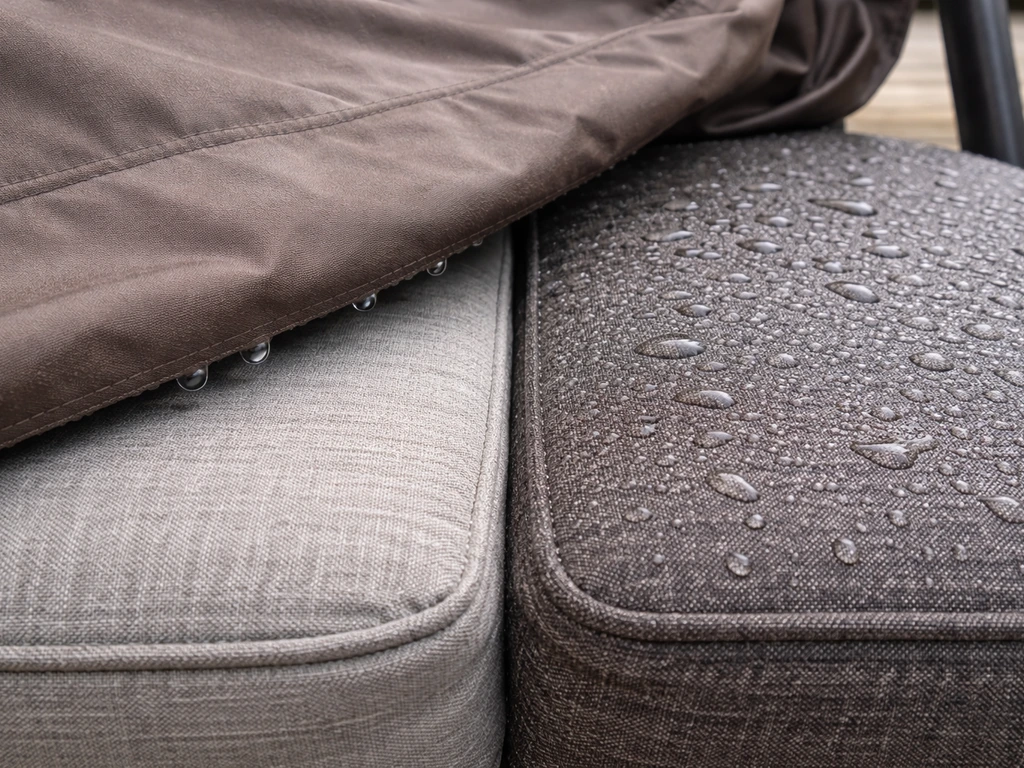
A patio swing takes hits from every direction. Rain soaks into cushion foam and breeds mildew within 48 hours if the fabric stays wet. UV light is slower but just as damaging: it breaks down polyester and acrylic fabric, bleaches out color, and makes cushion covers brittle and crackly after two or three summers of direct sun. Wind-driven debris, tree sap, bird droppings, and pollen are more of a nuisance than a structural threat, but they create staining and residue that shortens fabric life and makes cleaning a bigger job than it needs to be.
If you're in a climate that gets snow or ice, there's a specific risk to the canopy frame itself. Ice weight can bow or crack lighter aluminum and resin canopy arms over a winter. A well-fitted cover keeps ice from forming on the frame directly and shields the canopy fabric underneath. People in hot, dry climates worry less about that and more about UV degradation. Knowing your primary enemy helps you prioritize features when you're comparing covers.
Types of swing top covers and when each one makes sense
Not all swing covers are designed the same way, and using the wrong type for your swing style causes the most common fit problems I see people complain about.
| Cover Type | Best Swing Style | Key Benefit | Main Limitation |
|---|---|---|---|
| Canopy swing cover (shaped/contoured) | 3-seat glider swing with arched canopy frame | Hugs the canopy shape; prevents pooling | Only fits swings with a defined canopy overhang |
| Standard porch swing cover (rectangular drape) | Flat bench-style porch swing without canopy | Simple sizing; easy on/off | No canopy shaping; can sag and pool water |
| Custom-fit cover | Oversized, odd-shaped, or rattan/wicker swing frames | Exact dimensions; best protection | Higher cost; 2-3 week lead time |
| Universal all-furniture cover (tarp-style) | Any swing in a pinch | Cheap and widely available | Poor fit; blows off; traps moisture easily |
The canopy swing cover is what most people shopping for a 'patio swing top cover' actually need. If you’re looking at step2 all around playtime patio swings with a canopy, compare the canopy depth and coverage area so the cover actually protects the fabric and cushions step2 all around playtime patio swings with a canopy reviews.
It's engineered to account for the curved or angled canopy arm structure, which means the cover drapes over the top of the whole unit, cushions included, rather than just throwing a flat sheet over the seat. If you have a rattan daybed-style swing or a heavier metal-frame glider, a custom cover is worth the extra cost because off-the-shelf sizes rarely account for the extra depth those frames add.
The standard porch swing cover is fine for a simple wood or metal bench hung from a porch ceiling with no canopy structure.
How to measure your patio swing so the cover actually fits
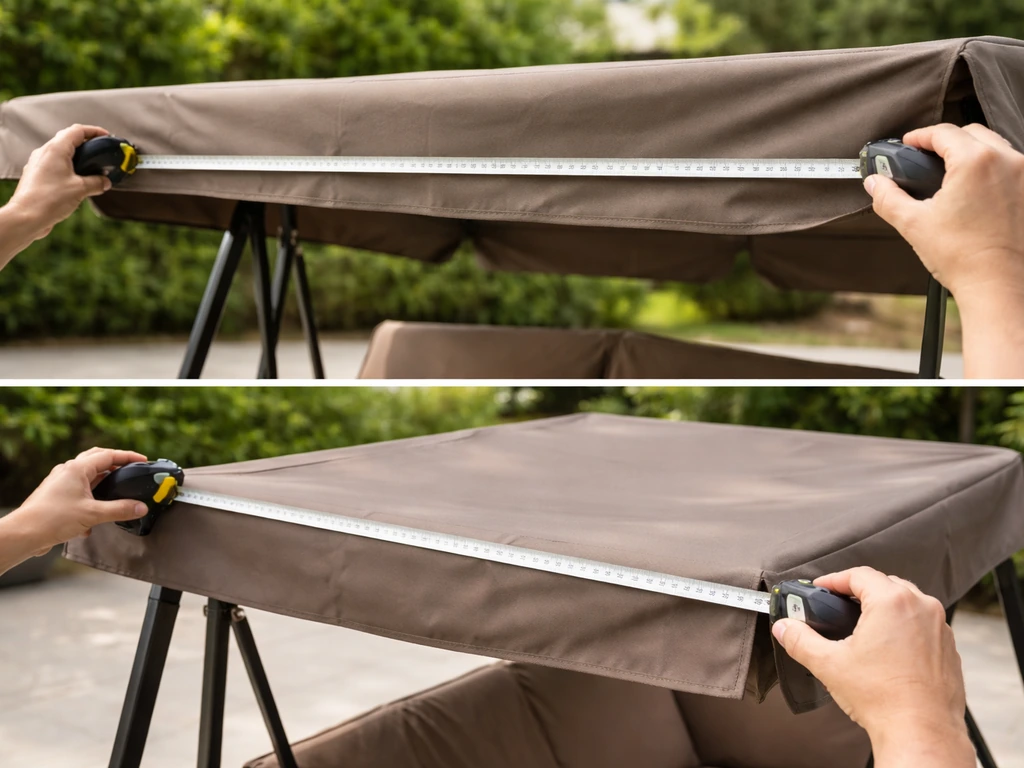
Measuring a canopy swing is different from measuring a standard piece of furniture. The two numbers that determine your cover size are the canopy fabric width (measured left to right across the widest part of the canopy) and the canopy fabric depth (measured front to back from the front edge of the canopy to the back). Height matters too, but only to confirm the cover will reach down far enough to protect the seat and cushions below.
- Measure canopy width: stand in front of the swing and measure from the leftmost edge of the canopy fabric to the rightmost edge. Include any overhang.
- Measure canopy depth: measure from the front edge of the canopy fabric straight back to where it meets the rear frame. This is often shorter than the width on most 3-seat gliders.
- Measure seat height: measure from the ground (or from the lowest point of the swing's footprint if it hangs) up to the top of the canopy. Compare this to the cover's listed height to make sure the cover hem reaches at least to the seat level.
- Add 2-3 inches to your width and depth measurements as a working buffer when matching to cover product dimensions. A slightly generous fit drapes better than one that's stretched tight.
- Write all three numbers down before shopping. Product listings almost always give width x depth x height in that order.
One mistake I see constantly: people measure only the seat width and ignore the canopy. The canopy on a typical 3-person glider swing is almost always wider than the seat because the frame arms extend outward. If you size to the seat, the cover won't reach the canopy edges and the frame gets no protection at all. Measure the canopy first.
Materials and how they actually perform in real weather
Water-resistant vs. waterproof: what the difference means for you
Most mid-range swing covers are water-resistant, not fully waterproof. The distinction matters in practice. A water-resistant cover uses a hydrophobic coating (often a DWR finish) that causes rain to bead up and run off under normal rain. Heavy or prolonged downpours, or rain combined with wind that drives water sideways, can eventually push moisture through the fabric. Fully waterproof covers use a laminated or multi-layer construction that blocks water even under sustained pressure. The Gardelle fabric system, for example, combines a water-repellent outer layer with a laminated backing and a splash guard skirt that redirects runoff away from the seat area. That layered approach performs better in heavy rain climates than a single-layer DWR fabric.
UV resistance

UV resistance is built into the fabric's dye and weave rather than a surface coating, which means it doesn't wash off over time the way a water-repellent finish can. Covers labeled UV-resistant use fabrics engineered to slow the degradation that sun exposure causes, both to the cover itself and to whatever it's protecting underneath. If you're in the Sun Belt or anywhere with intense summer sun, this is a non-negotiable feature. Without it, a cover can degrade within a season and offer no meaningful shielding to the cushions underneath.
Breathability and why it matters more than people think
A cover that seals perfectly with no airflow creates a greenhouse effect underneath: temperature swings cause condensation, which soaks into cushion fabric and foam from the inside even when it hasn't rained. Mesh vents solve this by allowing air to circulate while still blocking rain from entering directly. Look for covered mesh vents (the mesh opening is shielded from above so rain can't pour straight through) rather than simple holes. This is one of the most underrated features on a swing cover and one of the most common missing elements on cheap universal tarps.
Features that stop sagging, leaking, and wind blow-off
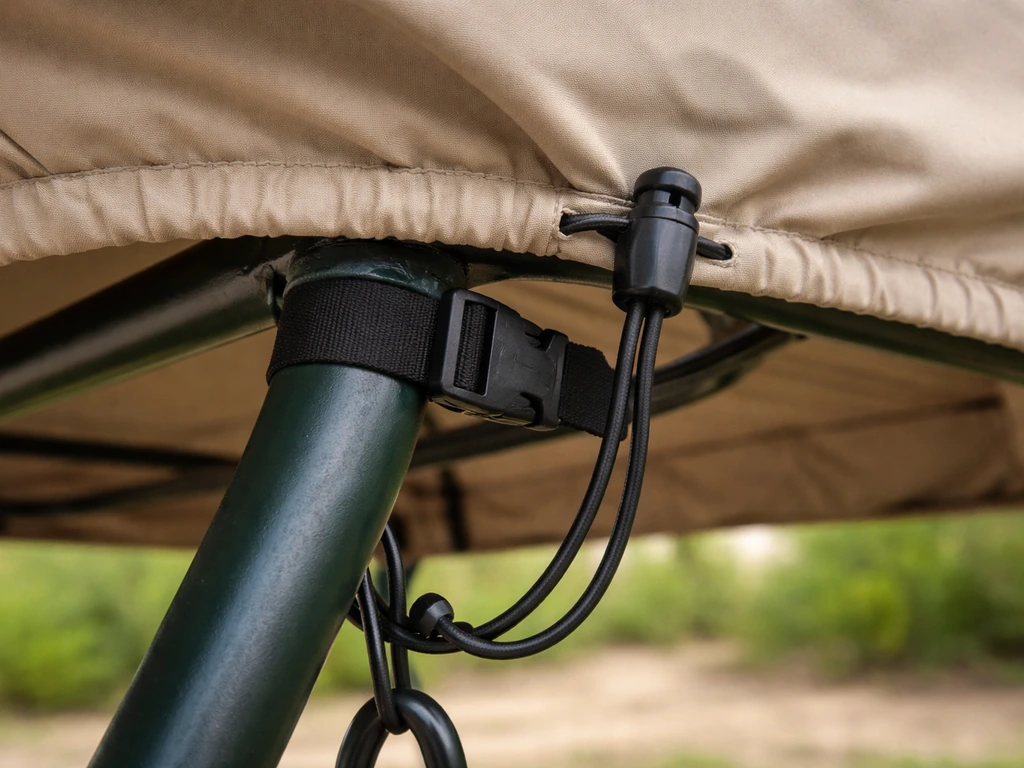
Cheap covers fail in one of three ways: they sag and pool water until the seams give out, they leak at untaped seams during heavy rain, or they blow off in the first wind event. Here's what actually prevents each problem.
- Elastic hem cord with toggle: wraps around the underside of the swing frame and cinches tight so the cover can't ride up. Look for a cord with a locking toggle, not just an elastic loop.
- Click-close buckles and adjustable straps: these are secondary anchors that go under the frame and clip together. Classic Accessories' WindLock system uses click-close buckles with an adjustable cord lock closure specifically for high-wind security. This is the difference between a cover that survives a 30-mph gust and one you find in your neighbor's yard.
- Auto-locking drawcord (360-degree): some covers, like Coverstore's Ultima ripstop, use a drawcord that runs the full perimeter of the cover hem and cinches with an auto-lock mechanism. This gives a tighter, more even cinch than a single-point strap.
- Covered mesh vents: prevents condensation from building up inside. As mentioned above, these need to be shielded so rain doesn't enter through the vent opening.
- Reinforced corners and double-stitched seams: corners take the most stress from wind flapping and weight. A cover without reinforced corners will tear there first.
- Splash guard skirt: a darker, denser fabric strip around the base of the cover that prevents rain runoff from wicking back up under the hem onto the seat area.
- Ripstop fabric construction: a grid-reinforced weave that prevents a small tear from spreading. Worth it if you're in a consistently windy area or if your swing is under a tree with branches.
Sagging is usually a sizing problem as much as a design problem. A cover that's significantly too large for the swing will always pool water in the middle no matter how good the drainage design. Getting close to the right dimensions (within 2-3 inches rather than 10-12 inches) removes most of the sagging risk before you even consider cover features.
How to install, secure, clean, and store your swing cover
Installation
Remove cushions before putting the cover on. Leaving cushions in place traps moisture between the cushion fabric and the cover, which is exactly the mold scenario you're trying to prevent. Store cushions indoors or in a sealed deck box when the cover goes on for extended periods. Once cushions are out, drape the cover over the canopy top and work it down evenly on all sides before cinching anything. Starting with the hem cord, pull it snug under the frame rail, then engage the click-close buckles or drawcord. Pull straps firmly but not so tight that the cover distorts over the canopy shape.
Securing in wind
Before a storm or if your area is consistently windy, double-check that all buckles are clicked, the drawcord is locked, and the hem cord toggle is fully tightened. If your cover has tie-down straps with loops, you can also thread a bungee cord through the loops and around a frame leg for extra security. Don't rely on just the weight of the cover itself: a large cover acts like a sail in wind and any loose corner will catch air and rip the whole thing off.
Cleaning
Lay the cover flat on a clean surface and rinse it thoroughly with a garden hose to remove loose dirt and pollen first. For general cleaning, use warm water and a soft scrub brush. For heavier grime, mildew spots, or tree sap residue, diluted white vinegar works well without damaging the fabric coating. Never put a patio swing cover in a washing machine: the agitation tears seams and destroys the water-repellent finish.
Air dry completely before putting it back on the swing or folding it for storage. Installing a damp cover will defeat the whole purpose and start a mildew cycle under the fabric. If you're in a coastal area, near heavy tree cover, or in a high-pollen region, plan on cleaning the cover 2-3 times per season rather than once.
Storage between seasons
When you're putting the cover away for a long stretch (end of season, extended travel), make sure it's fully dry, then fold it and store it in a cool, dry place like a garage shelf, shed, or deck box. Storing a damp cover folded tightly is the fastest way to grow mildew on the fabric itself, which will transfer back to your swing cushions next season. Most covers come with a storage bag: use it, since it keeps the cover from getting dusty or snagged on other stored items.
Choosing between a basic cover and a premium one
The honest budget vs. premium comparison for swing covers comes down to two things: fastening system quality and fabric durability. On Coverstore’s Custom Canopy Swing Cover product page, the fit and stability features are shown with design callouts such as buckles and straps, water-resistant fabric labeling, and venting, zipper, and grommets [custom canopy swing cover product page includes design-callouts](https://www. coverstore.
com/products/custom-canopy-swing-cover-elite-charcoal). A basic water-resistant cover in the $30-50 range will protect adequately in mild climates with occasional rain and light wind, but the fastening system is usually a single elastic hem with no straps. It will blow off in a serious storm. A mid-range cover from a brand like Classic Accessories' Veranda line ($50-80) adds the click-close buckle system, UV-resistant fabric, and venting, which addresses the three main failure points.
A premium ripstop cover with a 360-degree auto-locking drawcord and custom sizing ($80-150+) is the right call if you're in a high-wind area, have an oversized or uniquely shaped swing, or just want something that lasts 5+ years without rebuying.
If you're also looking at canopy-specific furniture like a rattan daybed with a retractable canopy or a 3-person swing with a full canopy structure, the cover sizing and shape logic is similar but the frame dimensions can differ significantly, so always measure that specific piece rather than assuming a cover that fits one swing fits another.
Your buying checklist before you order
Use this as your final gut-check before clicking buy. If you can answer yes to everything here, you're making a solid choice. If you are looking for aqua patio pontoon bimini top coverage, treat it like a specialized outdoor cover and match it to your pontoon’s measurements and sun exposure.
- I have measured my canopy width (left to right) and canopy depth (front to back) and confirmed the cover dimensions are within 2-3 inches of those numbers.
- I have checked the cover height to confirm it will reach down to seat level.
- The cover is rated water-resistant or waterproof (not just 'weather-resistant' with no specifics).
- The cover includes UV-resistant fabric treatment, not just a surface coating.
- The fastening system includes at least an elastic hem cord AND a secondary strap, buckle, or drawcord system (especially important if your area gets wind).
- The cover has at least one covered mesh vent for breathability.
- The seams are double-stitched or taped (listed in the product spec; this matters most for waterproof claims).
- If I'm in a high-wind or coastal region: the cover has a 360-degree drawcord or WindLock-style buckle system and reinforced corners.
- If I'm in a heavy-snow region: the cover material is rated for cold temperatures and the fit is snug enough that ice load won't cause sagging that pools water and refreezes.
- I plan to store cushions separately when the cover is on for multi-day periods.
- I know where I'll store the cover off-season (dry location, out of direct sun when not in use).
Quick climate and swing-style decision guide
| Your Situation | Priority Features | Recommended Cover Type |
|---|---|---|
| Mild climate, occasional rain, light wind | Water-resistant fabric, elastic hem, UV protection | Standard canopy swing cover, mid-range |
| Rainy/humid climate (Southeast, Pacific Northwest) | Laminated/waterproof backing, covered vents, taped seams, splash guard skirt | Mid to premium canopy swing cover with Gardelle-style layered fabric |
| High-wind area (Midwest, coastal) | 360-degree drawcord or click-close buckle system, ripstop fabric, reinforced corners | Premium ripstop canopy swing cover with WindLock-style fastening |
| Intense UV/desert (Southwest) | High UV-resistance rating, breathable vents to reduce heat buildup | UV-rated mid or premium cover; lighter color reduces heat absorption |
| Snow and ice (Northern US, Canada) | Waterproof with cold-rated fabric, snug fit to prevent sagging/ice pooling | Premium waterproof cover; consider removing cover and storing swing during heavy snow seasons |
| Oversized, rattan, or custom-frame swing | Exact dimension match; buckle system for unusual shapes | Custom-fit cover from Coverstore or similar (measure before ordering) |
FAQ
What size should I choose if my patio swing has both a canopy and a removable cushion set that varies in thickness?
Use the canopy’s left-to-right width and front-to-back depth to choose the cover size, then confirm height clearance by measuring the tallest cushion stack when installed. If the cover rides up because it is too short, it will miss the canopy edges and let water reach the seat area, even when the width and depth are correct.
Do I need a patio swing top cover if I already use a waterproof seat cushion bag or storage box?
A cushion box helps, but a top cover still matters for the canopy structure and for residual moisture that migrates into the frame area. If your cushions are left outside for any period, also remove them under the cover to avoid trapping condensation between cushion fabric and the cover.
How can I tell whether a cover is truly waterproof or just water-resistant before I buy?
Look beyond wording and check for design cues that indicate layered or seam-managed construction, such as laminated backing and a splash guard skirt, plus taped or otherwise sealed seams. A water-resistant fabric often beads rain briefly but can wet through during windy or long downpours, especially at seams and corners.
Are mesh vents enough, or can condensation still build up under the cover?
Mesh vents greatly reduce the risk, but placement matters. If the cover sits too low and blocks airflow, you can still get a greenhouse effect. After installation, check that vent areas are not fully pressed against cushion surfaces, and that vents are not obstructed by the way you cinch the hem cord.
What’s the best way to prevent the patio swing top cover from blowing off in gusty weather?
Verify the fastening system first, then add a secondary tie-down method when needed. Make sure the hem cord and drawcord are locked, buckles are fully engaged, and any corner straps are snug. If your cover includes loop tie-down points, use bungee or cord around a sturdy frame leg, not around lighter trim pieces.
My cover pools water in the middle even though the size seems close. What should I check?
Confirm the cover is not oversized by a large margin and that it is seated evenly on all sides. A significantly oversized cover will sag and create low spots. Also ensure the canopy arms are fully covered so the cover does not sag around protruding frame sections and create a trough.
Can I put a patio swing top cover on with cushions still attached or in place?
Avoid it. Leaving cushions on traps moisture between layers and increases mildew risk. If you must cover temporarily, lift cushions slightly for airflow if possible, but for real weather protection, remove cushions and store them indoors or in a sealed deck box when the cover will be on for extended periods.
What should I do if my cover gets tree sap or bird droppings on it?
Rinse thoroughly first to remove loose residue, then spot-clean. Diluted white vinegar is a good option for stains and mildew-like spots on coated fabrics, but rinse after spot treatment and air dry completely before reuse, since residue can harden and attract more dirt.
Is it safe to use a washing machine on a patio swing top cover?
No. Machine agitation can tear seams and can degrade the water-repellent finish. Stick to laying the cover flat, rinsing with a hose, using mild warm water with a soft brush for general cleaning, and air drying fully.
How often should I clean a patio swing top cover in different climates?
In light rain and low pollen areas, occasional cleaning per season may be enough. In coastal zones, under heavy tree cover, or where pollen is heavy, plan for more frequent cleaning (about every 2 to 3 times per season) because buildup holds moisture and accelerates fabric wear.
What’s the correct way to store a patio swing top cover at the end of the season?
Only store it when it is fully dry, fold it without leaving damp sections trapped inside, and keep it in a cool, dry place like a garage shelf or deck box. Using the included storage bag is helpful because it reduces dust and prevents snagging against other stored items.
Do I need a cover made specifically for my swing model, or will a universal patio swing top cover work?
Universal covers can work, but canopy structures are where they fail most often. If your canopy has unusual arm angles or extra depth beyond the seat, custom or canopy-swing-specific sizing is usually safer, because off-the-shelf covers often cover the seat but miss the canopy edges.
Will a patio swing top cover protect the frame in winter, or will ice still damage it?
A well-fitted cover can reduce direct ice formation on the canopy fabric and the most exposed frame sections, which helps lower stress on lighter arms. However, in heavy snow or ice climates, still expect some risk, especially if water gets trapped under the cover during thaw-freeze cycles.
How do I confirm after installation that the cover is correctly positioned?
Do a quick fit check: verify the hem cord sits under the frame rail evenly, ensure straps and buckles are tight but not distorting the cover, and look for gaps at the canopy edges and corners. If you see uncovered frame portions or the cover is riding up, you likely need a different size or better placement before the next storm.
Next Articles
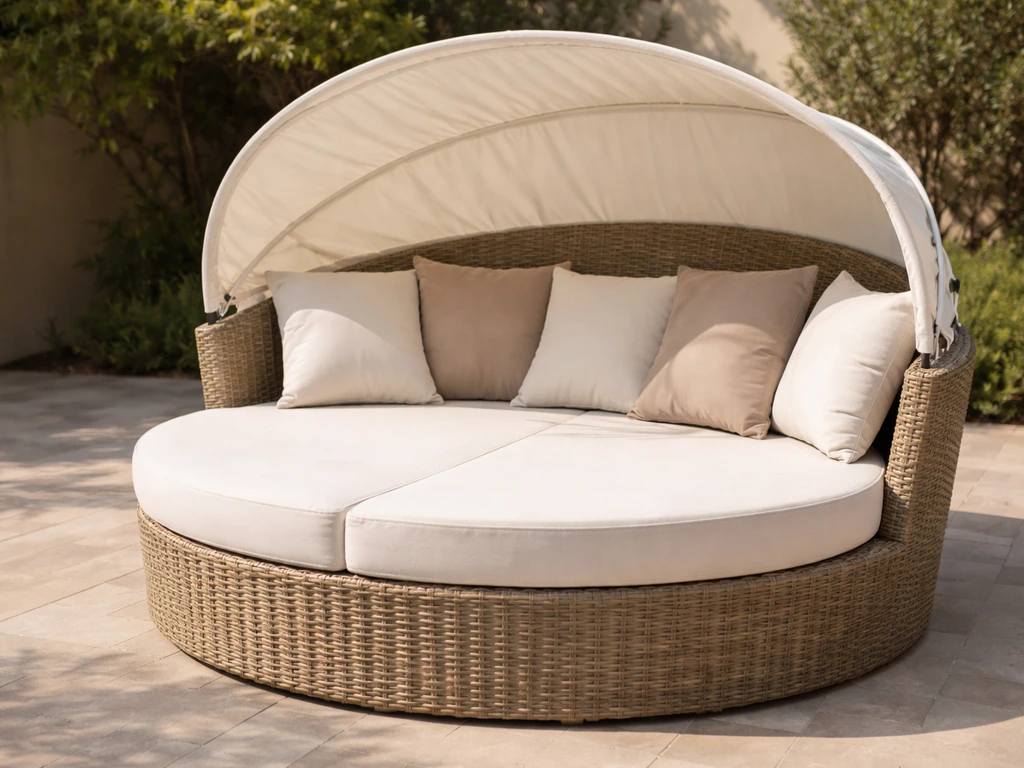
Patio Rattan Daybed with Retractable Top Canopy: How to Choose
Choose a patio rattan daybed with retractable canopy: size, canopy type, weatherproof rattan, comfort, and care tips.
Best Sunbrella Patio Cushions: Top Picks, Guide & Maintenance
Find the best Sunbrella patio cushions: durable, fade‑resistant picks, buying tips, care, and top recommendations.
Alternative to Patio Cushions: Durable, Stylish Options and DIY
Alternative to patio cushions: durable, weatherproof seating options, pros, DIY tips & buying guide.