
The best patio lights on Amazon right now are the Brightech Ambience Pro for plug-in string lights, the Brightown 100FT Solar String Lights for solar, the Addlon 48FT LED Outdoor String Lights for a budget-to-mid plug-in alternative, and the Globe Electric Bowery for hardwired wall sconces. Each one earns its spot because of strong verified-purchase feedback, real safety certifications (UL or ETL), and specs that hold up against what Amazon listings actually claim. If you have an outlet within reach and want the most reliable ambiance lighting, the Brightech Ambience Pro at $44.99 for 48 feet is the one to start with.
Best Patio Lights on Amazon: Top Picks, Buying Guide and Reviews

Lark Perry
21 Jul 2026
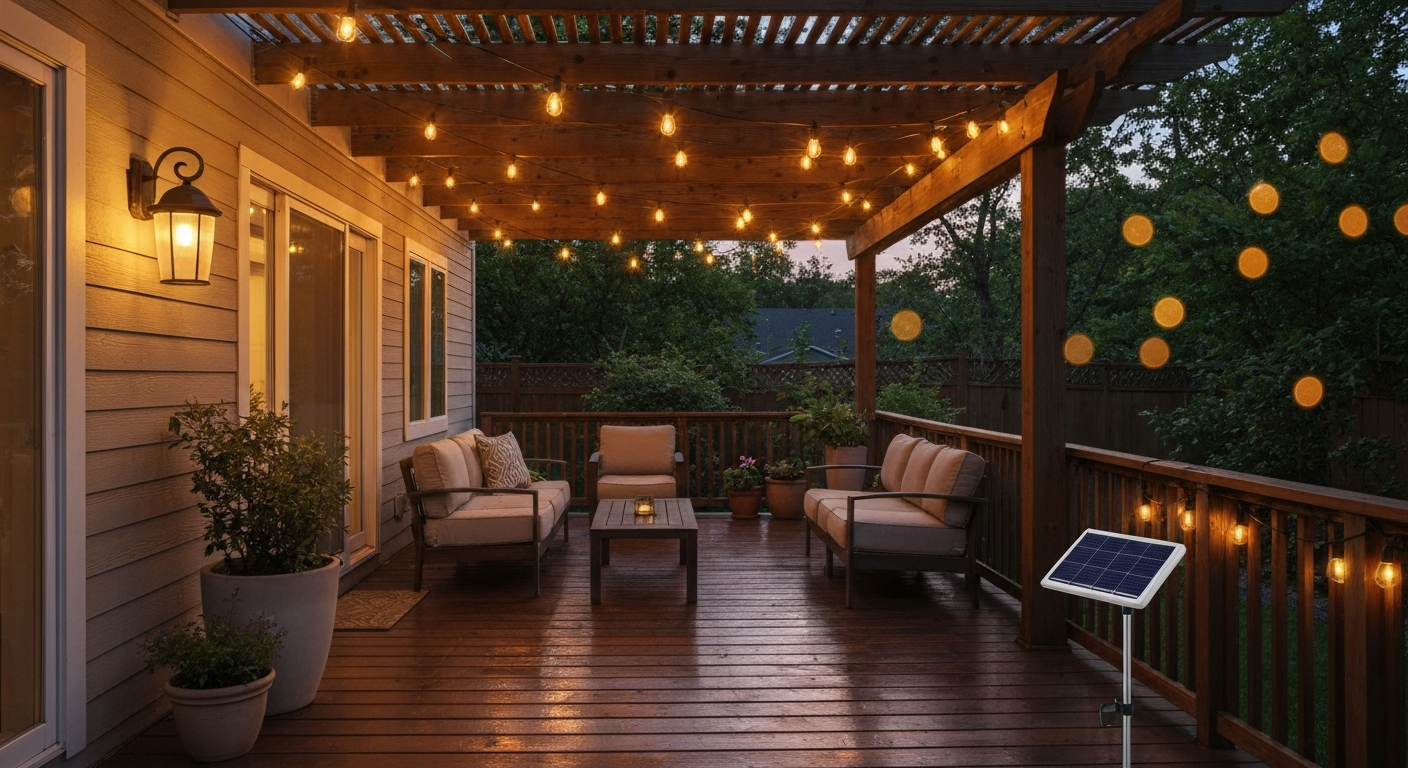
Quick take: best patio lights on Amazon by category
Here are the top picks at a glance, with one line on who each one is for. Deeper breakdowns follow in later sections. For a quick shopping guide and direct recommendations, see our roundup of the best patio lights to buy.
| Category | Top Pick | Best For |
|---|---|---|
| String / Bistro | Brightech Ambience Pro (48FT) | Anyone who wants plug-in bistro-style lights with UL listing, dimmable vintage Edison bulbs, and a weatherproof cord |
| Solar String | Brightown 100FT Solar String Lights | Renters or areas without nearby outlets who need 100 feet of coverage with remote dimming and a backup USB charge option |
| LED Plug-In (budget-mid) | Addlon 48FT LED Outdoor String | Cost-conscious buyers who still want ETL-certified commercial-grade weatherproof construction |
| Hardwired Wall Sconce | Globe Electric Bowery Outdoor Sconce | Homeowners doing a permanent install who want a polished fixture in the $30–$40 range with a strong rating track record |
How to choose patio lights: five decisions that actually matter
Before you filter Amazon results, you need to make five choices. Get these right and everything else, including which specific listing to buy, falls into place.
1. Power source
Plug-in string lights are the most reliable option if you have a GFCI outdoor outlet within a reasonable cord run. They charge fast, dim consistently, and do not depend on weather. Solar lights are genuinely useful when there is no outlet nearby, but their runtime is directly tied to panel wattage, battery capacity (in mAh), and how much sun the panel sees each day. Hardwired fixtures are permanent and the cleanest-looking, but they require opening a junction box and, in most cases, hiring an electrician.
2. Style
The two main decorative formats are bistro/string lights (suspended strands with globe or Edison bulbs at intervals) and fixed fixtures (wall sconces, post lights, or flush mounts). String lights create the warm, draped-canopy look most people picture for a patio. Fixed fixtures deliver directed light for tasks like grilling or reading but do less for atmosphere. Both have their place, and most patios benefit from combining them.
3. Brightness
For ambient patio string lights, individual bulb output typically runs from about 1W to 4W per socket, producing roughly 80 to 350 lumens per bulb. A 48-foot strand with 15 bulbs at 2W each delivers gentle, conversational light, not work-surface brightness. If you need enough light to cook or read comfortably, you will want a higher-lumen LED flood or a wall sconce in addition to string lights. Color temperature is equally important: 2200K–2700K (warm white) looks like candlelight and suits relaxed settings; 3000K–4000K (neutral to cool white) is cleaner and brighter but less cozy.
4. Durability and IP rating
IP (Ingress Protection) ratings are defined by IEC 60529 and use two digits: the first covers solids, the second covers liquids. IP44 means protected against objects larger than 1mm and splashing water from any direction, which is fine for a covered patio. IP65 means fully dust-tight and protected against direct water jets, which is what you want for an exposed deck or pergola. Most quality Amazon string lights land at IP44 or IP65. Anything below IP44 should be treated as indoor-only.
5. Controls and dimming
Not all LED string lights are truly dimmable. Even when a product claims dimming, the bulbs must be compatible with the dimmer you are using. LED drivers can flicker, buzz, or fail entirely when paired with older leading-edge (TRIAC) dimmers. Lutron and other major manufacturers publish compatibility charts for a reason. Look for listings that specify LED-compatible or CL-rated dimmer compatibility, or use a smart plug with built-in dimming. Some solar string lights, including the Brightown model, include a remote with discrete brightness steps, which sidesteps the dimmer compatibility issue entirely.
String/bistro vs solar vs LED plug-in vs hardwired: which type fits your setup
| Type | Typical Cost Range | IP Range | Brightness | Install Effort | Best Scenario |
|---|---|---|---|---|---|
| String / Bistro (plug-in) | $30–$90 | IP44–IP65 | Low–medium (ambient) | Low (needs outlet) | Covered or semi-exposed patio with outlet access |
| Solar String | $25–$70 | IP44–IP65 | Low–medium | Very low (no wiring) | No-outlet areas, renters, balconies with good sun exposure |
| LED Plug-In (non-string) | $20–$60 | IP44–IP65 | Medium–high | Low (needs outlet) | Task lighting, spotlights, or supplemental brightness |
| Hardwired Fixture | $25–$120+ | IP44–IP65+ | Medium–high | High (electrical work) | Permanent installs, homeowners wanting clean flush or sconce fixtures |
The practical rule: if you have an outdoor GFCI outlet, plug-in string lights are the sweet spot for most people. They are reliable, bright enough for ambiance, genuinely dimmable with the right equipment, and easy to take down or replace. Solar is the right call only when an outlet is truly not an option, and you need to be realistic about runtime in cloudy climates. Hardwired fixtures are worth the investment for a permanent deck or patio renovation, but they are overkill for renters or anyone who might move in the next few years.
Top Amazon picks by category
String / Bistro: Brightech Ambience Pro
The Brightech Ambience Pro (ASIN B08763PLFL) is the most consistently well-reviewed patio string light on Amazon, holding a 4.7 out of 5 from more than 15,500 verified ratings at the time of writing. The 48-foot version lists at $44.99, and Brightech also sells 24-foot and 105-foot versions. Bulbs are 2W LED Edison-style with 3-foot spacing, and the cord uses Brightech's WeatherTite construction. It is UL listed and the bulbs are dimmable with a compatible LED dimmer. Brightech publishes a 3-to-5-year warranty, which is among the better coverage you will find for Amazon string lights.
- Pros: UL listing (a real safety credential), dimmable bulbs, heavy-duty weatherproof cord, 15,500+ verified ratings, multiple length options
- Cons: At $44.99 for 48 feet it is not the cheapest option, and like all LED string lights it requires a compatible LED dimmer if you want smooth dimming
- Best-use scenario: Medium to large patios and pergolas where you want a reliable, long-term canopy lighting setup
- Cost/value verdict: Strong value at the price point given the UL listing and warranty backing
Solar String: Brightown 100FT Solar String Lights
The Brightown 100FT Solar String Lights (ASIN B0FJRP5GLH) stand out in the solar category because of the dual charging option: solar panel plus a Type-C USB backup input. That matters because the single biggest frustration with solar string lights is dead batteries after a cloudy stretch. Having a USB fallback means you are not completely dependent on the sun. The strand includes 31 shatterproof LED globe bulbs rated IP65, and a remote control with multiple brightness levels and a timer function. Brightown claims 10-plus hours of runtime on a full charge.
- Pros: 100 feet of coverage, IP65 rating, dual solar + USB-C charging, remote with dimming and timer, shatterproof bulbs
- Cons: Actual runtime varies significantly based on panel placement and seasonal sun hours; battery capacity will degrade over 2–3 years of cycling as with all lithium-ion packs
- Best-use scenario: Renters, balconies without outlets, or any area where running a cord is not practical
- Cost/value verdict: Good value for the feature set; budget for a replacement strand or battery in years 3–4
LED Plug-In: Addlon 48FT LED Outdoor String Lights
The Addlon 48FT (ASIN B07QMKZWQF) earns its place with an ETL/Intertek certification listed on the product page and a 4.6-star average from over 16,000 ratings. ETL certification (from Intertek) is the North American equivalent of UL listing and confirms the product has been tested against applicable safety standards. The shatterproof bulbs and commercial-grade weatherproof strand make it a durable choice, and it is generally priced slightly below the Brightech, making it the better pick if budget is a priority and you still want a certified product.
- Pros: ETL/Intertek certified, shatterproof bulbs, 16,000+ verified ratings, typically priced lower than the Brightech
- Cons: Warranty terms are less prominently published than Brightech's; dimmer compatibility should be confirmed before purchase
- Best-use scenario: Budget-conscious buyers who want a certified, high-volume-reviewed product for a medium-sized patio
- Cost/value verdict: Best cost-per-foot option among certified plug-in string lights
Hardwired Fixture: Globe Electric Bowery Outdoor Sconce
The Globe Electric Bowery (ASIN B075Y6LZXP) consistently ranks among Amazon's top-selling exterior wall sconces, with ratings averaging around 4.8 stars and a price in the $30–$40 range. It is a hardwired fixture, meaning installation requires connecting to your home's wiring. Globe Electric is a well-established lighting brand with wide distribution, and their product pages list the fixture ratings needed for exterior installation. This is a permanent solution for anyone building out a finished patio who wants a clean, architectural light source alongside decorative string lights.
- Pros: Polished, permanent look; strong brand reputation; wide bulb compatibility; priced well for a hardwired fixture
- Cons: Requires hardwired installation (hire a licensed electrician for anything beyond a direct fixture swap on an existing junction box); not a good fit for renters
- Best-use scenario: Permanent patios and decks where a homeowner wants wall-mounted ambient or task lighting that does not depend on a cord
- Cost/value verdict: Excellent value for a permanent fixture; the low upfront cost makes it accessible for DIY fixture swaps
Spec comparison: all four picks side by side
| Spec | Brightech Ambience Pro | Brightown 100FT Solar | Addlon 48FT LED | Globe Electric Bowery |
|---|---|---|---|---|
| Price Range | $44.99 (48FT) | ~$40–$60 | ~$30–$45 | $30–$40 |
| Length / Coverage | 24FT, 48FT, 105FT | 100FT | 48FT | N/A (wall mount) |
| Bulb Type & Base | LED Edison, E26 | LED Globe, integrated | LED Edison, E26 | E26 (bulb sold separately on some versions) |
| Lumens & Color Temp | ~200 lm/bulb, 2200K–2700K | Warm white, lumens vary by brightness level | ~200 lm/bulb, 2200K–2700K | Depends on bulb choice; fixture accepts standard E26 |
| IP Rating | IP44 (WeatherTite cord) | IP65 | IP44–IP65 | Listed for exterior/wet/damp per product page |
| Rated Bulb Life | 25,000+ hrs (LED) | 25,000+ hrs (LED) | 25,000+ hrs (LED) | Depends on bulb installed |
| Dimmable | Yes (LED-compatible dimmer required) | Yes (remote with brightness steps) | Yes (LED-compatible dimmer required) | Depends on bulb and dimmer used |
| Certification | UL Listed | IP65 rated; dual charging | ETL / Intertek | Listed for exterior use |
| Warranty | 3–5 years (Brightech) | Manufacturer limited warranty | Manufacturer limited warranty | Globe Electric limited warranty |
Real-world performance and durability: what the specs actually mean
IP ratings in practice
An IP65 rating means the fixture or cord is dust-tight and can handle direct water jets, which is meaningful on an exposed pergola or deck that gets rained on from multiple angles. IP44 is sufficient for a covered or semi-sheltered patio where rain hits at an angle but does not blast the fixture directly. One caveat: IP ratings test the product as manufactured. A cord that flexes and stretches from seasonal installation and removal can develop micro-cracks that reduce its real-world water resistance over time. This is why Brightech's WeatherTite cord is worth noting, as it is specifically designed for durability under repeated outdoor use.
Bulb life and the L70 standard
When a manufacturer claims 25,000 hours of LED bulb life, that figure typically refers to L70 lifetime: the point at which the bulb drops to 70% of its original lumen output, as tested and projected using IES LM-80 data and TM-21 methodology. blank" rel="noopener noreferrer">Final ENERGY STAR Luminaires V1.2 Specification (ENERGY STAR / U.S. EPA) documents typical L70 guidance (for example, ~25,000 hours for many residential indoor luminaires and ~35,000 hours for many residential outdoor/commercial luminaires) and requires LM‑79/LM‑80/TM‑21 substantiation for lumen‑maintenance claims. That is the accepted industry standard for LED lifetime claims. In practical terms, 25,000 hours at three to four hours of use per night works out to roughly 17–23 years before reaching 70% brightness. Real-world failures usually come from driver failure, socket corrosion, or physical damage long before the LED chip itself dims out. Look for products with replaceable E26 bulbs, which is standard on the Brightech and Addlon models, since those let you swap a failed bulb without replacing the whole strand.
Brightness and color temperature: practical guidance
For evening ambiance on a residential patio, 2200K to 2700K (warm white) is the right choice. It looks like a warm incandescent or candle flame and flatters outdoor furniture, skin tones, and food. At 3000K you get a slightly crisper look that works well for a modern or contemporary patio design. Avoid anything 4000K or above for string lights: it reads as office-lighting cold and kills the relaxed atmosphere you are going for. In terms of brightness, a standard 48-foot strand with 15 to 16 bulbs at 2W each delivers pleasant ambient coverage for a medium patio, but you will need supplemental lighting if you also want to read or cook.
Solar performance season to season
Solar string lights use lithium-ion batteries in virtually all current consumer models. Li-ion cells deliver more usable capacity per charge than older Ni-MH chemistry and handle deeper discharge cycles better, but they still lose capacity over time: real-world testing and battery research consistently documents 20–30% capacity loss after 300–500 full charge cycles, which at daily summer use translates to 2–3 seasons before runtime begins to noticeably shorten. In northern climates, solar panel output in winter months may not fully recharge the battery in a single day, so the USB-C backup on the Brightown is genuinely useful, not just a marketing feature.
Sizing and layout: matching string lights to your patio
Small balconies and apartment patios (under 100 sq ft)
A single 24-foot strand is usually enough for a small balcony. Run it in a simple perimeter layout along the railing and up one side, or drape it in a single straight line from one wall anchor to another. Use the smallest bulbs available to keep the scale appropriate and avoid overpowering a tight space visually.
Medium patios (100–300 sq ft)
A 48-foot strand covers a medium patio comfortably in one of two common layouts. The perimeter layout strings the lights around the edges of the space, anchored at each corner. The zig-zag layout runs strands back and forth across the width of the patio, creating a denser overhead canopy feel. For a 12x16 foot patio, a zig-zag with two passes using a 48-foot strand works well. Space the attachment points every 8 to 10 feet across the width and repeat.
Large decks and pergolas (300+ sq ft)
For large spaces, plan on a 100-foot strand or two 48-foot strands connected in series (confirm the product supports daisy-chaining before buying). A full canopy layout works best on a pergola: run parallel strands lengthwise across the beams, spaced 18 to 24 inches apart, to create an even overhead light ceiling. On an open deck without a pergola, use freestanding poles or deck-post mounts at the corners and midpoints to support the strands at a height of 8 to 10 feet above the deck surface.
| Patio Size | Recommended Strand Length | Suggested Layout | Attachment Points Needed |
|---|---|---|---|
| Small balcony (under 100 sq ft) | 24 FT | Perimeter or single drape | 2–4 |
| Medium patio (100–300 sq ft) | 48 FT | Perimeter or zig-zag | 4–8 |
| Large deck / pergola (300+ sq ft) | 100 FT or two 48FT strands | Canopy or parallel runs | 6–12+ |
Installation and placement tips
Anchors, mounts, and sag prevention
The most common installation mistake is running string lights without enough support points, which causes the strand to sag heavily in the middle. For runs longer than 10 feet, add an intermediate support using a screw-in hook, a guide wire, or a wooden post. Stainless steel cup hooks rated for outdoor use are cheap, widely available, and hold well in wood framing, deck posts, and fascia boards. For masonry or stucco, use a masonry anchor with a stainless screw-in hook. Always tension the guide wire or strand enough to prevent sagging, but not so tight that it creates stress on the end sockets during thermal expansion and contraction.
Routing cords safely
Never run an extension cord under a rug or door threshold, even temporarily. Use only outdoor-rated extension cords (look for W-A in the cord designation, which indicates weather-resistant) and size the cord for the load: 16-gauge for runs under 50 feet at low wattage, 14-gauge for longer runs or higher loads. Zip-tie or clip excess cord along baseboards, railings, or wall edges to keep it out of foot traffic paths. Plug into a GFCI-protected outdoor outlet. See The Differences Between AFCIs and GFCIs, EC&M (National Electrical Code guidance summary) for more details on NEC Article 210.8 and how states adopt the 2020/2023 code cycles The Differences Between AFCIs and GFCIs — EC&M (National Electrical Code guidance summary). Under the NEC (Article 210.8), GFCI protection is required for outdoor receptacles in most residential applications in jurisdictions that have adopted the 2020 or later code cycle.
Solar panel placement
Place the solar panel where it gets the most direct sunlight during peak hours, ideally south-facing and unshaded from 10am to 3pm. Even partial shade from a tree branch or overhang can cut charging efficiency dramatically. Most solar string light panels include a 6-to-10-foot lead wire so you have some flexibility in placement. Tilt the panel toward the sun rather than laying it flat on a horizontal surface if possible, especially in northern latitudes where sun angles are lower.
Hardwired installs: a few important notes
A basic fixture swap on an existing outdoor junction box is a DIY-friendly task if you are comfortable with turning off the circuit breaker and following the fixture's wiring diagram. But adding a new outdoor circuit, running conduit, or installing a new junction box in a location that did not previously have one all require a licensed electrician and a permit in most jurisdictions. Always consult a licensed electrician for any wiring work beyond a direct like-for-like fixture replacement, and confirm the new circuit meets local NEC adoption requirements for GFCI protection.
Maintenance and safety
Patio string lights are low-maintenance, but a few seasonal habits make a real difference in how long they last and how safely they operate.
- Cleaning: Wipe bulbs and sockets with a dry cloth at the start and end of each season. Do not use high-pressure water directly on sockets even on IP65-rated products; a damp cloth handles dust and spider webs without risking socket ingress
- Bulb replacement: On strands with E26 or similar replaceable bulbs, keep two to three spare bulbs on hand. Replace a failed bulb promptly; a failed socket in some designs can affect neighboring bulbs in the same circuit section
- Winter storage: In climates with hard freezes, remove plug-in string lights and store them loosely coiled in a cool, dry space. Tight coiling puts stress on the cord and sockets. Solar panels should be stored indoors during extended freezes to protect the battery
- GFCI and outdoor-rated equipment: Always plug into a GFCI outlet, use outdoor-rated extension cords, and never use indoor-only extension cords or power strips outside
- Fire and electrical safety: Do not leave patio lights on unattended overnight near flammable materials like dry leaves, patio umbrella fabric, or wood fences. LED string lights run cool but can still pose a risk if a socket or cord is damaged. Inspect cords annually for cracks, fraying, or discoloration
Troubleshooting common problems
Flickering lights
Flickering on LED string lights is almost always a dimmer compatibility issue. If you are using a wall dimmer, check that it is LED-rated or CL-rated (Lutron labels these as LED+, for example). Leading-edge TRIAC dimmers designed for incandescent bulbs do not work well with most LED drivers. Swap to a trailing-edge or LED-specific dimmer, or use a smart plug with built-in dimming capability instead. If you are not using a dimmer and still seeing flicker, check the socket-to-bulb connection: a bulb that is not seated fully in an E26 socket will flicker under vibration or wind.
Intermittent or dead bulbs
On strands where bulbs are wired in series-parallel groups, one failed bulb can take out a section of the strand. Start by replacing the visibly dark bulb with a spare. If the section stays dark, use a non-contact voltage tester to check whether power is reaching that section of the cord. Corrosion in the socket from moisture ingress is the second most common cause. A light application of dielectric grease on the bulb base before reinstalling slows corrosion in humid climates.
Solar underperformance
If your solar string lights are dying well before the advertised runtime, start with panel placement. Verify the panel is unshaded during peak sun hours and is oriented toward the sun. If placement is not the issue, the battery may have degraded. After two or three seasons of daily cycling, lithium-ion battery capacity drops meaningfully. Some solar string lights allow battery replacement; others are sealed. If the unit is sealed and the battery is the problem, a replacement strand is often the most practical path.
Limited dimming range
If dimming cuts out abruptly at the low end or the light jumps straight from full brightness to off, the dimmer's low-end trim is set too high or the LED driver has a narrow dimming range. Some LED dimmers have a small adjustment screw (or a firmware setting on smart dimmers) that lets you set the minimum brightness threshold. Consult your dimmer's documentation. If the product page does not specify a minimum dim level, assume it may not dim below 20–30% smoothly.
Cost vs value: how to spend your budget on Amazon
Patio string lights on Amazon span a wide price range, and the gap between a $15 no-name strand and a $45 certified one is not just marketing. Here is how to think about the tiers.
| Budget Tier | Price Range | What You Get | What You Give Up | Best For |
|---|---|---|---|---|
| Budget | Under $25 | Basic strand, often no certification listed, limited warranty | Safety certification, verified durability, replacement part availability | Short-term use, parties, or testing a layout before committing |
| Mid-Range | $25–$55 | UL or ETL listing, replaceable E26 bulbs, weatherproof cord, 1–3 year warranty | Premium cord materials, extended warranty | Most homeowners and renters: best overall value zone |
| Premium | $55–$90+ | Heavy-duty cord, longer strands, extended warranty (3–5 years), often commercial-grade specs | Marginal gains over mid-range for residential use | Permanent pergola or deck installs where you want to set it and forget it |
Replacement bulb cost is easy to overlook. For strands with proprietary bulb designs, spares can be hard to source two or three years out. The Brightech and Addlon models use standard E26 bases, which means you can buy replacement bulbs from any manufacturer at commodity prices. That is a real long-term cost advantage over strands with integrated or proprietary LED modules.
Amazon-specific buying tips
Shopping Amazon for patio lights involves a few pitfalls that are easy to avoid once you know what to look for.
- Check 'Sold by' vs 'Fulfilled by': A listing 'Sold and Fulfilled by Amazon' gives you the most straightforward return experience. A third-party seller 'Fulfilled by Amazon' (FBA) is generally reliable too, since Amazon handles shipping and returns. A third-party seller shipping directly from their own warehouse adds complexity to returns
- Use Amazon's A-to-Z Guarantee: If you buy from a third-party seller and the product does not arrive or is materially different from the listing, the A-to-Z Guarantee is your backstop. You have 90 days from the maximum estimated delivery date to file a claim
- Filter for Verified Purchase reviews: Amazon labels reviews from confirmed buyers. When a product has thousands of reviews, sort by 'Most Recent' and look for patterns in the one- and two-star verified reviews. Repeated mentions of 'stopped working after one season' or 'bulbs arrived cracked' are meaningful signals
- Watch for listing hijacking: High-selling listings sometimes get third-party sellers attaching to them and shipping counterfeit or inferior units. If the 'Sold by' name differs from the original brand name and the price seems unusually low, check the seller's storefront rating and age before buying
- Prime and return window: Most Prime-eligible lighting products come with Amazon's standard 30-day return window. For patio lights bought in spring, that means you may not discover weather-performance issues until after the return window closes. Prioritize products with manufacturer warranties that extend beyond 30 days
- Bundle deals: Several brands, including Brightech, sell bundles that include extra replacement bulbs or additional cord sections. These are typically better value than buying separately and ensure bulb batch consistency
Related patio accessories worth adding to your cart
Once you have your lighting sorted, a few follow-up purchases make the setup easier and better-looking. Outdoor-rated smart plugs (from brands like Kasa or Wyze) let you set schedules and control brightness without needing a wall dimmer, and they work well with the Brightech and Addlon strands. Stainless steel screw-in cup hooks and clear guide wire are inexpensive and prevent the sag problem described above. A spare pack of E26 LED bulbs in the same color temperature as your strand means you are never waiting on a delivery to fix a dead bulb.
If you are building out the full patio atmosphere, decorative flags and banners are a natural complement to string lighting and add visual interest during the day when the lights are off. Mounting hardware for solar panels, additional deck post mounts, and a weatherproof outdoor extension cord rated for outdoor use round out the installation kit. If you are interested in exploring decorative flag options for your patio, that is a closely related category worth looking into alongside your lighting setup.
Visuals to look for and layout diagrams explained
When shopping or planning your layout, a few visual references are genuinely useful. A brightness and color-temperature comparison swatch showing 2200K, 2700K, and 3000K side by side helps set expectations for what warm white actually looks like outdoors at night. Many buyers are surprised that 2700K looks noticeably cooler than 2200K in an outdoor setting. A mounting detail showing the hook-and-guide-wire method makes the sag-prevention approach concrete. For layout planning, a top-down diagram of a 12x16 foot patio with zig-zag string placement (four attachment points across each short wall, strand running back and forth) and a canopy-style pergola diagram (parallel runs spaced 18 inches apart across the beams) are the two most practical references. Before-and-after photos of a medium patio without lighting versus the same space with a 48-foot canopy setup are consistently the most persuasive planning tool for helping readers visualize scale and coverage.
Final recommendations and quick-buy checklist
Here is the bottom line by use-case. For the best overall ambiance lighting, go with the Brightech Ambience Pro 48FT: UL listed, dimmable, 15,500+ verified ratings, and a 3-to-5-year warranty. For broader options beyond Amazon, see our guide to the best outdoor patio lights. See our full roundup of the best outdoor string lights for patio for more options and direct buying links. For maximum brightness alongside ambiance, add a Globe Electric Bowery wall sconce on a permanent install for task lighting at the grill or seating area. For low-maintenance solar, the Brightown 100FT is the strongest solar option on Amazon right now, mainly because the USB-C backup charging removes the single biggest solar string light failure mode. For a budget-certified option, the Addlon 48FT delivers ETL certification and comparable durability at a slightly lower price point.
If you are also exploring other decorative and outdoor lighting categories for your patio, it is worth reading through guides on outdoor string lights more broadly and bistro lights specifically, since there are some models worth considering that sit slightly outside the pure Amazon-focused picks covered here.
Quick-buy checklist to bring to Amazon
- Confirm power source: do you have an outdoor GFCI outlet within reach, or do you need solar?
- Measure your space and calculate the strand length you need (add 20% for sag and routing)
- Check the IP rating: IP44 minimum for covered patios, IP65 for exposed areas
- Look for UL listed or ETL/Intertek certification on the product detail page
- Confirm bulbs are E26 replaceable, not integrated or proprietary
- Check that the listing specifies LED-compatible dimming if you plan to use a dimmer
- Verify 'Sold by' status and seller rating before checking out
- Add stainless cup hooks, outdoor-rated guide wire, and a spare bulb pack to your cart
- Note the warranty length and how to claim it before you need to
FAQ
What product-level research is required to choose and justify top picks on Amazon (string, solar, LED plug-in, hardwired)?
Collect candidate SKUs/ASINs across categories (outdoor string/bistro, solar string, LED plug-in, hardwired fixtures). For each: capture ASIN, seller, FBA/Prime status, current price, available lengths/configurations, SKU variants (CCT, bulb style), and warranty. Pull manufacturer product pages and Amazon detail pages to confirm published specs (IP rating, certification claims, bulb spacing, socket type, bulb watt-equivalent, dimmability, battery specs for solar). Prioritize high-volume listings and well-reviewed models (e.g., Brightech Ambience Pro, Brightown solar, Addlon) and include a few newer entrants for freshness.
Which technical specs must you record and compare for accurate performance/durability reporting?
Record: luminous flux (lumens per bulb and string), total wattage, efficacy (lm/W), correlated color temperature (CCT), CRI, rated bulb life (Lxx hours), IP/IK ingress protection rating, certifications (UL/ETL/Intertek), dimming compatibility and control method, socket/bulb type, string length and bulb spacing, cord gauge and weatherproofing notes, material/construction (strand rating), solar panel watts, battery chemistry & capacity (mAh/Wh), charging options (USB/Type‑C/solar), and manufacturer-stated runtime. Also note physical dims and weight for mounting.
What industry standards and certifications must you consult and cite?
IEC 60529 for IP ratings; IES LM‑79 (photometric/electrical testing), LM‑80 (LED package lumen maintenance), and TM‑21 (lumen maintenance projection); ENERGY STAR luminaire requirements (for reference on L70 thresholds); UL and ETL/Intertek listings for safety; NEC code guidance for hardwired/outdoor receptacles (GFCI and outlet placement requirements); and relevant battery safety standards for Li‑ion cells. Cite authoritative sources (IES, ENERGY STAR/EPA, IEC guides, Intertek/UL).
How should user feedback and Amazon reviews be analyzed to surface real-world failure modes?
Sample Verified Purchase reviews at scale and by filter (weather failures, bulb burnout, connector failures, dimming issues, corrosion). Extract prevalence of issues by counting keywords (IP complaints, bulbs out, water ingress, frayed cords, flicker, short runtime for solar). Read recent reviews first (last 12–24 months) to detect quality shifts. Cross-check negative patterns against manufacturer responses and warranty/resolution trends. Record examples with dates to avoid making unsupported historical claims.
What empirical tests and methods produce testing‑informed performance claims?
Photometric tests: measure lumens and CCT with a calibrated integrating sphere or a calibrated light meter/colorimeter following LM‑79 style methods. Lumen maintenance: obtain LM‑80 reports or perform accelerated lumen-degradation runs and use TM‑21 best practices to project L70. Solar tests: measure panel power output under standard test conditions (STC or normalized sun-hours), charge time, and runtime at multiple brightness levels; cycle batteries through repeated charge/discharge to estimate seasonal degradation. Environmental durability: do controlled water-jet/immersion checks consistent with claimed IP rating, plus outdoor weather exposure (salt spray or wet/dry cycles for coastal cases). Electrical safety: test in-line insulation, cord heating with clamp meter and thermal camera under rated load. Dimming compatibility: test with representative LED-rated dimmers (leading-edge and trailing-edge) and note flicker or minimum load issues. Use repeatable test fixtures and document ambient conditions.
What measurement tools and lab resources should be used or referenced?
Integrating sphere or calibrated lux meter + fixture for lumen/CCT; spectroradiometer or colorimeter for CCT/CRI; handheld power meter/clamp meter for wattage/efficacy; thermographic camera for hotspot detection; solar irradiance meter or solar simulator for panel testing; battery analyzer for capacity/cycling; IP test rig or standardized spray/immersion setup; environmental chamber for temperature/humidity cycling. If in-house testing isn't possible, gather LM‑79/LM‑80/TM‑21 reports from manufacturers or test labs (Intertek, UL, ETL) and cite them.
Next Articles
Best Bistro Lights for Patio: Buy Guide and Setup Tips
Choose the best patio bistro lights with brightness, bulb type, coverage, power, weather safety, and setup tips by layou
Best Outdoor Patio Lights: Buying Guide by Patio Type
Best outdoor patio lights by patio type, with brightness, color, power, and placement tips to choose and install fast.
Best Outdoor String Lights for Patio: 2026 Buyer Guide
2026 guide to the best outdoor patio string lights with LED, solar, sizing, wet rating, setup tips, and troubleshooting.