
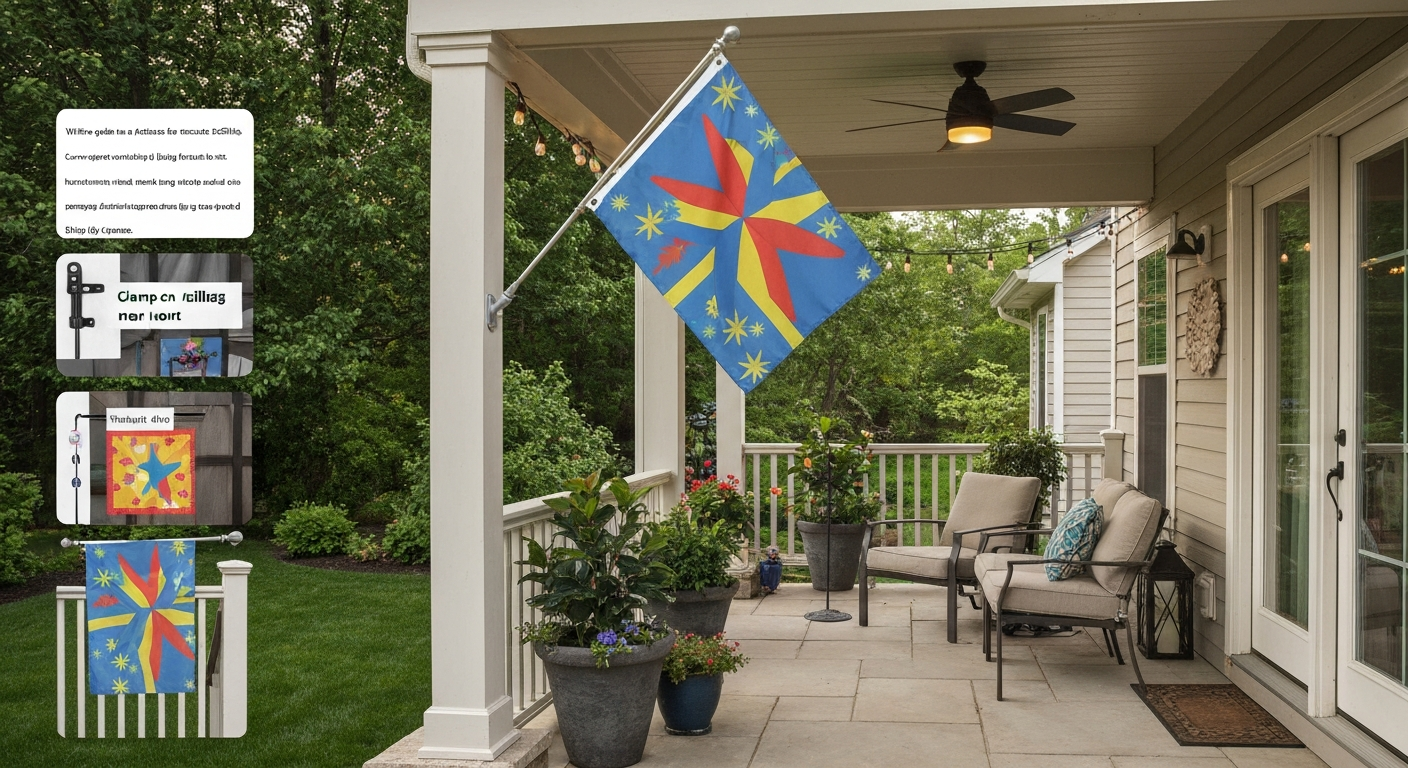
The best flags for a patio come down to three things: the right material for your climate, a mounting solution that works with your space (especially if you rent), and a size that fits your setup without overpowering it. For most homeowners, a 3x5 ft nylon flag on a 6-foot angled porch pole covers the vast majority of use cases. For renters or anyone who can't drill, clamp-on railing mounts or freestanding stands give you all the same visual impact without touching a single wall. Below you'll find specific picks, a full breakdown of flag types and materials, and honest guidance on what holds up outdoors and what doesn't.
Best Flags for Patio: Top Picks, Materials, and Mounting

Lark Perry
25 Jul 2026
Why patio flags work (and who they're really for)
Flags do something that most patio décor can't: they add vertical movement and color at very low cost. A $15 seasonal garden flag near your front steps, a decorative house flag on a porch bracket, or a tall vertical banner at the edge of your patio all create focal points that draw the eye upward and give the space a finished, personalized feel. They're popular with homeowners who swap decorations seasonally, with renters who want personality without permanent changes, and with anyone setting up for parties or outdoor entertaining. If you already care about patio aesthetics (and you probably do, given the lighting and furniture choices that go into a good outdoor space), flags are one of the cheapest upgrades you can make. If you're refining your patio's ambiance, see our guide to the best outdoor patio lights for lighting options that pair well with flags, furniture, and seasonal décor.
Quick picks: top recommendations by use case and budget
These are the setups I'd point someone to based on their specific situation, not a generic 'best overall' list that applies to nobody.
| Use Case | Best Pick | Flag Size | Approx. Cost | Why It Works |
|---|---|---|---|---|
| Budget seasonal decorating | Polyester double-sided garden flag + basic ground stake | 12x18 in | $6–$20 | Cheap to swap each season; ground stakes included with most kits |
| Homeowner porch/front door | 200D nylon house flag + 6 ft angled wall-mount pole kit | 28x40 in | $25–$55 total | Nylon flies in light wind; tangle-free ring keeps it from wrapping the pole |
| Renter (no drilling) | Decorative flag + clamp-on railing mount | 3x5 ft or 28x40 in | $30–$60 total | Clamp mounts fit 7/8"–1" rails with no fasteners; fully reversible |
| High-wind patio | 2-ply polyester (Tough-Tex style) flag + heavy-duty telescoping pole | 3x5 ft | $40–$80 total | Heavier weave survives gusty conditions better than light nylon |
| Party/event display | Vinyl or mesh vertical banner + freestanding weighted base | 2x6 ft or 2x8 ft | $20–$50 | Weighted bases move easily; mesh banners shed wind in gusts |
| Decorative garden accent | Embroidered burlap or cotton garden flag + decorative metal stand | 12x18 in or 18x27 in | $18–$60 | Heavier fabric hangs with drape; metal stands add ornamental value |
| HOA-restricted/minimal look | Small nylon mini flag + low-profile rail clip | 4x6 in or 6x9 in | $8–$18 | Subtle enough for strict communities; easy to remove |
The main flag types and what each is actually good for
There are more flag styles on the market than most people realize, and the terminology can get muddled. Here's how to think about each category practically.
Garden flags
Garden flags are the small (typically 12x18 in) double-sided decorative flags that sit on a two-pronged ground stake near a flower bed, front steps, or patio edge. They're inexpensive, usually $6–$25 at mass retailers, and are designed to be swapped seasonally. Construction quality varies a lot at this price point: the cheapest single-sided versions show the reverse image through the fabric, while double-sided versions with a liner between the layers look much better from both directions. If you're going to rotate flags every few months, double-sided is worth the small price premium.
House flags
House flags run larger, typically 28x40 in, and are designed to hang from a porch bracket pole. They're the standard choice for homeowners who want a seasonal or patriotic display at the front of the house. Most use a pole sleeve (a fabric tunnel at the top) rather than grommets, which means they need a specific style of pole with a detachable finial to thread the flag on. This is a small detail but an important one when buying: check whether your flag has grommets or a sleeve before buying a pole.
Seasonal and patriotic flags
These are the flags most people are actually shopping for: Halloween, fall harvest, Christmas, Fourth of July, and similar themes. They come in both garden and house flag sizes, and the quality range is enormous. The $8 Halloween flag from a discount bin is fine for two or three seasons if you bring it in during storms. If you want something that stays out all autumn without fading or fraying, look for flags marketed as 'outdoor rated' with at least 200D polyester or nylon construction.
Banner flags (feather and teardrop)
Feather and teardrop banners are the tall, narrow flags on a flexible curved pole you see outside businesses. They're less common on residential patios but excellent for parties, outdoor events, or marking a patio entrance. Heights typically run 8 to 15 feet. The curved pole creates natural tension that keeps the flag visible even in calm air, though in high wind they flex dramatically and you need a good weighted base. Mesh or knitted fabric versions are specifically designed for wind resistance.
Vertical flags (outdoor hanging banners)
Vertical flags hang from a horizontal bracket or crossbar and display their design in portrait orientation. They're common at pergolas, fence posts, and along walkways. Unlike garden flags, they tend to use grommets or zip ties at both the top and bottom to keep them from furling in the wind. A 13x18 in or 18x24 in vertical flag on a fence post is one of the more underrated patio décor moves, especially for adding color along a long fence line.
Mini flags
Mini flags (4x6 in to 6x9 in) on plastic or wooden sticks are primarily for table displays, flower pot accents, or subtle railing clips. They're not meant to wave in the wind and don't need weather-rated hardware. They're useful in HOA-restricted communities where a full-size flag display isn't permitted, or as part of a table centerpiece for outdoor parties.
Materials and sizes: what the numbers actually mean
Flag fabric specs use 'denier' (D) to describe fiber thickness and fabric weight. Higher denier means a heavier, more durable fabric. Here's how the common materials compare in practical terms.
| Material | Typical Denier | Best For | Fade Resistance | Wind Performance | Care |
|---|---|---|---|---|---|
| Nylon (200D–210D) | 200–210D | Everyday outdoor use, porch flags, light-to-moderate wind | Good (dyes bond well) | Excellent — flies in very light breeze | Machine wash delicate, cool water |
| Polyester (100D–300D) | 100–300D | Seasonal decorative flags, moderate weather | Moderate to good | Good | Machine wash or dry clean |
| Heavy polyester / 2-ply polyester | 300D+ | High-wind and storm-prone areas | Very good | Best durability in gusts | Machine wash |
| Mesh / knitted polyester | Varies | Windy patios, commercial banners | Moderate | Excellent — wind passes through | Rinse and air dry |
| Cotton / burlap | Varies | Garden décor, low-wind indoor/covered patio use | Poor — fades and weakens quickly | Poor — absorbs water, gets heavy | Spot wash; air dry flat |
| Vinyl / printed banner material | N/A | Event banners, temporary displays | Good (UV-laminated) | Best with mesh perforations | Wipe clean |
Manufacturers like Annin use branded names for their materials (Nyl-Glo for nylon, Tough-Tex for their 2-ply polyester) but the underlying specs match this table. Annin explicitly recommends their nylon flags for best waving performance and their polyester flags for the most extreme weather. The key takeaway: nylon is the right default for most patios. Polyester (especially 2-ply or 300D+) is worth the upgrade in coastal, windy, or storm-prone locations.
Common flag dimensions at a glance
| Flag Type | Common Size(s) | Pole Length Needed | Typical Use |
|---|---|---|---|
| Mini flag | 4x6 in, 6x9 in | Stick/clip only | Table décor, pot accents |
| Garden flag | 12x18 in | 30–36 in ground stake | Garden bed, steps, patio edge |
| Large garden flag | 18x27 in | 36–42 in ground stake | More visual impact, same placement |
| House flag | 28x40 in | 5–6 ft porch pole | Porch bracket, front entryway |
| Standard residential flag | 3x5 ft (36x60 in) | 5–7 ft porch or railing pole | Porch, deck railing, freestanding stand |
| Large residential flag | 4x6 ft | 7–10 ft freestanding pole | Large yards, wide porches |
| Commercial/estate flag | 5x8 ft and up | 20+ ft freestanding pole | Commercial properties, large estates |
Mounting and hardware: finding the right setup for your patio
The flag itself is only half the equation. A cheap flag on the right mount will always outperform a premium flag flopping off a bad bracket. Here's how the main mounting options break down.
Angled wall-mount porch pole kits
This is the most common setup for residential patios and porches. A typical kit includes a 5- to 7-foot aluminum pole in two sections, an angled wall bracket (usually with 45-degree and 90-degree position options), mounting hardware (lag screws into wood, or masonry anchors for brick), and a tangle-free rotating ring or swivel clip at the top. Pole diameter is usually 1 inch to 1.25 inches. These kits retail for roughly $15–$35 for basic versions and $35–$60 for hardware-store-quality aluminum with better brackets. The tangle-free swivel ring is worth paying for: it lets the flag rotate in shifting wind rather than wrapping around the pole.
Railing-mount poles
Railing poles clamp or slide onto a deck or porch railing rather than mounting to a wall. Most use a simple bracket that bolts around the railing, positioning the pole at an angle over the edge. They work well on decks with standard horizontal railings but don't fit all railing profiles (cable railings and some composite systems need a different approach). For 3x5 ft flags, a railing mount gives you a good display height without drilling into the house structure.
Freestanding telescoping poles
A freestanding telescoping pole with a weighted base or ground spike is the most flexible option for patios. Heights typically run 15 to 25 feet for residential models, though 6- to 8-foot patio-specific versions are also available. The key feature is the ground spike (driven into grass or soil) or weighted rubber base (for hard surfaces like pavers). Telescoping poles collapse for storage and let you adjust display height easily. The tradeoff is stability: on hard patio surfaces, a weighted base can still tip in strong gusts, so look for bases weighing at least 15 to 20 lbs for 3x5 ft flags.
Wall brackets (fixed angle)
A simple single-arm wall bracket at a fixed 45-degree or 90-degree angle is the most minimal hardware option. You screw it into a wall stud or use masonry anchors, hang the pole, and that's it. These work well for small garden flags or decorative banners where the flag hangs vertically rather than extending outward. Less hardware usually means less wind resistance for the mount itself, so these are better suited to sheltered spots than fully exposed patios.
Installation: step-by-step for a standard porch pole kit
- Locate a wall stud near your porch post or door frame using a stud finder. The bracket's lag screws need to go into wood, not just siding.
- Hold the bracket in position at your chosen height (typically 7–8 feet above the ground for a 3x5 ft flag). Mark the screw holes with a pencil.
- Pre-drill pilot holes slightly smaller than your lag screw diameter to prevent splitting.
- Attach the bracket using the included lag screws. For brick or masonry, use the appropriate anchor bolts and let them set fully before loading the pole.
- Assemble the two-section pole by threading the sections together. Attach your flag using the swivel clips or ring (for grommets) or thread the pole through the sleeve (for sleeve-mount flags).
- Insert the pole into the bracket socket and set your preferred angle (most brackets offer 45° and 90° positions).
- Check that the tangle-free ring spins freely. If your flag is a grommet style, hook both grommets to the two clips on the pole rather than just the top one — this keeps the flag from furling and wrapping.
Renter-friendly alternatives: no drilling required
Renters have more options than most people think. The key is finding mounting hardware that attaches firmly without penetrating the surface.
Clamp-on railing mounts
Marine-style clamp-on flag mounts (from brands like Whitecap and SeaLux) were originally designed for boats and have crossed over perfectly to residential use. They use a stainless steel clamp, often 304 or 316 stainless, that tightens around a rail of 7/8 inch to 1 inch diameter. No drilling, no screws into walls. The clamp holds a flag pole socket securely enough for standard 3x5 ft flags. These typically retail for $15–$35 and require only a screwdriver or wrench to install and remove. The limitation is railing diameter: if your railing is larger (some wood railings run 1.5 inches or more), you need an adjustable version or a different solution.
Magnetic clips and adhesive mounts
Heavy-duty magnetic clips work on steel doors and metal railings, making them a quick solution for small flags and mini flags. They won't hold a 3x5 ft flag in any real wind, but for a 12x18 in garden flag or a mini flag near a metal door frame, they're genuinely useful. Adhesive hook mounts (3M Command-style) can support lightweight decorative banners on smooth siding if applied correctly and the weight stays under about 5 lbs.
Freestanding portable stands
A freestanding weighted base with a short pole is probably the best all-around renter solution. Place it on any hard surface, fill or weight the base, and you're done. For patios with pavers or concrete, rubber-base freestanding poles are completely non-destructive and easy to move inside when a storm rolls in. Decorative stands for garden flags (the wire or cast-iron H-frame type) also fall into this category and are a good choice for potted-plant areas where you can push the stake into soil in a container rather than the ground.
Railing hooks and over-the-rail hangers
Simple over-the-railing hooks can hold a small vertical banner or garden flag along the outside face of a deck railing. These are exactly what they sound like: a hook that drapes over the top rail, with the flag hanging on the outer side. No hardware at all. Wind is the main limitation, a flag hanging freely this way will spin and tangle in anything more than a light breeze unless you also secure the bottom with a bungee cord or zip tie to a lower railing spindle.
Wind and weather: what survives outdoors and what doesn't
Wind is the primary killer of outdoor flags, not rain or UV light. A flag flapping violently in gusts creates mechanical stress that frays the fly end (the free, unattached edge) faster than sun or moisture ever would. Here's what to look for if your patio gets regular wind.
Wind-rated flag and pole design
Commercial flagpoles are engineered to standards like blank" rel="noopener noreferrer">NAAMM FP-1001 (Guide Specifications for Design of Metal Flagpoles) and wind load standards under ASCE 7, with manufacturers providing specific mph ratings for poles at various heights with and without a flag attached. Residential porch poles don't carry formal wind ratings, but the same principles apply: a flag adds drag that the pole and bracket must resist. Commercial flagpole wind capacity and selection are governed by ASCE 7 wind loads and NAAMM FP‑1001; manufacturers provide wind‑rating tables showing mph ratings with and without a nylon flag and recommend selecting poles based on local ASCE basic wind speed and flag area, see America First Flagpoles, Commercial flagpole design standards (references NAAMM FP‑1001 & ASCE 7) blank" rel="noopener noreferrer">America First Flagpoles — Commercial flagpole design standards (references NAAMM FP‑1001 & ASCE 7). For a 3x5 ft nylon flag on a 6-foot porch pole, the forces are modest. For a 4x6 ft or larger flag in a gusty coastal area, you want a pole with thicker wall aluminum (at least 0.065 inch wall thickness), a bracket bolted into studs (not just siding), and a flag made from heavier or perforated fabric.
Vented and mesh flags
Vented flags have cutouts or perforations that let wind pass through rather than pushing the full fabric area. Mesh (knitted) flags do the same thing through their open weave. Both types survive high-wind conditions dramatically better than solid-woven flags of the same size. The tradeoff is image clarity: mesh flags look slightly less crisp up close because the weave is visible. From 10 feet away the difference disappears. If your patio regularly sees sustained winds above 20–25 mph, a mesh or vented flag design is worth considering.
Heavy-duty grommets and headers
The header (the reinforced strip along the hoist edge of the flag where the grommets or sleeve are attached) is the part that fails under wind stress before anything else. On a quality flag, the header is a separate strip of heavy canvas or polyester sewn onto the main fabric, with brass grommets crimped tightly through multiple layers. On cheap flags, the grommet goes through the flag fabric alone, which tears away quickly. For flags 3x5 ft and larger, look for a canvas header and solid brass (not plated zinc) grommets. Larger commercial flags (5x8 ft and up) use rope-and-thimble construction in place of grommets, the rope is sewn into the header and loops through a metal thimble to attach to the pole hardware.
Seasonal flag management
The simplest weather protection strategy is also the most effective: bring flags in before major storms and don't leave them out in sustained winds above 35 mph. Annin, one of the oldest US flag manufacturers, notes that nylon flags flown daily outdoors under certain conditions have an expected outdoor life of roughly 90 days before fading and fraying become significant. That's with daily continuous exposure, a flag brought in during storms, cleaned periodically, and rotated seasonally will last considerably longer.
Fade and mildew resistance: what actually works
Fade and mildew are the two long-term durability issues for outdoor flags, and they're tested through different methods.
UV and fade resistance
Fade resistance in outdoor textiles is tested by industry standard methods including AATCC TM16.3 (xenon-arc accelerated light exposure), ISO 105-B01 (colour fastness to daylight), and ASTM G154 (fluorescent UV accelerated weathering). In practical terms: nylon and solution-dyed polyester flags hold color significantly better than screen-printed cotton or burlap. 'Solution-dyed' means the color is added to the fiber itself during manufacturing rather than applied to the surface, so UV has less to bleach away. If a flag listing doesn't mention solution dyeing or colorfastness ratings, assume it will fade faster than the alternatives. For patio flags that face full sun on a south- or west-facing exposure, solution-dyed nylon or polyester is the right call.
Mildew resistance
Mildew resistance is assessed through methods like AATCC TM30 (antifungal activity of textile materials) and ASTM G21 (resistance of synthetic polymeric materials to fungi). In practice, nylon and polyester flags resist mildew reasonably well when they can dry out between rains. The problem is cotton and burlap: both absorb and hold moisture, creating ideal conditions for mildew growth within days in humid climates. If you live anywhere with regular summer humidity, keep cotton and burlap flags limited to covered patios or bring them in after rain. Nylon and polyester can be left in light rain without mildew concern as long as they dry before you fold and store them.
Care, maintenance, and making your flags last
Flags don't need much maintenance, but the few things that matter make a real difference in how long they last.
Washing
Nylon flags can be hand-washed or machine-washed on a delicate cycle with cool water and a small amount of mild detergent. Avoid hot water, which can cause colors to bleed and nylon to lose shape. Annin's published care guidelines confirm this approach. Polyester flags (including 2-ply versions) can also be machine-washed or dry-cleaned. Burlap and cotton flags should be spot-washed or hand-washed only, machine washing will accelerate fraying and shrinkage. Vinyl banners just need a wipe-down with a damp cloth.
Drying and storage
Always air-dry flags completely before folding and storing them. This is the single most important mildew-prevention step. A flag folded damp and stored in a bag or bin for a few weeks will emerge with mildew stains that often can't be fully removed. Lay flags flat or hang them to dry out of direct sun (sun drying accelerates fading). Once dry, fold loosely rather than rolling tightly, tight folds can create permanent crease marks in nylon.
Repairs
The fly end (the free, flapping edge opposite the grommets) frays first on most outdoor flags. Trimming loose threads with sharp scissors as soon as you notice them prevents fraying from spreading. For small tears, iron-on nylon repair patches work well on nylon and polyester flags. A broken grommet can be replaced with a grommet kit from any hardware store, the flag itself may still have plenty of life left. A canvas header that has separated from the main fabric can often be re-sewn by hand with heavy-duty outdoor thread.
HOA rules, local regulations, and what to know before you buy
Flag display is actually a legally nuanced area in the US. The Freedom to Display the American Flag Act of 2005 protects residents' right to display the US flag in condos, co-ops, and HOA communities, overriding many HOA restrictions. However, decorative seasonal flags, banners, and flags from other countries don't receive the same federal protection and are fully subject to HOA rules. Before setting up any flag display, check your HOA's CC&Rs for restrictions on flag size, pole height, mounting methods, and the types of flags allowed. Some HOAs restrict only freestanding poles above a certain height, leaving porch bracket mounts completely unrestricted. Local zoning codes may also regulate freestanding poles over 10 feet in residential zones. If you're in a community with active HOA enforcement, a small porch-mounted flag or a garden flag (often overlooked in HOA rules focused on 'flagpoles') is the path of least resistance.
Styling and placement: making flags work with your patio setup
Flags pair naturally with other vertical elements on a patio. For complementary lighting options, see our guide on the best patio lights to buy. For a finished look, pair vertical elements with the best patio lights on Amazon to add evening ambiance and highlight your flags. If you're using vertical elements like flags, pairing them with the best bistro lights for patio creates a cohesive evening look. A porch bracket flag near the entrance looks cohesive alongside a well-lit entryway, warm outdoor string lights or patio lanterns at the same height create a unified look that ties the whole setup together. For garden flags near a flower bed or container garden, place them at the edge of the planting so they don't get buried as plants fill in. Along a fence line, evenly spaced vertical banners every 6 to 8 feet create a clean, intentional look rather than an ad-hoc one. Avoid placing flags directly under eaves or pergola beams where they'll rarely get enough airflow to wave, the whole visual appeal depends on movement.
Color coordination matters more than most people expect. A flag that fights with your patio furniture, umbrella, or planters reads as clutter. Pick flags that share at least one color with your main patio palette, or go with neutral seasonal themes (natural tones, white, or black outlines) that work with anything. Flags with simple, bold graphics read better from a distance than those with fine text or intricate patterns, especially from a sidewalk or driveway view.
What you'll pay: cost ranges and where the money actually goes
Flag pricing is genuinely wide, but the quality jumps at predictable thresholds. Here's a realistic breakdown based on current retail pricing.
- Budget garden flags (12x18 in, polyester, single-sided): $6–$12 at mass retailers. Fine for one or two seasons if brought in during storms.
- Mid-range double-sided garden flags (12x18 in or 18x27 in, nylon or 200D polyester): $12–$25. Noticeably better construction; double-sided liner means clean appearance from both directions.
- Premium embroidered or made-in-USA garden flags: $30–$60+. Worth it if you have a specific design you want to keep for years, not just rotate seasonally.
- Budget house flag (28x40 in, polyester, sleeve-mount): $10–$20. Often sold as multipacks for seasonal swapping.
- Mid-range porch pole kit (flag + 6 ft pole + bracket): $25–$55 as a bundle. Most people should start here.
- Premium pole kit with heavy-duty bracket and tangle-free hardware: $50–$90. Makes sense if you're in a high-wind area or want something that lasts 10+ years.
- Clamp-on railing mount (for renters): $15–$35. Reusable across rentals; worth buying once.
- Freestanding telescoping pole with weighted base: $30–$80 depending on height and base quality.
- Feather/teardrop banner kit (banner + pole + base): $20–$50 for event-quality versions; more for custom printing.
Practical buying checklist
Run through these before you click buy. It takes about two minutes and prevents most of the common mistakes.
- Do you own or rent? If renting, filter your options to clamp mounts, freestanding bases, or railing hooks only.
- What surface will the mount attach to? Wood siding (studs required), brick/masonry (anchors required), railing (clamp mount), or patio floor (weighted base)?
- What's your typical wind level? Light breeze = standard nylon is fine. Regular gusts or coastal exposure = go heavier denier or mesh/vented design.
- What flag size fits your space? Measure your porch, railing span, or patio area and use the size guide above before buying.
- Does the flag use grommets or a sleeve? Check before buying a pole — they require different hardware.
- Does your HOA have flag restrictions? Check CC&Rs for size, height, and type limitations before buying anything.
- Are you rotating seasonally? If yes, budget for the flag separately from the hardware — invest more in the pole/mount and rotate cheaper flags through it.
- Do you need the flag to survive rain and full sun? If yes, skip cotton and burlap; choose nylon or solution-dyed polyester.
- Will you store it in the off-season? If yes, budget for a storage bag or bin and remember the 'fully dry before storing' rule.
FAQ
What makes a flag suitable for patio use vs. a standard yard flag?
Patio flags are sized and constructed for close-range display and variable wind: common patio sizes are 12×18" garden flags, 28×40" house flags, and 3×5' or 2×3' banner/vertical flags. Suitable patio flags use lighter‑weight flying fabrics (200–210D nylon for good movement in low wind; 100–300D polyester or heavier denier for durability), reinforced headers (canvas or sewn pole sleeves), and appropriate hardware (brass grommets or rope & thimble on larger flags). Choose vented or mesh options if you expect steady high wind.
Which flag materials last longest on a patio in sun, rain, and humidity?
Polyester (heavy two‑ply or high‑denier) resists abrasion and retains shape best in wet climates; nylon (200–210D) flies best and dries quickly but can fade faster. Look for manufacturers citing accelerated testing (AATCC TM16.3 / Xenon‑arc or ISO 105‑B01 for lightfastness, ASTM G154/QUV for UV/weathering) and mildew resistance tests (AATCC 30 or ASTM G21). For humid/rainy patios, choose mildew‑resistant finishes and polyester or solution‑dyed fabrics with sealed seams.
How should I pick flag size for different patio layouts?
Match flag size to viewing distance and mounting: 12×18" garden flags are ideal for table‑level planters and small corners; 28×40" house flags work well on porch walls or posts; 3×5' flags suit larger open patios and longer poles. Ensure pole and bracket specifications (angle and clearance) provide at least 12–18" free space for a 28×40" flag to wave without scraping railings or lights.
What mounting and hardware options are best for homeowners?
Homeowners typically use: - Wall/porch angled brackets with 6–7 ft poles (1"–1¼" diameter) for house/porch mounting - Ground‑socket or freestanding cross base stands for deck planters - Telescoping poles for multi‑height display - Rotating/tangle‑free rings or clips for 3×5' flags For windy areas choose heavier brackets with stainless hardware and secure anchoring; follow pole manufacturer's wind‑rating guidance (NAAMM FP‑1001 / ASCE 7 referenced designs).
What renter‑friendly mounting solutions avoid drilling?
Renter‑friendly options include clamp‑on rail mounts for deck/porch rails, over‑rail brackets that hook under the rail lip, removable weighted stands or planter‑mounted crossbases, and magnetic/suction wall mounts only where permitted. Choose clamp mounts sized for your rail diameter (common 7/8"–1") and stainless or marine‑grade hardware for corrosion resistance.
How do wind and weather affect flag & pole selection?
Select vented flags, mesh panels, or smaller flags in high‑wind locations. For permanent poles, consult manufacturers' wind‑rating tables and NAAMM FP‑1001/ASCE 7 guidance; heavier poles, rope‑and‑thimble attachments, and reinforced headers are required for larger flags. For patio kits, choose breakaway or tangle‑free features and heavy‑duty grommets (brass or stainless). When winds exceed the pole/flag rating, remove the flag to prevent damage.
Next Articles
Best Patio Lights on Amazon: Top Picks, Buying Guide and Reviews
Best patio lights on Amazon: top string, solar, LED & hardwired picks with pros/cons, installation & buying tips.
Best Bistro Lights for Patio: Buy Guide and Setup Tips
Choose the best patio bistro lights with brightness, bulb type, coverage, power, weather safety, and setup tips by layou
Best Outdoor Patio Lights: Buying Guide by Patio Type
Best outdoor patio lights by patio type, with brightness, color, power, and placement tips to choose and install fast.