
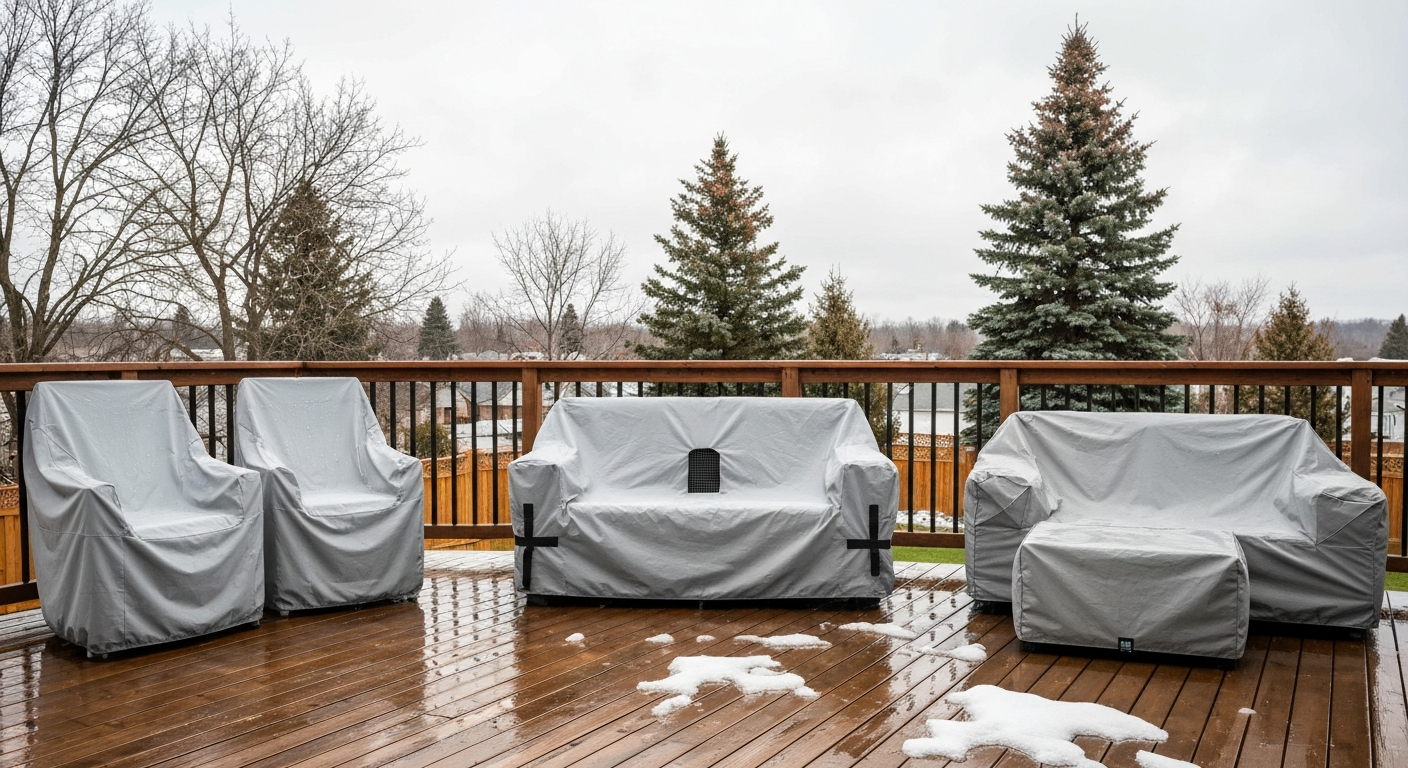
The best patio furniture covers in Canada right now are Classic Accessories Veranda covers for mid-range buyers, Duck Covers for premium protection, and Outsunny 600D Oxford covers from Walmart.ca for budget-conscious shoppers. All three are available across major Canadian retailers like Home Depot Canada, Walmart.ca, and Wayfair Canada. What separates a good cover from a bad one in Canada specifically is not just waterproofing, it is how the cover handles freeze-thaw cycles, heavy wet snow loads, and the kind of persistent coastal rain that does not show up in most American buying guides.
Best Patio Furniture Covers Canada: Top Picks & Buying Guide

Lark Perry
23 Jul 2026
Who this guide is for
If you own or rent a place in Canada with any kind of outdoor patio, deck, or balcony, this guide is written for you. Canadian climates range from the wet, salt-air winters of Halifax and Vancouver to the bone-dry deep freezes of Winnipeg and Calgary, and a cover that handles Florida rain does not automatically survive a Prairie winter. I have tested and researched covers across all three tiers, budget, mid-range, and premium, with Canadian weather specifically in mind. You will find vetted product picks, real buying criteria explained in plain language, step-by-step measuring instructions, and honest guidance on when a standard cover is enough and when you should spend more on a custom fit.
Quick recommendations: best patio furniture covers in Canada
Here are my top picks across three price tiers. For a quick roundup of the best rated patio furniture covers, see our detailed recommendations. Canadian pricing fluctuates by retailer and season, so treat these as reference points rather than fixed numbers. I have focused on brands that ship reliably to Canadian addresses and carry warranties honoured in Canada. For a complete list and buying advice, see our guide to the best outdoor patio furniture covers. For a quick comparison of the best covers for patio furniture, see our roundup.
| Tier | Brand / Model | Material | Where to Buy (Canada) | Approx. CAD Price | Best For |
|---|---|---|---|---|---|
| Budget | Outsunny 600D Oxford Cover | 600D Oxford + PE coating | Walmart.ca | $25–$55 | Apartment balconies, seasonal use, chairs and small sets |
| Budget | King Do Way Patio Furniture Cover | 210D/420D Oxford + PU coating | Amazon.ca | $20–$50 | Single chairs, small tables, light-duty seasonal use |
| Mid-Range | Classic Accessories Veranda Cover | WaterShield polyester + UV-treated coating | Home Depot Canada, Amazon.ca | $60–$120 | Sofas, loveseats, dining sets, year-round use |
| Mid-Range | Backyard Basics Patio Cover | Oxford polyester, reinforced handles | Canadian Tire, Amazon.ca | $45–$90 | Standard furniture shapes, deck sets, moderate climates |
| Premium | Duck Covers Elite Cover | Repreve recycled polyester, vented | Home Depot Canada, Wayfair.ca | $100–$200+ | Large sectionals, year-round heavy-weather use |
| Premium | Wayfair 1000D PVC-Coated Sectional Cover | 1000D polyester + PVC laminate | Wayfair.ca | $130–$250+ | Large sectionals, coastal and high-snow regions |
A note on Backyard Basics and King Do Way
Backyard Basics covers are a solid mid-range choice for Canadian shoppers who want something widely available at Canadian Tire without overthinking the purchase. The Oxford polyester construction handles moderate rain well and the reinforced handles make pulling covers on and off in cold weather much easier than flimsy alternatives. King Do Way is a value-tier brand available on Amazon.ca that uses 210D to 420D Oxford fabric with a polyurethane coating. For the price, the fit and stitching are decent, but I would not rely on King Do Way covers for year-round exposure in harsher Canadian climates. They are a good seasonal cover or a backup for secondary furniture pieces. If you want a deeper look at how King Do Way compares against other brands in the same price range, that comparison is worth exploring separately. Similarly, if you are focused purely on finding the best-rated options regardless of where you live, the broader patio furniture cover landscape has more options worth considering.
Materials and construction: what the specs actually mean
Most patio furniture covers list a denier (D) number, a fabric type, and some kind of coating. Denier refers to the thickness of the individual fibres: a 210D fabric is lighter and less abrasion-resistant than a 600D fabric, which in turn is lighter than a 1000D cover. For Canadian conditions, I would not go below 300D for anything left outdoors through autumn and winter. A 600D Oxford polyester with a polyurethane (PU) or polyethylene (PE) coating is the practical minimum for year-round use.
Coating matters as much as denier. PU coatings bond better to the fabric and tend to resist cracking in cold temperatures, which is directly relevant if your cover is going to experience -20°C nights in Edmonton or Quebec City. PE coatings are cheaper and generally less cold-weather flexible. PVC-laminated fabrics (found on premium 1000D covers) are the most waterproof option available but they add weight and can crack at extreme low temperatures if the material quality is poor. Seams are where most covers fail first: look for double-stitched seams at a minimum, and taped or welded seams if you want genuine waterproof performance rather than just water resistance.
- 210D–300D Oxford: light duty, seasonal use only, acceptable for balcony chairs stored under an overhang
- 420D–600D Oxford with PU/PE coating: good all-purpose choice for most Canadian buyers, handles rain and light snow
- 1000D polyester or PVC-laminated fabric: heavy-duty, best for large sectionals and high-snow or coastal regions
- Taped seams: a strip of waterproof tape is bonded over the stitch line from the inside, preventing water from wicking through needle holes
- Welded seams: heat-bonded, no needle holes at all, the most waterproof option but less common in standard retail covers
- Double-stitched seams: stronger than single stitch but not inherently waterproof — water will still wick through thread holes without additional sealing
Waterproofing vs. breathability: the tradeoff Canadian buyers need to understand
This is the most misunderstood aspect of patio covers and it matters especially in Canada. A fully sealed, non-breathable cover will keep rain out, but it also traps moisture underneath. Condensation builds up on cool mornings, furniture fabric stays damp, and over a season you end up with mildew on cushions even though the cover technically never leaked. The industry uses two main lab standards to measure this: blank" rel="noopener noreferrer">ISO 811 for hydrostatic head (how much water pressure a fabric resists before leaking) and ASTM E96 for Moisture Vapor Transmission Rate (MVTR), which measures how quickly water vapour escapes through the material. A blank" rel="noopener noreferrer">review discussing ISO 11092 and MVTR/RET metrics (journal summary) notes that ISO 11092 (sweating guarded‑hot‑plate) and related RET methods quantify evaporative resistance and comfort, which is relevant when assessing breathable versus non‑breathable covers. A cover with a high hydrostatic head but near-zero MVTR is waterproof but not breathable. Ideally, you want both.
The practical solution most quality covers use is air vents, usually small mesh-covered openings near the bottom hem. Duck Covers Elite, for example, includes patented air vents that allow moisture vapour to escape without letting rain in from the sides. These vents make a genuine difference in real-world use, I have had cushions develop mildew under cheaper non-vented covers in Vancouver's wet winters and never had the same issue under a well-vented mid-range cover. If a cover does not mention vents, assume it is a sealed system and plan to remove it periodically during dry spells to let furniture breathe.
UV resistance is a separate but equally important property. AATCC TM16 (colorfastness to light) and ASTM G154 (accelerated UV weathering) are the lab tests manufacturers use to validate UV claims. In practical terms, look for covers described as UV-treated, UV-stabilized, or rated to a specific number of hours under accelerated UV exposure. In Canada, UV load is highest in July and August, particularly at higher elevations and in the Prairie provinces. A cover that fades and degrades within one summer is not protecting your furniture, it is creating a secondary cleanup problem.
Closures, straps, and wind-securement features
A cover that blows off in a windstorm is not protecting anything. Canadian spring and fall storms regularly produce gusts above 60 km/h in coastal and Prairie regions, so wind securement is not optional. The main closure systems you will encounter are elastic hem cords (drawstrings with cinch locks), adjustable straps with buckles that pass under furniture legs, and click-close or snap buckles that fasten under the piece. Elastic hem cords alone are the weakest system, fine for sheltered balconies, inadequate for exposed decks. Strap-and-buckle systems are significantly more reliable.
For coastal buyers in Nova Scotia, BC, or PEI, hardware quality matters too. Buckles, D-rings, and zipper pulls on cheaper covers are often uncoated zinc or low-grade plastic that corrodes or becomes brittle within one season of salt-air exposure. ASTM B117 is the neutral salt spray test used to rate hardware corrosion resistance. You likely will not see this spec listed on retail product pages, but it is a reason to favour covers from brands that use stainless steel or UV-stabilized polypropylene buckles rather than bare metal. Duck Covers and Classic Accessories both use better hardware than most budget brands.
- Elastic hem cord with cinch lock: minimum acceptable, good for sheltered spots only
- Adjustable strap with buckle passing under furniture legs: reliable for moderate wind, easy to use with gloves on in cold weather
- Velcro side-cinch tabs: useful for fine-tuning fit but degrade with UV exposure over time
- Snap buckles or click-close fasteners: fast to operate, but low-quality plastic versions crack below -10°C
- Stainless steel or coated hardware: worth prioritising in coastal, high-humidity, or freeze-thaw regions
How to measure your patio furniture for a cover
Most cover sizing failures come from measuring the wrong dimensions. Manufacturers dimension covers by length x width x height, and they expect a few inches of clearance. Here is how to measure each common furniture type.
- Single chair: measure the widest point across the arms (width), front-to-back depth at the deepest point including any leg overhang (depth), and floor-to-top-of-back height. Add 2–3 inches to each dimension to allow for easy on/off.
- Loveseat (2-seat sofa): same approach as a single chair but measure the full width across both arms. Many loveseats are 52–60 inches wide. If armrests flare, measure at the widest flare point.
- Sofa (3-seat): typically 72–84 inches wide. Measure at the widest point including any pillow overhang if cushions will be left in place under the cover.
- Dining table: measure the longest diagonal for round tables (this is the effective maximum dimension), or length x width for rectangular. Add at least 4 inches per side for drop coverage.
- Dining set (table + chairs): measure with chairs pushed fully in or slightly out depending on how you plan to store them. Push chairs in and measure the full assembled footprint length, width, and the height of the tallest chair back.
- Sectional: measure each piece individually first, then measure the full assembled L-shape or U-shape by its bounding rectangle (longest leg x longest leg). Note that most standard covers will not fit true sectionals well — see the custom covers section below.
- Chaise lounge: measure flat length, widest point (usually the footrest), and height at the back. If the back reclines, measure with it in the fully upright position.
- Fire pit or side table: measure the widest diameter (for round) or diagonal (for square/rectangular) and height. Add 3–4 inches for safe clearance around heat-affected surfaces.
A general rule: size up rather than down. A cover that is 3 inches too long on each side creates a small amount of pooling risk at the hem, which you can manage with a proper strap system. A cover that is 2 inches too short will not close properly, will expose legs and lower frames to moisture, and will eventually tear at the hem from being stretched.
When a custom cover is worth the extra cost
Standard sized covers work for the vast majority of furniture, but there are situations where off-the-shelf options simply do not fit well enough to provide real protection. Built-in furniture, bench seating framed into a deck structure, permanent corner sofas, or custom-built dining tables, rarely matches standard cover dimensions closely enough. If you are dealing with irregular shapes, furniture that cannot be moved or disassembled, or high-end pieces where protection is genuinely critical to long-term value, custom covers are worth the investment.
Custom covers are also a smart long-term play for furniture that will stay in place for many years. A custom cover made from commercial-grade fabric (typically 600D or heavier with taped or welded seams) will outlast two or three cycles of budget standard covers and provide better fit throughout. The cost premium for a custom cover depends heavily on size and fabric choice, but for large sectionals or built-in pieces, expect to spend $200–$600 CAD for a quality custom-made option from a Canadian outdoor canvas shop. That cost-benefit calculation changes depending on the value of the furniture underneath. If the furniture cost $3,000 and a custom cover adds $300 in protection, that is a straightforward decision.
If you are dealing with complex shapes that are just slightly outside standard sizing, it is worth exploring what the best custom patio furniture cover options look like before committing to an ill-fitting standard cover. A poor fit creates its own problems: pooling water at low spots, wind lift at loose edges, and chafing damage on sharp corners.
Canadian climate guide: matching your cover to your region
Canada does not have one climate, it has at least six meaningfully different outdoor furniture cover challenges depending on where you live. Environment and Climate Change Canada publishes Climate Normals by station, and the differences are dramatic: Vancouver gets roughly 1,150 mm of rain per year with mild temperatures but almost no snow at sea level; Winnipeg gets only 520 mm of precipitation but endures temperatures below -30°C and significant snow accumulation. Your cover needs change substantially based on which end of that spectrum you are on.
Rain and heavy downpours
British Columbia's Lower Mainland, Vancouver Island, and Atlantic Canada (particularly Halifax and Saint John) deal with sustained, heavy rainfall for months at a time. In these regions, waterproof performance is the primary spec to prioritise. Look for a hydrostatic head rating of at least 1,500 mm, ideally 2,000 mm or higher, and taped or welded seams. A cover marketed as water-resistant rather than waterproof typically passes a 500–800 mm hydrostatic head test, which is enough for light showers but not for the sideways rain that shows up in a Pacific coastal storm. Venting becomes critical here too: with persistent moisture in the air, non-vented covers will trap condensation and create mildew problems on cushions within weeks.
Snow and ice buildup
Quebec, Ontario, Alberta, and Saskatchewan all see significant snow accumulation. The National Building Code of Canada publishes ground snow load values by region, cities like Montreal face design snow loads around 3.0 kPa, while parts of Newfoundland exceed 5.0 kPa. Patio covers are not structural, but the practical point is that heavy wet snow (common in coastal and transitional zones) adds significant weight to a cover. A flat-lying cover over a dining table can accumulate 30–50 kg of wet snow in a single storm. This is where cover material strength and seam integrity matter: cheap stitching tears under this kind of load. For snow-heavy regions, choose heavier denier fabrics (600D or above), look for reinforced corner gussets, and make sure the furniture underneath can support the combined weight. When possible, sweep snow off covers rather than leaving it to melt and refreeze.
Freeze-thaw cycles
Freeze-thaw cycles are arguably the most damaging climate condition for cover materials and hardware. In cities like Ottawa, Toronto, and Edmonton, temperatures regularly swing above and below zero multiple times per week during spring and fall. Water trapped in cover fabric or accumulated under a poorly fitted cover freezes, expands, and then thaws repeatedly. This degrades coatings, cracks stitching, and embrittles buckles and snap closures. For these regions, PU coatings outperform PE coatings in cold-weather flexibility, and strap hardware made from UV-stabilized polypropylene or stainless steel holds up better than bare zinc or cheap plastic. Avoid covers with thin PVC laminate in extreme cold, standard PVC becomes brittle below -15°C and will crack at fold points.
Coastal salt air and corrosion
If you live within a few kilometres of saltwater, which applies to large portions of BC, Nova Scotia, New Brunswick, PEI, and Newfoundland, salt air accelerates corrosion on every metal component of your cover. ASTM B117 salt spray testing is the standard used to rate hardware corrosion resistance, and it is a meaningful differentiator in this context. Prioritise covers with non-metallic closures (UV-stabilized plastic buckles) or stainless steel hardware over bare zinc or chrome-plated metal. Rinse covers with fresh water a few times per season to remove salt deposit buildup, and check hem grommet eyelets (often the first thing to corrode) each spring. Fabric-wise, a tight-weave outer layer with a full-coverage PU coating gives salt air less opportunity to degrade the underlying fibres.
Where to buy in Canada and what to know about warranties
The most reliable Canadian retail channels for patio furniture covers are Home Depot Canada (strong Duck Covers and Classic Accessories selection, in-store availability from spring through fall), Canadian Tire (Backyard Basics and private-label covers, good for in-person sizing checks), Amazon.ca (widest SKU selection, fastest delivery, but sizing descriptions vary in accuracy across third-party sellers), Walmart.ca (competitive pricing on 600D Oxford covers from brands like Outsunny), and Wayfair.ca (best selection of large-format and heavy-duty premium covers, particularly for sectionals). Most of these retailers offer free or low-cost returns on patio covers, which matters because fit is the number-one reason for returns.
On warranties: Classic Accessories (which also covers the Duck Covers brand) publishes a clear Out-of-Box warranty that includes replacement or refund for manufacturing defects, with specific exclusions for misuse and what they classify as environmental hazards. Importantly, the warranty is non-transferable and applies to the original purchaser only. The practical takeaway is that most brand-name cover warranties cover material defects and seam failures, but they do not cover UV degradation over multiple seasons or damage from improper use, including leaving a cover on furniture that sits in pooled water, which is one of the most common real-world failure scenarios I have seen. Keep your purchase receipt, register your product if the brand offers registration, and document any defects within the first season.
Installation, securing tips, and seasonal maintenance
Putting a cover on correctly sounds simple but there are a few things that consistently cause premature failure. First, never cover furniture with wet cushions. Even the most breathable cover will trap moisture if you seal it over soaked fabric. Give cushions at least a few hours of air drying before covering, or bring them inside if rain is coming and they are already damp. Second, position the cover so there is no low point where water can pool. If the cover sags in the middle over a table, that pooling point creates constant pressure on the seam or fabric, eventually causing failure. Adjust the fit or add a simple foam pool-noodle under the cover at the lowest point to create a slope for runoff.
For wind securement, use all available straps every time, not just when a storm is forecast. Covers that flap repeatedly in moderate wind cause abrasion damage to both the cover and the furniture underneath, and partially secured covers act like sails, creating lift forces that can damage furniture. If your cover only has an elastic hem cord, consider adding aftermarket bungee tie-downs passed under furniture legs for extra security.
At the end of the outdoor season (typically October to November depending on your region), clean covers before storing them. A mild soap and water wipe-down removes mold spores, salt deposits, and debris that would degrade the coating over the off-season. Let covers dry completely before folding, storing a damp cover folded in a bag is the fastest way to destroy the coating. Store covers loosely folded or rolled (not compressed tightly) in a dry space away from rodents, which are attracted to the fabric for nesting material. At the start of the following season, do a quick seam check and look for any coating delamination before relying on the cover for another year.
Real-world performance expectations and cost-benefit reality
A $30 budget cover used carefully and seasonally in a moderate climate can last three to five years. A $30 budget cover left outdoors year-round in Vancouver or Halifax will likely show coating breakdown and seam failure within two seasons. A $150 premium cover used correctly in a harsh climate will likely give you five to eight years of reliable protection. The math usually favours spending more once, particularly when you are protecting furniture that cost $1,000 or more. Where budget covers genuinely make sense is for secondary furniture, balcony chairs stored under a roof overhang, or short-term rental situations where you cannot justify premium spend.
One honest limitation worth naming: no patio cover eliminates all maintenance. Even the best covers benefit from being removed on dry sunny days occasionally to let furniture air out, and no cover fully replaces the need to bring cushions inside for winter storage in regions with heavy snow and freeze-thaw cycles. Covers protect frames, tabletops, and woven materials well, they protect foam cushions and fabric only in conjunction with proper ventilation. If protecting cushions specifically is a priority, that is a parallel consideration worth researching alongside your cover choice.
The broader principle that applies across all outdoor furniture protection decisions, covers, shade solutions, or even protecting electronics like outdoor speakers on your patio, is that fit, material quality, and correct installation do more work than brand name alone. Buy the right size, secure it properly, and clean it between seasons, and almost any mid-range cover from a reputable brand will serve you well through a Canadian winter.
FAQ
Which Canadian climate datasets should be used to tailor cover recommendations by region?
Use Environment and Climate Change Canada (Canadian Climate Normals) and NBCC snow/wind station locators to map precipitation, temperature ranges, freeze–thaw cycles and regional snow‑load/wind exposure; supplement with coastal salinity maps and local municipal meteorological data for microclimates.
What material performance standards must be checked to verify waterproofing and breathability claims?
Reference ISO 811 (hydrostatic head) for waterproofness and ASTM E96/E96M (MVTR/WVTR) plus ISO 11092/RET metrics for breathability and condensation risk; obtain third‑party lab reports (SGS, Intertek) that show these test results.
Which tests are relevant for UV and weathering durability of cover fabrics and coatings?
Use AATCC TM16 (colorfastness to light) and ASTM G154 accelerated UV/weathering (QUV) results to assess fabric/coating UV resistance and expected fade/coating breakdown over time.
How should hardware and fasteners be vetted for coastal salt‑air corrosion?
Require ASTM B117 (neutral salt spray) test data or corrosion‑resistance specs for buckles, zippers, D‑rings and anchor hardware; look for stainless‑steel (316) or coated hardware with documented test reports for coastal buyers.
What retail and marketplace sources must be surveyed for Canadian availability, SKUs and pricing?
Survey Canadian retailers and marketplaces: Home Depot Canada, Walmart Canada, Wayfair Canada, brand Canadian sites (e.g., Classic Accessories), and leading specialty outdoor retailers to capture SKU, CAD pricing, stock/fulfillment, shipping and warranty/return terms.
Which manufacturer warranty and return policy details are essential to document?
Collect manufacturer warranty pages and retailer return policies that specify warranty length, coverage (material/coating failures, workmanship), exclusions (misuse, environmental damage), remedies (repair/replace/refund), proof requirements, and any non‑transferability or registration steps.
Next Articles
Best Custom Patio Furniture Covers: Fit, Materials, and Care
Measure, choose, and care for custom patio furniture covers with the right fit, materials, and wind and UV protection.
Backyard Basics Patio Furniture Covers: Fit, Material, Wind
Measure, choose materials, and add wind control for patio furniture covers that protect against rain, sun, mildew.
Best Outdoor Patio Furniture Covers: Buy Guide and Sizes
Choose the best outdoor patio furniture covers: materials, climate features, and exact sizing for sets, chairs, and tabl