
The best outdoor oscillating fan for most patios right now is a wet-rated pedestal fan with a 16- to 24-inch blade span, at least three speed settings, and a rust-resistant motor housing. If you want a quick shortlist, compare the best outdoor floor fans for patios by blade size, UL wet or damp rating, and how much coverage you need outdoor oscillating fan. Something like the Misting Direct MDPF24ORB (a 24-inch UL-listed wet-location pedestal fan) covers the sweet spot: enough airflow for a mid-size patio, safe for exposed outdoor use, and priced under $200. But the right pick depends on how big your space is, how exposed it is to rain and humidity, and whether you want a fan you can move around or one that stays put. This guide walks through everything so you can match the right fan to your actual setup.
Best Outdoor Oscillating Fan for Patio: Buying Guide

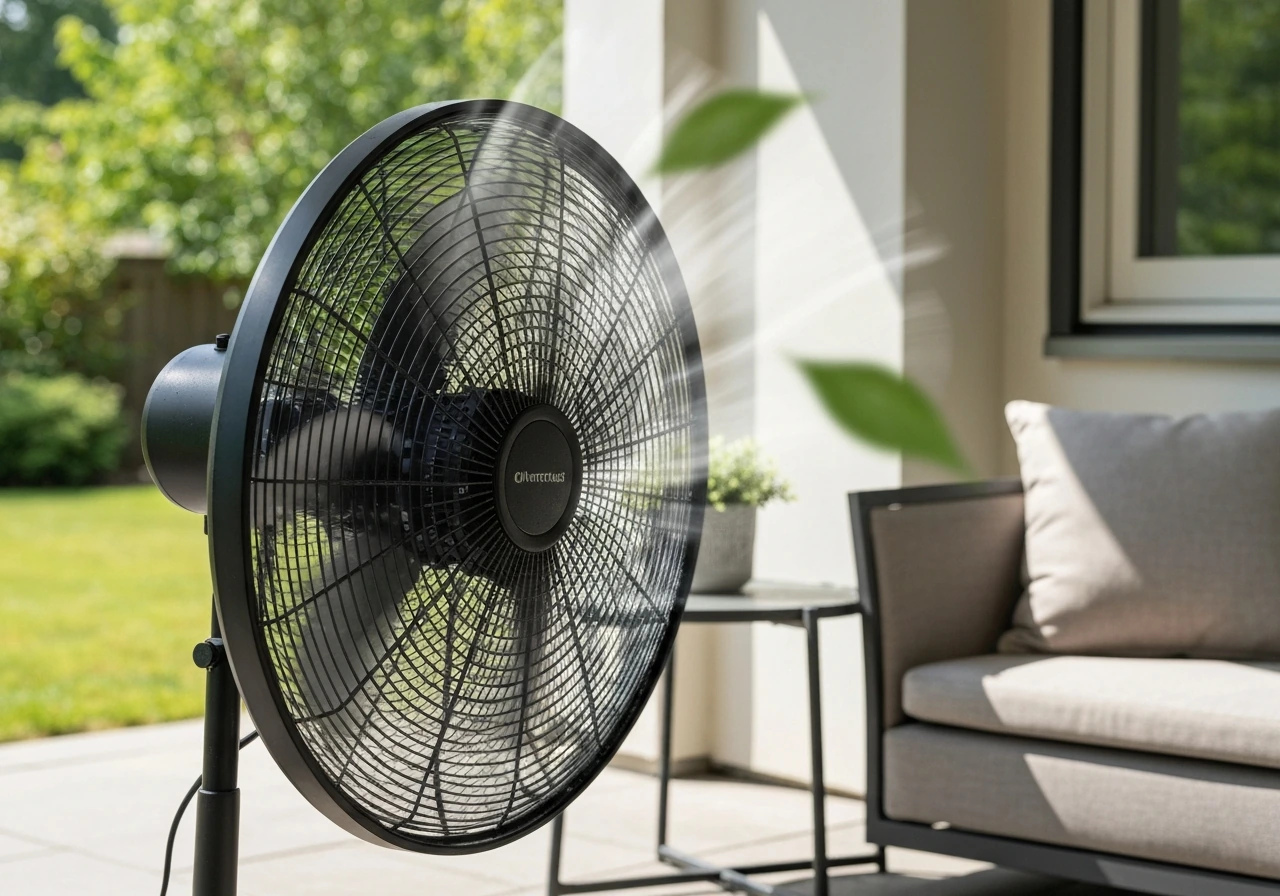
Outdoor fans have different rules than indoor fans
A fan that works great in your living room will rust, short out, or become a fire hazard on an exposed patio within a season. Moisture is the main enemy, and not just rain. Humidity, morning dew, splashback from a nearby pool or fountain, and even condensation can all get into an unrated motor. That is why the first thing to check on any fan you are considering for outdoor use is its location rating.
UL (Underwriters Laboratories) blank" rel="noopener noreferrer">defines a wet location as any place where water or liquids may drip, splash, or flow on or against the equipment. For fans, this plays out as two tiers: damp-rated and wet-rated. A damp-rated fan is meant for covered outdoor areas where rain never directly hits the unit, like a deep covered porch or a fully enclosed pergola. A wet-rated fan is built for direct rain exposure and is what you want for any open or semi-open patio situation. Both ratings fall under UL 507, the specific safety standard for electric fans, which includes water-spray and corrosion testing. If a fan is not explicitly marked as wet-rated or damp-rated, assume it is indoor-only and skip it.
Beyond the UL rating, look at the motor housing material. Die-cast aluminum and UV-stabilized ABS plastic both hold up well. Powder-coated steel works too, but only if the coating is intact. Bare steel or chrome hardware on blades and stands will show rust within one summer in humid climates. Some newer fans use an IP rating (like IP44) alongside their UL listing. IP44 means the motor is protected against solid objects larger than 1mm and against water splashing from any direction. That is a meaningful standard for patio use, especially if your setup gets afternoon rain.
Which type of fan actually works for a patio
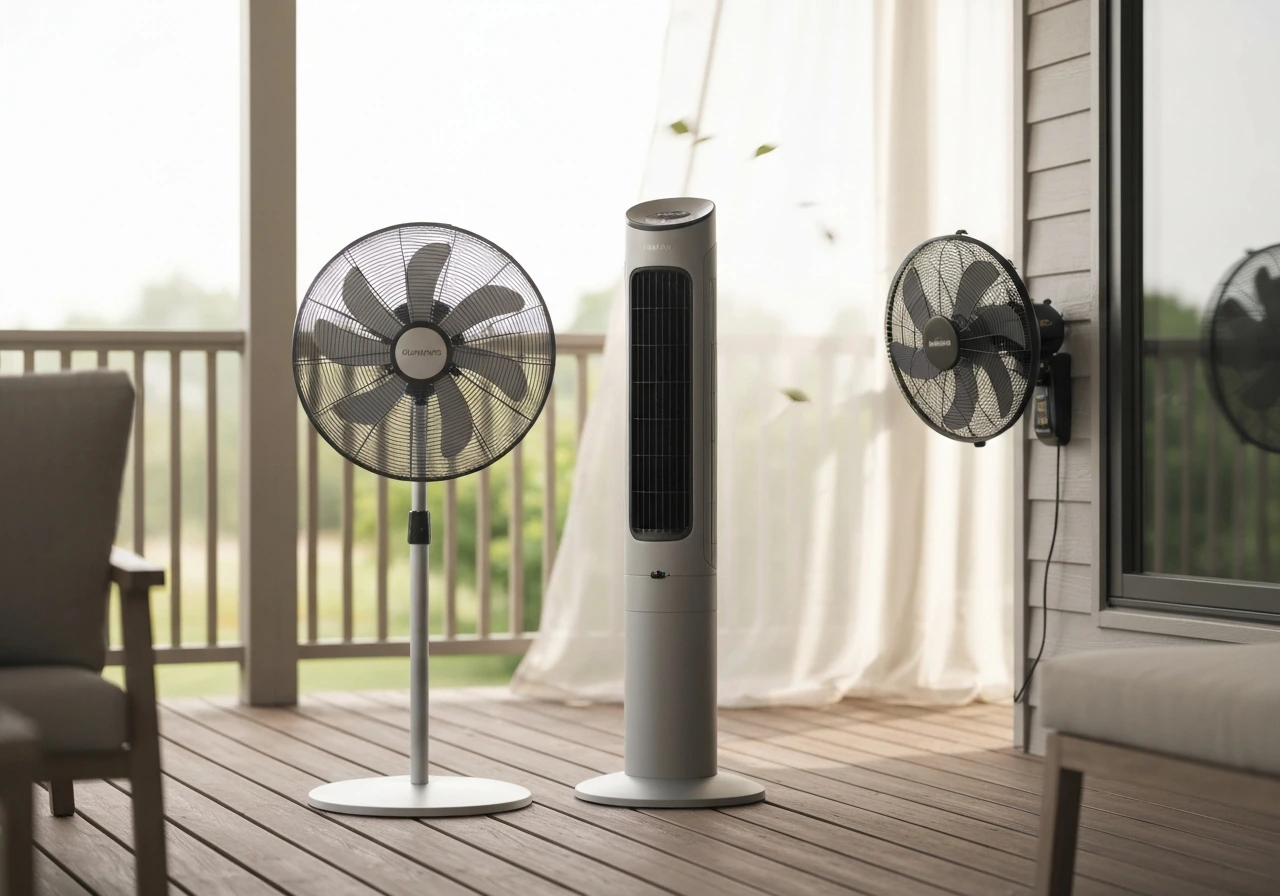
Oscillating fans for patios come in a few formats and they are not interchangeable. The format you choose shapes where the airflow goes, how easy the fan is to move, and how well it handles the scale of an outdoor space.
Pedestal (stand) fans
Pedestal fans are the workhorses of outdoor fan setups. They sit on an adjustable stand, oscillate side to side, and can be moved wherever you need them. For a patio, this is almost always the most practical choice. You can reposition them as the sun moves or as the seating arrangement changes. A quality outdoor pedestal fan on a 24-inch blade will push 3,000 to 5,000 CFM (cubic feet per minute) of air, which is enough to make a 200- to 300-square-foot seating area noticeably more comfortable. The main downside is that they tip in wind, so you need a weighted or wide-base model for exposed patios.
Tower fans
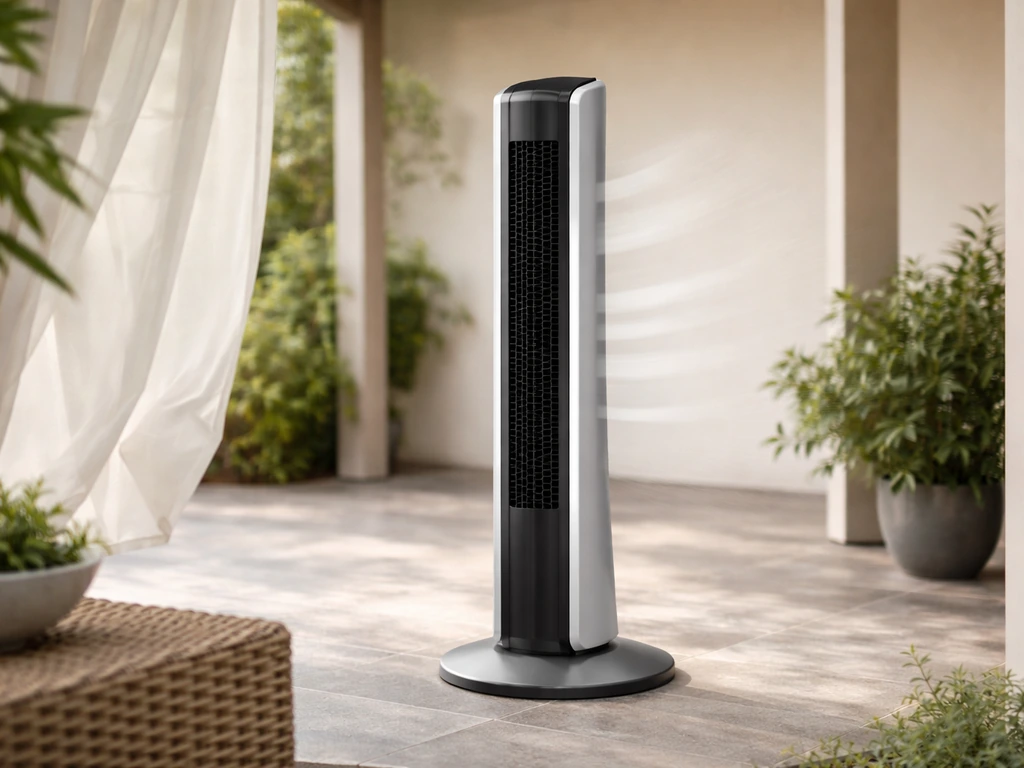
Tower fans have a sleeker profile and a lower center of gravity, which makes them more stable in wind than tall pedestal fans. The tradeoff is airflow: most tower fans max out around 1,500 to 2,000 CFM, which works for a small seating nook but struggles in a larger open patio. Genuinely wet-rated tower fans are also harder to find than wet-rated pedestal fans, so check the rating carefully before buying. If aesthetics matter and your patio is compact, a wet-rated tower fan is a reasonable pick.
Wall-mount and ceiling-style fans
Wall-mount oscillating fans are great when you have a pergola post, fence, or exterior wall to attach to. They keep the floor clear, aim airflow precisely, and stay put even in wind. The oscillation range on wall-mount fans varies a lot, from 90 degrees on cheaper models to 180 degrees on better ones. Outdoor patio ceiling fans with lights are in their own category (and worth a separate look if you have a covered patio with overhead clearance), but they do not oscillate in the traditional sense. For this guide, the focus stays on oscillating stand, tower, and wall-mount fans.
Sizing the fan to your patio
Outdoor spaces do not contain air the way a room does, so traditional CFM-per-square-foot formulas from HVAC work only as rough starting points. Think of it less like cooling a sealed space and more like creating a wind corridor: you want the airflow strong enough that people sitting in the zone actually feel it as moving air against their skin, not just as a slight breeze.
A general rule that works well in practice: a 16-inch fan handles up to about 150 square feet of seating area comfortably. A 20-inch fan covers 150 to 250 square feet. A 24-inch or larger fan is what you want for patios over 250 square feet or any space that is more open and exposed. If you have a large patio, say 400 square feet or more, two mid-size fans placed strategically will outperform one giant fan. Oscillation matters here too: a fan covering a 90-degree sweep will cool a focused zone, while a 180-degree sweep covers a wide seating area without you having to constantly redirect the fan.
| Patio Size | Recommended Blade Size | Target CFM | Fan Type |
|---|---|---|---|
| Up to 150 sq ft | 16 inches | 1,500–2,500 CFM | Pedestal or tower |
| 150–250 sq ft | 20 inches | 2,500–4,000 CFM | Pedestal or wall-mount |
| 250–400 sq ft | 24 inches | 4,000–5,500 CFM | Pedestal (heavy base) |
| 400+ sq ft | 24 inches x2 or 30 inches | 5,500+ CFM | Two pedestal fans or industrial pedestal |
Also factor in sun exposure. A south-facing patio that bakes in afternoon sun needs more airflow than a shaded north-facing one, even at the same square footage. If you are also fighting heat radiated from a concrete or tile surface, size up one category from the table above.
What actually separates a good outdoor oscillating fan from a mediocre one
Once you have the size and rating dialed in, these are the features that separate a fan you will love from one you will replace after one summer.
- Oscillation range and smoothness: Look for at least 90 degrees of sweep. 120 to 180 degrees is better for wider seating areas. The oscillation motor should feel smooth, not clunky or herky-jerky, which is a sign it will fail early outdoors.
- Speed settings: Three speeds is the minimum. Five or more speeds gives you much finer control for different times of day and activity levels. Remote control or a built-in timer adds real convenience.
- Noise level: Outdoor fans run louder than indoor fans because they move more air, but good ones stay under 55 dB on their highest setting. At low speed, anything under 45 dB will let you have a normal conversation without raising your voice.
- Airflow (CFM): Always check the actual CFM rating, not just the blade size. Two 24-inch fans from different brands can differ by 1,500 CFM or more. Higher CFM at the same noise level is a sign of a better blade pitch and motor design.
- Power draw: Most quality outdoor oscillating fans run between 70 and 150 watts. If you are running a fan several hours a day all summer, a 100W fan will cost noticeably less than a 150W fan. Look for an energy-efficient motor, often labeled as EC (electronically commutated) on higher-end models.
- Stability: For pedestal fans, the base matters. A wide-leg tripod or a weighted round base is far more stable in outdoor wind than a narrow single-column base. Some fans include stake anchors for grass or deck mounts for hardwood patios.
- Cord length and plug type: Outdoor-rated fans should have a polarized or grounded plug and ideally a cord of at least 6 feet. Shorter cords force you to place the fan near the outlet rather than where it is most effective.
The top picks for most patio setups
These recommendations are based on features, real-world performance data, and what actually holds up in outdoor conditions. Prices shift seasonally, so treat ranges as a guide, not a guarantee.
| Category | Fan | Blade Size | Key Features | Price Range |
|---|---|---|---|---|
| Best Overall | Misting Direct MDPF24ORB | 24 inches | UL-listed wet location, 3-speed, rust-resistant, solid oscillation | $160–$200 |
| Best for Large Patios | WOCK HICFM 30" Outdoor Oscillating | 30 inches | IP44 motor, UL listed, high CFM output, misting-ready | $220–$280 |
| Best Quiet Pick | Honeywell HT-900 (Outdoor-rated variant) | 16 inches | Low noise profile (~45 dB low speed), compact, 3-speed | $80–$110 |
| Best Budget | Genesis G16 Outdoor Stand Fan | 16 inches | Damp-rated, adjustable height, 3-speed, under $60 | $45–$65 |
| Best Wall-Mount | iLIVING ILG8SF24V-T | 24 inches | Variable speed, wall-mountable, 180-degree oscillation, wet-rated | $175–$220 |
Best overall: Misting Direct MDPF24ORB
This is the fan I point most people toward first. It is explicitly UL 507 rated for wet and damp locations, comes on a 24-inch blade, and is built to handle the kind of casual outdoor abuse a residential patio delivers. The oscillation is smooth and covers a wide arc, the height is adjustable, and the rust-resistant finish holds up well in humid environments. At around $160 to $200, it is not the cheapest option, but it is the one least likely to cause regret after one rainy summer.
Best for large patios: WOCK HICFM 30-inch Misting Fan
If you have a sprawling patio or a covered outdoor entertaining space, the 30-inch WOCK fan with its IP44 motor is hard to beat. The misting capability is a bonus for hot climates (though you can run it dry if you prefer). The high CFM output on this one actually pushes air across a wide zone, and the IP44 motor rating means rain and splashback are not a concern. Budget closer to $250 for this one.
Best quiet pick for conversation-friendly patios
If you host dinners or have neighbors close by, noise matters. A 16-inch fan running at low speed in the 40 to 45 dB range lets you have a full conversation without shouting. The Honeywell HT-900 line has outdoor-rated variants that fit this profile well. You give up some raw airflow compared to the 24-inch options, but for a small to mid-size covered patio where you want gentle circulation rather than a wind tunnel, it is the right trade.
Best budget pick under $65
The Genesis G16 or similar 16-inch damp-rated stand fans from budget brands are genuinely decent for covered patios. The key word is damp-rated, meaning you should not leave it out in direct rain. But for a screened porch, a covered pergola, or a patio where you bring the fan in when it rains, these work fine and are easy to replace if one does not last. Do not spend $150 on a fan for a covered porch you barely use.
Where to place the fan for maximum effect
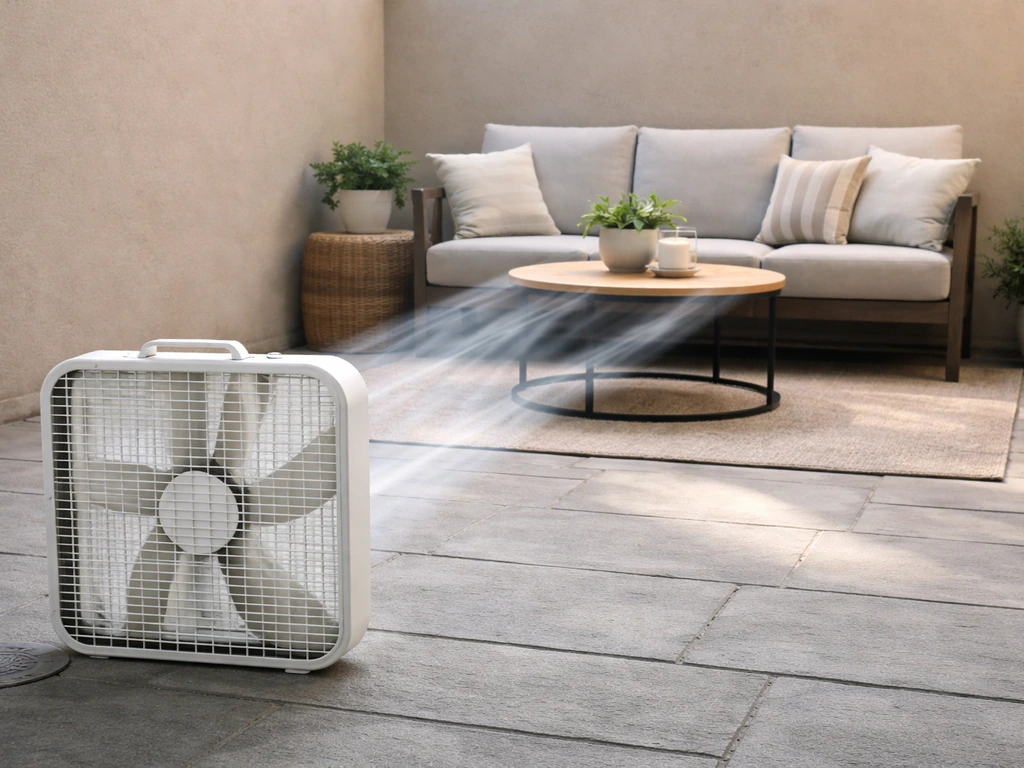
Fan placement makes more difference than most people expect. A fan pointed directly at the seating area from a few feet away will cool people faster than the same fan aimed across the patio from the far side. Here are the placement principles that consistently work best outdoors.
- Position the fan within 8 to 10 feet of where people are sitting. Beyond that distance, airflow dissipates quickly in open outdoor air.
- Angle the fan slightly downward toward the seating height, especially if it is set on a tall pedestal. Airflow aimed at chest and face level is more effective for cooling than airflow aimed at knees.
- If you have a covered patio, place the fan to push air through the space rather than recirculate it. Put it at one end blowing toward an opening or screen, not pointed at a wall.
- Use oscillation to cover the full seating area rather than locking the fan in a fixed direction. For a dining table, set the oscillation to sweep across the table width.
- If you are using two fans for a large space, place them at opposite sides angled toward each other slightly. This cross-ventilation pattern is more efficient than two fans aimed in the same direction.
- Keep the fan away from the cooking area if you have a grill. Blowing air at an open flame is a safety issue, and grease particles in the airstream will clog and corrode the blade assembly quickly.
- For wall-mount fans, install on a post or wall that puts the blade center at about 7 to 8 feet off the ground. That height gives good coverage without creating a direct blast at seated guests.
Safety around water and electrical sources
Even a wet-rated fan is not a bathtub appliance. Do not run any fan with its cord running through standing water or across a wet deck surface. Use a GFCI (ground fault circuit interrupter) outlet for all outdoor fans, full stop. Most modern outdoor outlets are already GFCI-protected, but check before you plug in. Keep at least 3 feet of clearance between the fan and any pool, hot tub, or water feature. And if a storm is rolling in with high winds, bring in a pedestal fan or at minimum unplug it. A tipping fan in a windstorm is a hazard and a broken fan.
Keeping your fan running season after season
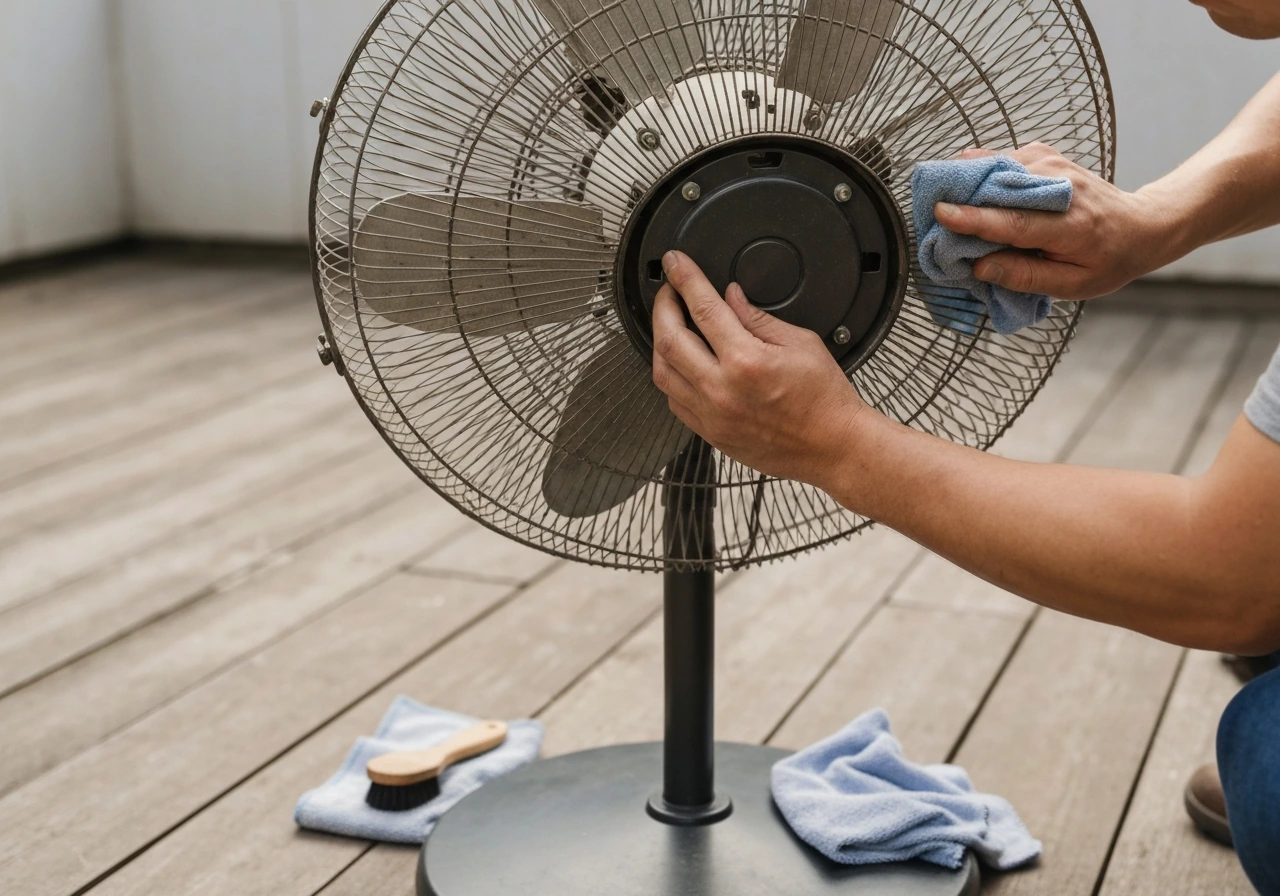
Outdoor fans take more abuse than indoor ones, but a little maintenance goes a long way. Most fans that fail after one or two seasons fail because of neglect, not because they were bad fans.
Regular cleaning
Outdoor fans collect pollen, dust, and debris on the blades and motor housing much faster than indoor fans. A buildup on the blades changes the aerodynamics and makes the motor work harder, shortening its life. Wipe blades down with a damp cloth every two to three weeks during heavy use season. For the motor housing, use compressed air or a soft brush to clear vents. Never spray water directly into the motor housing, even on a wet-rated fan. Wet-rated means it can handle rain from outside, not a direct hose-down of the motor internals.
Protecting the motor and hardware
At the end of the season, inspect any exposed metal screws, bolts, and blade clips for early rust. A dab of WD-40 or a rust-inhibiting spray on those fasteners takes two minutes and adds years to the fan's life. If your fan has any chrome or uncoated steel parts, consider wrapping them in a light coat of automotive paste wax before storing. It is the same principle as waxing outdoor furniture hardware.
End-of-season storage
Even wet-rated fans benefit from being stored indoors or in a covered shed during the off-season. UV exposure degrades ABS plastic over multiple years, and prolonged moisture sitting in motor bearings over winter accelerates wear even on outdoor-rated units. If you store the fan outside under a patio furniture cover, make sure there is enough ventilation so condensation does not build up inside the cover against the motor housing. A breathable fan cover or a cotton furniture cover is better than a sealed plastic bag for off-season storage.
Waterproof outdoor fans are a related category worth knowing about if your patio is extremely exposed. And if you are also thinking about ceiling-mounted options for a covered patio, outdoor patio ceiling fans with lights handle that use case differently than oscillating stand fans do. But for most open-air patio setups where portability and targeted airflow matter, a wet-rated oscillating pedestal fan sized to your seating area is still the most practical and cost-effective solution available today.
FAQ
Is a wet-rated oscillating fan safe to leave outside year-round on an open patio?
It is designed to handle rain and splash exposure, but it is still smarter to store it during off-season. Winter moisture sitting in bearings and UV exposure on plastics can shorten life, even with wet ratings. If you must leave it out, use a breathable cover that allows airflow, so condensation does not collect inside.
Can I use an outdoor oscillating fan with the cord through a window or near wet walking surfaces?
Avoid routing the cord across wet decks or through puddles, even if the fan is wet-rated. Use an outlet location where the cord stays dry, and power it from a properly functioning outdoor GFCI outlet. If the cord needs to cross a damp area, use a covered, outdoor-rated extension setup kept off the ground.
What’s the difference between “damp-rated” and “wet-rated” for a patio fan in real life?
Damp-rated is for covered areas where rain never directly hits the unit, such as a deep porch or enclosed pergola. Wet-rated is for situations where water can drip or splash onto the fan. If your patio ever sees direct afternoon rain hitting the fan or splashes from a pool or fountain, choose wet-rated to avoid corrosion and internal damage.
Do oscillating fans actually cool, or are they just moving hot air?
Outdoor fans do not lower the ambient temperature like AC, they increase perceived cooling by moving air across your skin. To get real comfort, aim for airflow that feels like a steady breeze at seating height, and size the fan so it reaches your seating zone rather than only blowing across empty space.
How should I choose between one larger fan versus two smaller fans?
For wide patios (around 400 square feet or more), two mid-size fans placed on opposite sides of the seating area usually work better than one large fan. This reduces dead zones and creates more consistent airflow across people, especially when a 180-degree oscillation sweep still cannot reach every corner.
What oscillation range should I look for, 90 degrees or 180 degrees?
If you want to cool a focused section, a 90-degree sweep can be more effective because it concentrates airflow. For a larger or more spread-out seating layout, 180 degrees helps cover more of the zone without you manually redirecting the fan. Match the sweep to your furniture layout, not just the patio size.
My patio is windy. Will a pedestal fan tip or move around?
Pedestal fans can tip in gusts, so use a wide base or a weighted model, and avoid placing it where it can catch direct wind funnels. If high winds are common, consider wall-mount positioning or remove and store the fan during storms, since a tipping fan can be a safety hazard.
How much clearance do I need between the fan and people or objects?
Keep the fan aimed so airflow reaches seating comfortably, but maintain practical clearance from obstacles that block the wind path, like planters, railings, or patio furniture backs. Also keep at least the recommended distance from water features and ensure the fan has room to oscillate without striking nearby items.
Can I mist with an outdoor fan, or does misting damage the motor?
Some outdoor fans include misting capability, but misting systems still require proper setup and regular cleaning to prevent mineral buildup and clogging. If you mist, use the manufacturer’s instructions and avoid continuous misting in salty or mineral-heavy water areas, since residue can degrade performance over time.
How loud should I expect an outdoor oscillating fan to be at night?
Noise depends heavily on blade size and speed setting. If you need conversation-level comfort, prioritize lower-speed operation and look for models with a clearly defined low-speed mode. Also remember that oscillating motion can create a noticeable airflow “whistle” if the fan is not level or if the blades collect debris.
What maintenance prevents early failure for outdoor fans?
Clean blades and vents regularly, especially during pollen and dust season. Use a damp cloth to remove buildup on blades every couple of weeks with heavy use, and clear vents with compressed air or a soft brush. Do not hose down the motor internals, even on wet-rated fans, and inspect fasteners for rust at least once per season.
Should I cover a wet-rated fan when it rains or store it indoors during storms?
Do not rely on a cover to protect against driving rain or storm debris in the moment. During high winds or severe storms, bring the fan inside or unplug it to reduce tipping risk and electrical hazards. After storms, wipe off surface grime and let it dry before covering for storage.
Is “IP44” enough for a patio oscillating fan?
IP44 indicates protection against small solids and water splashing, which can be useful for rain and splashes. However, IP ratings do not replace the UL location rating for safety. If you want rain exposure where water may directly hit the unit, prioritize explicit wet or damp UL location labeling, then treat IP as a helpful extra.
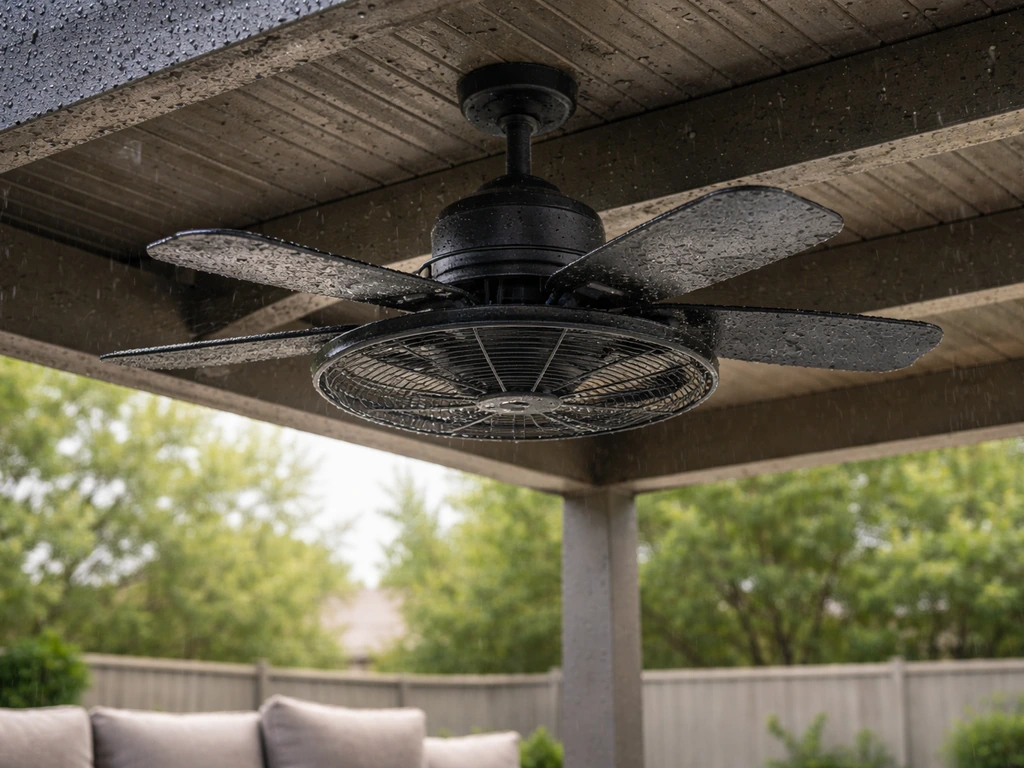
Buy the best waterproof patio fans for 2026 with IP ratings, wet-location tips, airflow, noise, setup and maintenance ch
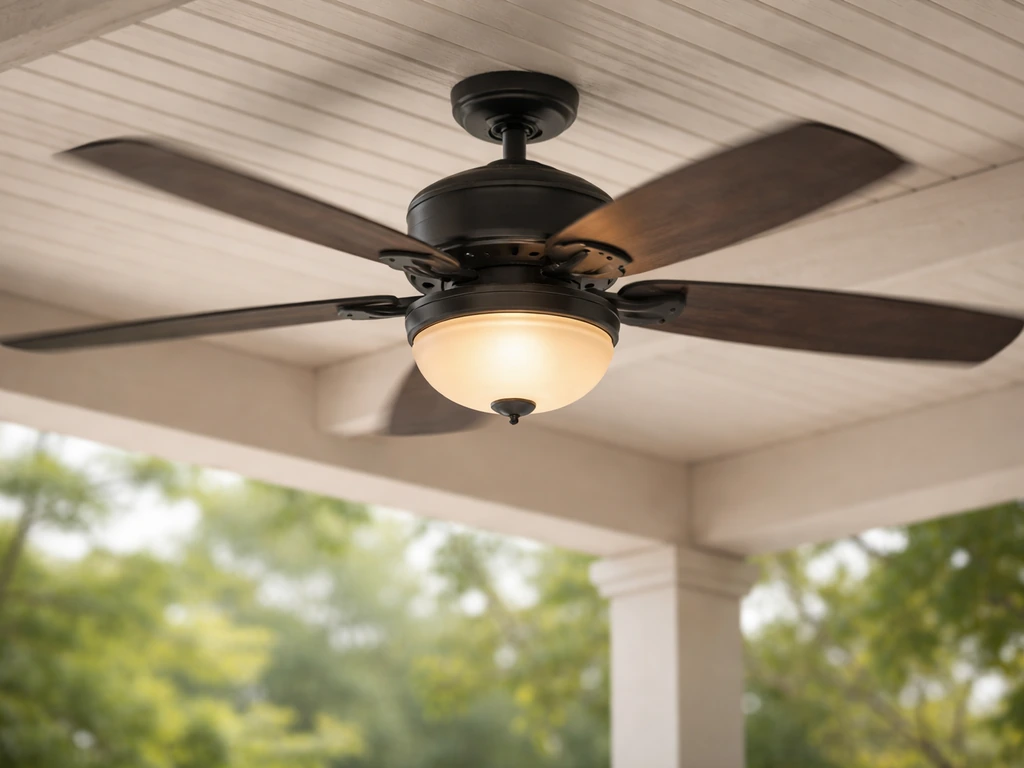
Choose the best outdoor patio ceiling fans with lights using size, wet rating, airflow, noise, wiring, and dimmable ligh
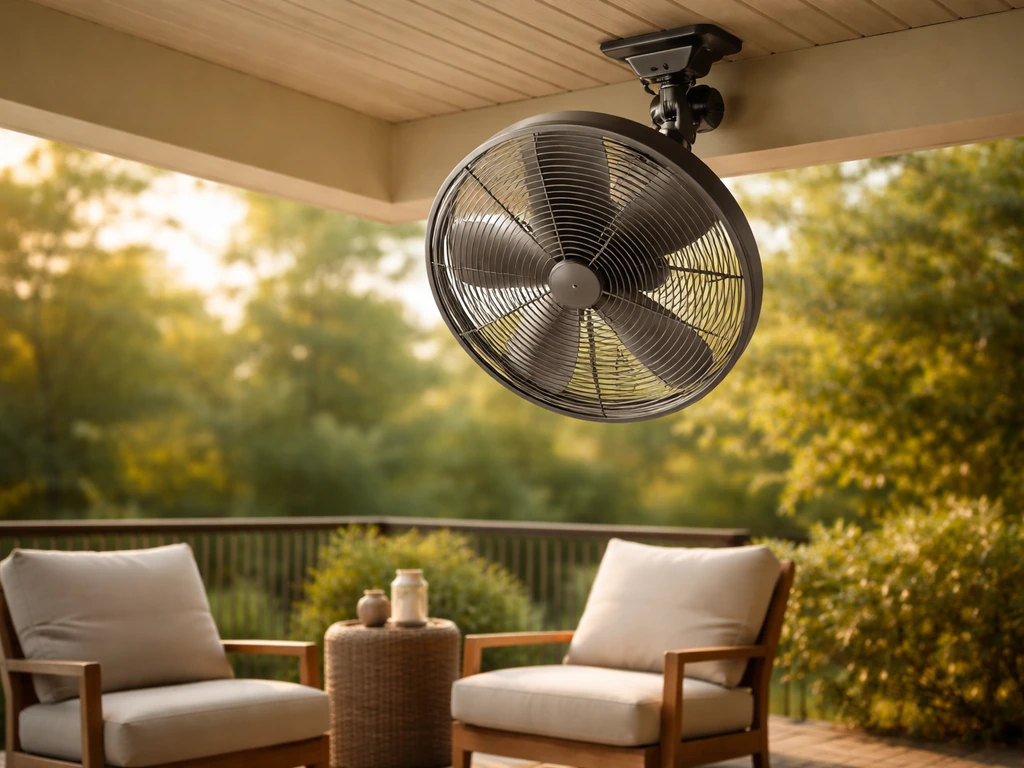
Choose the best outdoor patio cooling fan by CFM, size, noise, oscillation, weather rating, power, and mounting for your