
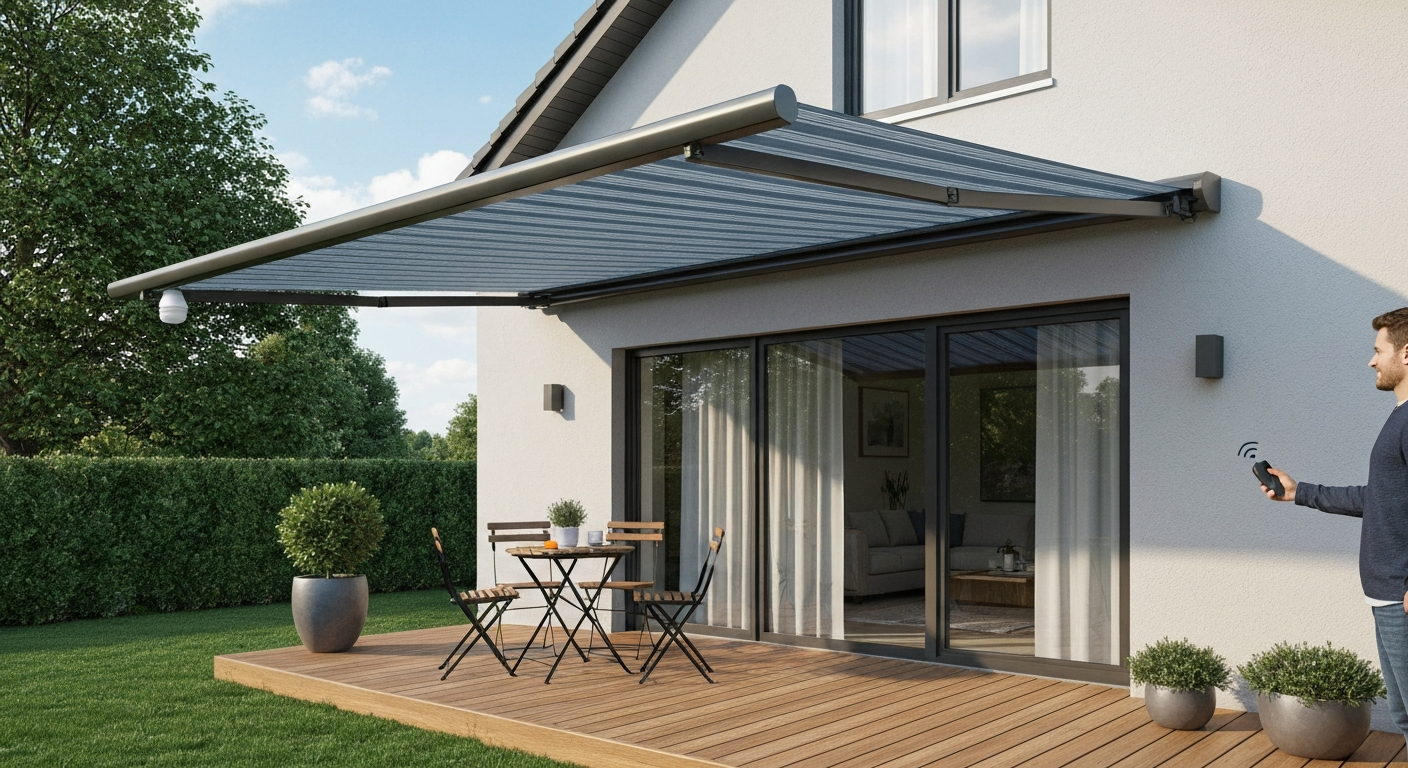
The best motorized patio awnings right now are the SunSetter Motorized Retractable Awning (best overall for most homeowners), the ALEKO Motorized Retractable Awning (best budget pick), and the Sunesta Custom Motorized Awning (best premium/quality choice). If you want a one-button solution that extends up to 20 feet of coverage, retracts automatically in wind, and integrates with Alexa or Google Home, those three brands cover the realistic price spectrum from around $500 to over $3,000 installed. This guide breaks down exactly which model fits your patio size, budget, and control preferences, and when a manual awning still makes more sense.
Best Motorized Patio Awnings: Top Picks & Buyer's Guide 2026

Lark Perry
20 Jul 2026
Who this guide is for
If you are a homeowner or renter trying to decide whether a motorized patio awning is worth the upgrade over a manual crank model, this article is written for you. I cover everything from quick verdicts and side-by-side specs to installation costs, landlord considerations, and how to connect your awning to a smart-home system. I also explain when budget manual models like the Best Choice Products 98x80 or the Outsunny manual retractable are actually the smarter call, because motorized is not always the right answer. For a budget manual option, consider the Outsunny patio manual retractable sun shade awning as a typical low-cost choice.
Quick verdicts: best motorized patio awnings at a glance
- Best Overall: SunSetter Motorized Retractable Awning — reliable Somfy motor, broad size range (8 to 20 ft wide), strong dealer network, and up to 10-year warranty on Platinum fabric tier.
- Best Budget: ALEKO Motorized Retractable Awning — available at Home Depot and Lowe's from around $500–$900, DIY-friendly installation, and decent specs for the price.
- Best Quality/Premium: Sunesta Custom Motorized Awning — fully custom sizing, Dickson or Sunbrella solution-dyed acrylic fabric, Somfy motor and sensor options, and professional installation included.
- Best for Small Patios: ALEKO 10x8 ft Motorized — compact footprint, easy wall-mount, suitable for apartment balconies and small decks.
- Best for Large Patios: SunSetter or Sunesta in 18–20 ft widths — heavy-duty frames, higher-torque motors, and wind sensors designed for wide coverage areas.
- Best Motorized Replacement for Manual Models: ALEKO motorized drop-in — if you already own a manual retractable and want to add a motor without replacing the whole unit, ALEKO and some Somfy retrofit kits support tubular motor upgrades.
Top picks by category
Best overall: SunSetter Motorized Retractable Awning
SunSetter is the brand most homeowners encounter first, and for good reason. The motorized line runs on Somfy motors, which carry a 5-year motor warranty and support optional Eolis 3D WireFree wind sensors for automatic retraction. The SunSetter Platinum tier uses solution-dyed acrylic fabric backed by a 10-year limited warranty. Widths range from 8 to 20 feet with projections up to 11 feet, which covers most standard decks and patios. Dealer installation is widely available, and the remote control is straightforward to use. It is not the cheapest option, but the combination of motor quality, fabric durability, and warranty depth makes it the easiest recommendation for most buyers.
Best budget: ALEKO Motorized Retractable Awning
ALEKO sells direct through Home Depot and Lowe's, which means competitive pricing and straightforward returns. Their motorized models start around $500 for a 10x8 ft unit and climb to roughly $900 for a 16x10 ft. The frames are aluminum, the fabric is solution-dyed acrylic on the better models (polyester on the entry-level), and the motors are basic tubular motors with a standard RF remote. ALEKO publishes downloadable installation manuals with clear bracket diagrams, which makes DIY mounting realistic for someone comfortable with a drill and a level. The motors do not have Somfy's 5-year guarantee, and wind sensors are an add-on expense, but for a covered patio or a yard with moderate wind exposure, ALEKO delivers solid value.
Best quality/premium: Sunesta Custom Motorized Awning
Sunesta builds to order, meaning you specify the exact width, projection, fabric pattern, and frame color. Fabrics are sourced from Dickson (Orchestra/Sunacryl lines) or Sunbrella, both of which are solution-dyed acrylics with multi-year fabric warranties and documented colorfastness ratings. Sunesta pairs their awnings with Somfy motors and offers wind and sun sensor add-ons. Price for a custom Sunesta with installation typically starts around $2,500 and can exceed $5,000 for a large unit with sensors and smart-home integration. The tradeoff is obvious, you pay more, but you get a product built to your patio's exact dimensions, installed by a professional, and backed by a strong warranty. For buyers seeking the best quality patio awnings, Sunesta's custom options exemplify this category.
Best for small patios: ALEKO 10x8 ft Motorized
A 10-foot-wide awning covers a small bistro set or a narrow balcony without overwhelming the space. ALEKO's 10x8 is wall-mounted, ships in a manageable box, and can realistically be installed by two people in an afternoon. It is also one of the few motorized options under $600 that does not feel completely flimsy. For renters with a landlord who permits wall anchors, this size is also the least likely to require structural review.
Best for large patios: SunSetter or Sunesta 18–20 ft
Wide awnings need heavier frames and higher-torque motors. Both SunSetter and Sunesta build in the 18–20 ft range with frames engineered for the extra weight and wind load. At these widths, professional installation is not just convenient, it is necessary for proper tensioning and bracket placement. A Somfy motor in a large SunSetter or Sunesta can handle widths up to 20 feet without the sagging or slow-retraction problems I have seen on cheaper wide-format units.
Best motorized replacement for manual models
If you already own a manual retractable awning with a tubular roller, retrofitting a motorized tubular motor is often possible. Somfy and Elero both manufacture tubular motors in torque ranges from 1.2 Nm up to 10+ Nm that can fit inside existing aluminum roller tubes, provided the tube diameter matches. ALEKO also sells standalone motor kits. The retrofit approach saves money on the fabric and frame, though it requires confirming tube diameter compatibility before ordering. If your existing awning is a budget PU-coated polyester model like the Outsunny 12x8, it may be more cost-effective to replace the whole unit rather than motorize a fabric that will wear out in a few seasons anyway.
Side-by-side comparison: top motorized patio awnings
| Model | Width Range | Projection | Fabric | Motor/Control | Wind/Water Rating | Price Range |
|---|---|---|---|---|---|---|
| SunSetter Motorized (Platinum) | 8–20 ft | Up to 11 ft | Solution-dyed acrylic (10-yr warranty) | Somfy tubular, RF remote + sensor-ready | Wind class rated; water-repellent | $1,500–$3,000+ (installed) |
| ALEKO Motorized Retractable | 10–20 ft | Up to 10 ft | Solution-dyed acrylic or polyester | Tubular motor, RF remote | Moderate wind; water-repellent | $500–$900 (DIY) |
| Sunesta Custom Motorized | Custom (up to 24 ft) | Custom (up to 13 ft) | Dickson/Sunbrella solution-dyed acrylic | Somfy tubular, remote + smart-home optional | EN 13561 wind class; water-repellent | $2,500–$5,500+ (installed) |
| SunSetter Motorized (standard fabric) | 8–16 ft | Up to 11 ft | Acrylic-blend (5-yr warranty) | Somfy tubular, RF remote | Wind class rated; water-repellent | $1,000–$2,000 (installed) |
| ALEKO 10x8 ft Motorized | 10 ft | 8 ft | Polyester or acrylic entry-level | Tubular motor, RF remote | Light-moderate wind; water-repellent | $500–$600 (DIY) |
How to choose the right motorized awning
Size, coverage, and projection
Start with your patio dimensions. The awning width should match or slightly exceed the width of the area you want to shade. Projection, how far the awning extends from the wall, determines how much sun you actually block. A 10-foot projection on a south-facing wall will shade a significant seating area at midday but will do less work in the morning or late afternoon when the sun is lower. For a standard 12x14 ft deck, a 14 ft wide awning with a 10 ft projection is a practical starting point. Wider awnings need heavier hardware and higher-torque motors, so do not oversize unnecessarily.
Fabric and frame materials
Solution-dyed acrylic is the fabric standard worth caring about. Both Sunbrella and Dickson (Orchestra/Sunacryl lines) manufacture solution-dyed acrylic awning fabrics where the color runs through the fiber rather than sitting on the surface, which means far better UV and lightfastness over time. Sunbrella's awning-grade fabrics carry a 10-year limited warranty on many collections, while Dickson warranties range from 3 to 10 years depending on the product line. These fabrics also meet or exceed the test properties specified in ASTM D4847, the North American specification for woven awning fabrics, covering breaking strength, tear strength, colorfastness, water resistance, and mildew resistance. PU-coated polyester (common on budget manual awnings like the Outsunny 12x8, which uses 280 g/m² coated poly) is cheaper but fades faster and tends to crack at the coating after a few seasons of UV exposure. For a motorized awning where you are spending $700 or more, pay the upcharge for acrylic fabric. Frames should be powder-coated aluminum for corrosion resistance. Avoid any frame described only as 'steel' without a galvanizing or coating specification.
Motor types and brands
Virtually all residential retractable awnings use tubular motors, the motor lives inside the aluminum roller tube and is invisible when the awning is rolled up. Somfy is the dominant brand in quality awning motors, and their residential motors carry a 5-year warranty. Elero is another reputable manufacturer, publishing tubular motor datasheets covering torque ranges from around 1.2 Nm on small motors up to 10 Nm or more on large-format units. Torque matters because a motor undersized for the awning weight will strain and fail early. For awnings up to 13 ft wide, a motor in the 3–5 Nm range is typically sufficient. Wider awnings may need 6–10 Nm. Always check the awning manufacturer's motor spec against the awning width and fabric weight. IP rating is the other motor spec that matters in practice: IP44 is the minimum for a sheltered installation, IP54 or IP55 is recommended for exposed residential use, and IP65 or higher is worth specifying in coastal or very wet climates.
Controls: remote, app, and smart-home integration
Most motorized awnings ship with a basic RF remote, which is fine for everyday use. If you want app control or smart-home integration, you need a Somfy-powered motor paired with a compatible Somfy hub. The Somfy TaHoma hub connects RTS and io-homecontrol protocol motors to Alexa, Google Home, and selected Apple HomeKit setups. Some products use Zigbee for hub integration depending on the model. If smart-home integration is important to you, confirm before buying that the motor protocol (RTS vs. io) matches the hub you plan to use, not all Somfy motors speak the same wireless language.
Wind and sun sensors
Automatic sensors are the feature that genuinely changes how you use a motorized awning. The Somfy Eolis 3D WireFree RTS is a battery-powered wireless wind sensor that mounts on the awning arm and triggers automatic retraction when wind exceeds an adjustable threshold. It communicates wirelessly to the motor with no wiring required. Sun sensors can automatically extend the awning when light intensity exceeds a set level and retract it at dusk or in low-light conditions. Both sensor types are add-on accessories (typically $100–$250 each) rather than standard inclusions on most residential units. For a patio in a region with unpredictable afternoon thunderstorms, a wind sensor is a worthwhile investment, awnings left extended in a sudden gust are one of the most common causes of frame damage.
Water resistance and wind ratings
Most residential awning fabrics are water-repellent, not waterproof. That means light rain beads off, but heavy or sustained rain will eventually seep through the seams or overwhelm the fabric's coating. No standard residential folding-arm retractable awning is designed as a rain structure, do not expect it to function like a permanent pergola cover. Wind resistance is more formally specified. In Europe, EN 13561 (External blinds and awnings, current edition 2015) is the standard, with wind resistance classes determined using the EN 1932 test method. A higher wind class means the awning can withstand greater wind loads without structural failure. U.S.-sold awnings do not always carry EN class ratings, but reputable brands will provide a maximum wind speed recommendation in their specs. As a general rule, retract any awning when sustained winds exceed 25 mph.
Motorized vs. manual: when each makes sense
Motorized awnings cost significantly more than manual equivalents, sometimes three to five times the price for a comparable size. The convenience is real, but so is the cost gap. A manual crank awning like the Best Choice Products 98x80 (roughly 98. GardenBeast, product roundup listing Best Choice Products 98×80 awning notes the model at approximately 98.5 × 80 inches with an aluminum frame and UV- & water-resistant polyester blank" rel="noopener noreferrer">GardenBeast — product roundup listing Best Choice Products 98×80 awning. 5 x 80 inches, aluminum frame, UV-resistant polyester) or the Outsunny 12x8 ft manual retractable covers a small patio for under $150 and can be installed by one person in an hour. For a renter, a small patio, or a buyer who only extends an awning occasionally, manual is a completely rational choice. The argument for motorized strengthens when the awning is large (cranking a 16-foot-wide awning is genuinely annoying), when the user has mobility limitations, when the awning is in a hard-to-reach location, or when automatic sensors add real value (for example, retracting automatically when you are not home and a storm rolls in).
| Factor | Motorized | Manual |
|---|---|---|
| Upfront cost | Higher ($500–$5,500+) | Lower ($100–$400) |
| Convenience | One-button or automatic operation | Requires physical cranking |
| Smart-home integration | Yes (with compatible motor/hub) | No |
| Wind/sun sensor support | Yes (add-on sensors available) | No |
| Motor maintenance | Required (annual lubrication, battery/power check) | None |
| Failure modes | Motor, remote, wiring faults possible | Mechanical crank, spring tension |
| Best for large awnings | Yes — much easier at 14 ft+ | Workable but tiring |
| Best for renters/small spaces | Possible, but harder to justify cost | Often the better value |
| Ideal candidate | Homeowner, large deck, frequent use, smart home | Renter, small patio, occasional use, tight budget |
Cost vs. quality: what you actually get at each price point
Budget motorized ($500–$900)
At this price you get an aluminum-frame folding-arm awning with a basic tubular motor, an RF remote, and either polyester or entry-level acrylic fabric. Wind sensors are usually not included. Smart-home integration is unlikely without additional hardware. Motor warranties at this tier are shorter and less clearly documented than Somfy. Installation is DIY, which saves $300–$800 but adds time and requires comfort with drilling into masonry or wood framing. ALEKO is the dominant brand here and represents the category honestly, good value for the price, with the understanding that you are not getting a premium motor or premium fabric.
Midrange motorized ($1,000–$2,500)
This is where Somfy motors start appearing as standard equipment. SunSetter's standard motorized line falls here. You get solution-dyed acrylic fabric with a real warranty, a 5-year motor warranty, sensor compatibility, and often dealer installation support. Remote control is standard; app and smart-home control typically requires a Somfy hub add-on ($150–$250). This tier is the sweet spot for most homeowners with a medium-sized deck, you get meaningfully better quality and support than the budget tier without the custom-order cost of premium.
Premium motorized ($2,500–$5,500+)
At the premium tier (Sunesta, custom SunSetter Platinum, high-end dealer brands), you get custom sizing, premium Sunbrella or Dickson fabrics with 10-year fabric warranties, Somfy motor and sensor packages, professional installation, and robust frame engineering. These awnings are built to last 15–20 years with proper maintenance. The price includes design consultation and professional mounting, the awning is tensioned correctly from day one. For a large patio or a permanent feature of a home you plan to stay in, the cost-per-year math over 15 years is not as daunting as the sticker price looks.
Installation and mounting: DIY vs. professional
Common mounting methods
Most residential retractable awnings mount to a wall (fascia or siding) or to a roof soffit. Wall mounting is the most common and requires locating studs or using masonry anchors if the wall is concrete or brick. Soffit mounting works for homes where the eave overhang provides a natural attachment point. Some larger awnings include a post/column mounting option for freestanding or pergola installation, which is useful when no suitable wall surface exists. Whatever the mounting method, the bracket attachment point must handle the combined static weight of the awning plus the dynamic load of wind, do not anchor into drywall or thin vinyl siding without solid blocking behind it.
DIY installation
Budget awnings like ALEKO include installation manuals with bracket diagrams and hardware. A typical DIY wall-mount installation requires a drill, level, stud finder, socket wrench set, and a helper to hold the awning while brackets are secured. For a 10–12 ft wide awning, two people can complete the job in 3–5 hours. For wider awnings (14 ft+), three people or a temporary support stand is necessary during bracket attachment. Electrical connection for the motor requires running a low-voltage wire from the awning to a nearby outdoor outlet or hardwired junction box, if you are not comfortable with basic wiring, that portion is worth hiring out even if you handle the structural mounting yourself.
Professional installation costs
Professional installation through a dealer or awning contractor typically runs $300–$800 for a standard residential wall-mount, depending on complexity, region, and whether electrical work is included. Premium brands like Sunesta build installation into their pricing. If you buy an awning at Home Depot and want a pro to install it, expect to pay separately for labor. Some electricians charge an additional $150–$300 to run a dedicated outdoor circuit if one does not already exist near the mounting location.
Renters, landlords, and permit considerations
Renters face a real complication with motorized awnings. A wall-mounted awning requires drilling into the building structure, which most leases restrict without written landlord approval. Get any permission in writing before ordering. In multi-unit housing (condos, townhomes, apartments), HOA rules or condo association bylaws may also restrict exterior modifications or require board approval, check these before purchasing. For renters who cannot or do not want to make permanent modifications, freestanding patio awning structures (canopy-style with weighted bases) are a genuinely useful alternative, though they lack the retractable mechanism of a wall-mounted unit. Freestanding pergola canopies with motor-driven shade screens are a growing category that sidesteps the landlord issue entirely. In some jurisdictions, a permanent awning installation on a home may require a building permit, particularly if it is attached to the roof structure rather than a wall. Check with your local building department if the installation involves any structural roof attachment, most simple wall-mount awnings do not trigger permit requirements, but it is worth confirming.
Maintenance, troubleshooting, and lifespan
Routine maintenance
- Clean fabric twice a year with mild soap and lukewarm water — avoid pressure washers, which can damage coatings and seams.
- Lubricate the folding arms and pivot points annually with a silicone-based lubricant (not WD-40, which attracts dirt).
- Inspect mounting brackets and hardware each spring for corrosion, loosened fasteners, or stress cracks.
- Check motor battery (if wireless sensor) at the start of each season.
- Retract the awning during winter or during extended periods of non-use to prevent fabric stress from ice, snow, or prolonged UV exposure.
Common problems and fixes
- Awning does not respond to remote: check battery in remote first, then confirm the motor is receiving power, then try re-pairing the remote per the manufacturer instructions.
- Awning retracts unevenly or bunches on one side: usually caused by one arm losing tension — re-tension the spring per the installation manual or call a dealer.
- Motor runs but awning does not move: the motor-to-tube connection (set screw or spline) may have slipped — requires opening the end cap and reseating the motor.
- Fabric sags in the middle: projection is too long for the fabric tension setting, or the pitch angle needs adjustment at the wall bracket.
- Wind sensor triggers retraction too frequently: adjust the sensitivity threshold on the Eolis or equivalent sensor using the adjustment tool provided.
Warranty and lifespan expectations
A Somfy motor is warrantied for 5 years and realistically lasts 10–15 years with normal residential use. Solution-dyed acrylic fabrics carry manufacturer warranties of 5–10 years depending on the brand (Sunbrella's awning-grade collections offer a 10-year limited warranty; Dickson ranges from 3 to 10 years by product line). The frame and mechanical components on a quality awning should outlast the fabric. Budget awnings with polyester fabric and no-name motors are harder to predict, figure on 5–7 years before significant degradation. Premium custom awnings with professional installation and quality fabric can reasonably last 15–20 years.
Integrating your awning with patio audio, lighting, and smart-home systems
A motorized awning with a Somfy TaHoma hub can sit alongside other smart-home devices in a single app. That means you can build scenes, for example, a 'patio mode' that extends the awning, turns on patio string lights, and activates outdoor speakers simultaneously from a single voice command or schedule. The Somfy ecosystem connects to Alexa, Google Home, and selected HomeKit setups, and Zigbee-based products can integrate with SmartThings or Home Assistant for more advanced automation. If you are already running smart outdoor speakers or smart lighting on your patio, adding a compatible motorized awning to the same hub is a natural extension of that setup. The key is confirming motor protocol compatibility (RTS vs. io-homecontrol) before purchasing the motor or hub.
Final buying advice
For most homeowners with a mid-size deck and a realistic budget, the SunSetter Motorized Retractable in the $1,500–$2,000 range (including dealer installation) is the clearest recommendation. You get a Somfy motor, real acrylic fabric with a documented warranty, sensor compatibility, and a brand with established dealer support. If budget is the priority, ALEKO via Home Depot or Lowe's delivers a workable motorized awning for $500–$900 DIY. If you want the best quality and do not mind the cost, Sunesta's custom-built, professionally installed option is hard to beat. And if you are a renter, or your patio is genuinely small, take a serious look at quality manual retractable options before spending extra on a motor you may not need, the best price awnings in the manual category can solve your shade problem for a fraction of the cost, especially if you do not need automatic retraction or smart-home control. For a quick comparison of budget manual options, see our roundup of the best price patio awnings for clear cost-to-value choices (c9fdf248-8298-429d-8d35-10077d136cd0).
FAQ
What regulatory standards and test methods should be consulted to evaluate safety and wind resistance of motorized patio awnings?
Consult EN 13561 (performance and safety requirements for external blinds and awnings) and EN 1932 (test method for wind resistance) for wind‑class ratings and safety. For North America, check industry test norms referenced by manufacturers and any applicable local building codes. Source examples: NEN EN‑13561 documentation and EN‑1932 test method.
Which technical motor and control specifications are essential to research for motorized awnings?
Investigate motor torque (Nm) ranges vs. awning size, motor tubular types, IP/ingress protection ratings for intended exposure, manufacturer warranties, and supported control protocols (Somfy RTS/io, Zigbee, Z‑Wave, Wi‑Fi). Consult motor manufacturer datasheets (e.g., Elero, Somfy) for torque, IP, and integration details.
What fabric and frame material properties must be verified when comparing awning models?
Check fabric type (solution‑dyed acrylic like Sunbrella or Dickson, vs. polyester/PU coatings), test standards (e.g., ASTM D4847 for woven awning fabrics), UV and colorfastness ratings, water repellency, mildew resistance, and manufacturer fabric warranties. For frames, verify material (aluminum grades, powder coating), corrosion resistance, and load/wind ratings from vendor datasheets.
Which product categories and retail sources should be consulted to determine realistic price ranges and representative models?
Survey major retailers (Home Depot, Lowe’s, Wayfair, Amazon) for current street prices of entry‑level and midrange models, manufacturer/brand sites (ALEKO, SunSetter, Sunesta) for spec sheets and dealer pricing, and mass‑market listings (Outsunny, Best Choice Products) for low‑cost manual examples. Use these to build cost/quality tradeoffs.
What installer, mounting, and permit information must be researched for DIY vs professional installation and for renters?
Research manufacturer installation manuals for mounting bracket types and structural requirements, average pro installation cost ranges, local building/HOA permit rules and landlord consent considerations for renters, and advice on reversible/non‑penetrating mounts. Source: manufacturer manuals (ALEKO), dealer/installer sites, and local building authority guidance.
How should research address choosing between motorized and manual awnings?
Compare costs (upfront and lifecycle), convenience (controls, sensors), reliability/maintenance, typical motor failure modes, and safety in wind. Use representative manual models (Best Choice Products 98×80, Outsunny manual retractable) and motorized equivalents from retailers to quantify cost and functionality differences.
Next Articles
best choice products 98 x80 retractable patio awning review
Best Choice Products 98x80 retractable patio awning review, specs, pros/cons, install, cost & alternatives.
Best Quality Patio Awnings: Ultimate Buyer's Guide 2026
Buyer's guide to the best quality patio awnings: materials, sizes, motorized vs manual, price tiers & top picks.
Outsunny Manual Retractable Patio Sun Shade Awning Guide
Step-by-step guide to sizing, mounting, and using an Outsunny manual retractable patio sun shade awning safely.