
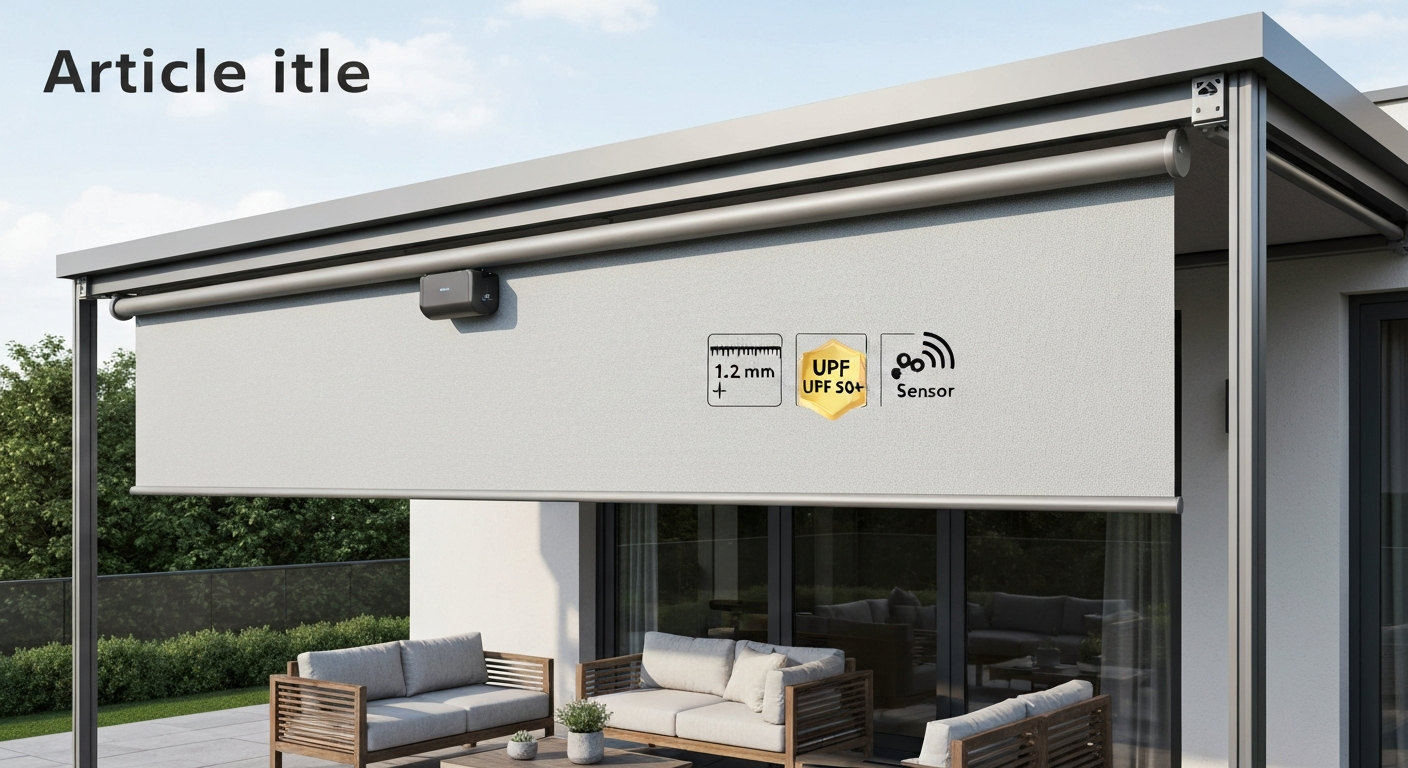
The best quality patio awnings share three things regardless of price: a powder-coated aluminum frame with a wall thickness of at least 1.2 mm, a solution-dyed acrylic or high-denier polyester fabric rated UPF 50+ and tested to EN 13561 or equivalent wind-resistance standards, and a mechanism (manual or motorized) that is easy enough to use consistently so you actually retract it before a storm. Everything else, including brand name, remote controls, and color options, is secondary to those three fundamentals.
Best Quality Patio Awnings: Ultimate Buyer's Guide 2026
Lark Perry
14 Jul 2026
Who this guide is for and how to use it
This guide is written for homeowners and renters who are ready to spend real money on a shade solution and want to understand exactly what they are paying for. Whether you are comparing a sub-$200 manual model like the Outsunny retractable sun shade against a $2,000+ motorized unit with wind sensors, or trying to figure out whether a 98 x 80-inch frame actually fits your wall, this article walks through every decision point in order. Read it front to back if you are starting from scratch, or jump to the section that matches your specific question using the headings below.
What 'best quality' actually means for a patio awning
Quality in a patio awning is not about aesthetics. It is about how well the product holds up after two summers of UV exposure, one bad thunderstorm, and a dozen cycle operations per week. There are four measurable dimensions worth evaluating: frame material and wall thickness, fabric composition and UV rating, hardware and fastener grade, and the wind-resistance class the product has been tested to.
Frame and finish
Premium awning frames use extruded aluminum alloy, typically 6063-T6, which offers a tensile strength around 207 MPa and excellent corrosion resistance in outdoor environments. According to MatWeb material property data for 6063-T6, this alloy machines cleanly, accepts powder coating well, and resists salt-air corrosion far better than the mild steel frames used in budget models. The powder coating itself matters too: look for finishes that meet AAMA 2604 or 2605 standards, which specify adhesion, humidity resistance, and a minimum film thickness of 40-60 microns. Budget-tier awnings often use thinner-wall extrusions (under 1 mm) and spray paint over aluminum, which chalks and peels within 18 to 24 months outdoors.
Fabric composition
Solution-dyed acrylic, with Sunbrella being the most widely cited industry benchmark, is the gold standard for awning fabric. In solution-dyed fabrics, the pigment is locked into the fiber before it is spun, so UV exposure does not strip color from a surface coating the way it does with piece-dyed or screen-printed fabrics. Sunbrella technical data documents colorfastness ratings that far exceed polyester or coated fabrics, and the material typically achieves a UPF 50+ rating (blocking over 98% of UV radiation) when tested under ASTM D6544 preparation protocols. High-denier polyester (300D-600D) with acrylic coatings is a reasonable midrange choice, but expect a shorter fade-free lifespan, typically 3 to 5 years versus 8 to 12 years for quality solution-dyed acrylic.
Wind resistance and certification
The European standard EN 13561 classifies external awnings by wind resistance into classes 0 through 3. A Class 1 product handles moderate wind exposure, Class 2 is suitable for more exposed residential positions, and Class 3 handles high wind loads. Most consumer-grade retractable awnings are rated Class 1 or Class 2 when extended, and almost all manufacturers, including Outsunny and entry-level Best Choice Products models, explicitly state in their owner manuals that the awning must be retracted in winds above roughly 22-27 mph (Beaufort Scale Force 5). If you live in a windy region, a wind sensor that triggers automatic retraction is not a luxury item. For U.S. permitting on permanent or semi-permanent installations, local building departments reference ASCE 7 wind-load parameters, which can require engineered anchor calculations beyond what a standard install kit provides. Consult the Florida Building Code, Chapter 16 Structural Design (references ASCE 7 for wind loads) for local permit requirements and site-specific wind-load interpretation Florida Building Code — Chapter 16 Structural Design (references ASCE 7 for wind loads).
How to read awning specs without getting lost
Manufacturer spec sheets pack a lot of numbers into small spaces, and marketing product pages frequently omit the limitations that are explicit in the owner's manual. Here is what each key spec actually tells you.
| Spec | What it means | Minimum to look for |
|---|---|---|
| Fabric denier (D) | Thickness and density of yarn; higher = more durable and tear-resistant | 300D polyester; 400-600D preferred; acrylic has no denier standard but check GSM (grams per square meter), aim for 280+ GSM |
| UPF / SPF rating | Ultraviolet protection factor; UPF 50+ blocks 98%+ of UV-A and UV-B | UPF 50+ for shade use; confirm fabric is tested under ASTM D6544 |
| Wind class (EN 13561) | Tested wind-resistance classification from 0 (minimal) to 3 (high exposure) | Class 1 minimum; Class 2+ for exposed patios or coastal areas |
| Frame wall thickness | Aluminum extrusion wall thickness; thicker = stronger and less flex under load | 1.2 mm minimum; 1.5-2 mm for spans over 12 feet |
| IP rating (motors) | Ingress Protection against dust and water; relevant for motorized units | IP44 minimum for outdoor motors; IP54 preferred in wet climates |
| Mounting load capacity | Maximum weight the wall bracket system can support | Must exceed combined weight of frame, fabric, and motor by a safety factor; verify fastener specs match your wall substrate |
| Warranty duration | Coverage period for frame, fabric, and mechanism | 5 years frame; 3 years fabric; 2 years mechanism as minimum benchmarks |
One thing I have learned from reading through multiple owner manuals, including the SunSetter installation manual and Outsunny's downloadable instruction PDFs, is that the clearance requirements listed in the manual are almost always more restrictive than what the marketing page implies. SunSetter's manual, for instance, specifies minimum wall clearance above the mounting brackets and explicit motor-limit adjustment procedures that require a follow-up site visit if not set correctly at install. Read the manual before you buy, not after.
Fixed vs. retractable, and manual vs. motorized
Before diving into specific products, it is worth being clear about which awning type actually fits your situation, because getting this wrong is an expensive mistake.
Fixed awnings
Fixed awnings are permanently extended metal or fabric structures, usually attached to a fascia or roof overhang. They require no operation, tolerate wind reasonably well because they have no extending mechanism to stress, and are lower maintenance in terms of moving parts. The trade-off is that they shade the same area year-round regardless of season, can trap heat against the house in summer if poorly positioned, and typically require a permit and professional installation. They are a good fit for entry canopies, storefront-style covers, or shading windows where you want permanent protection.
Retractable awnings: manual vs. motorized
Retractable awnings extend on demand and roll back when not needed, which is both their strength and their weakness. The strength is flexibility: you shade in the afternoon, retract before the evening storm, and protect the fabric during winter. The weakness is that retraction requires consistent action from the user, and when people do not retract in time, that is how most awning damage happens.
| Feature | Manual Retractable | Motorized Retractable |
|---|---|---|
| Operation | Hand-crank or pull-strap, takes 30-60 seconds | Button or remote, 15-30 seconds; can include automatic sensors |
| Cost (unit only) | $150 – $800 for most consumer models | $600 – $3,500+ depending on size and motor brand |
| Installation complexity | DIY-friendly for most models; 2-person job | More complex; wiring may require electrician for hardwired motors |
| Wind sensor compatibility | Not available | Available; sensors auto-retract at preset wind speed |
| Failure modes | Crank gearing, spring tension, fabric sagging | Motor burnout, control board failure, sensor miscalibration |
| Best for | Budget buyers, renters, smaller spans under 12 ft | Large spans, frequent users, high-tech patios, those who forget to retract |
| Ongoing cost | Minimal; possible spring/crank replacement | Motor service or replacement every 8-15 years; $200-$600 for motor swap |
For renters, a manual retractable model that mounts with minimal wall penetration is the practical choice. The Outsunny manual retractable sun shade awning is a commonly searched option in this category and offers a usable entry point, though its fabric weight (typically around 180-200 GSM in the brand's consumer line) is meaningfully below the 280+ GSM threshold I would recommend for multi-year outdoor use. For detailed specs and the owner's manual, see the Outsunny patio manual retractable sun shade awning. It is a fair choice for a rental patio where you cannot justify a larger investment, but go in knowing its lifespan is shorter than a premium unit.
How motorized awning systems actually work
Motorized awnings use a tubular motor that sits inside the rolling tube (the horizontal bar that the fabric wraps around). When energized, the motor rotates the tube to either extend or retract the fabric. The key specs to understand are torque, IP rating, control protocol, and power source.
Torque and motor sizing
Motor torque, measured in Newton-meters (Nm), must be matched to the fabric canopy span and fabric weight. Somfy's product catalog, one of the most widely used tubular motor suppliers for residential awnings, offers motors ranging from roughly 30 Nm for small spans up to 100 Nm or more for large commercial-grade canopies. A common failure mode in budget motorized awnings is an undersized motor (10-20 Nm) paired with a heavy fabric on a 13-foot span, which leads to motor overheating and burnout within one to two seasons. Reputable manufacturers and dealers publish motor-selection torque charts and explicitly state which tube diameter and fabric weight each motor is rated for.
IP rating and control protocols
The IP (Ingress Protection) rating tells you how well sealed the motor is against dust and water. IP44 is the minimum acceptable for an outdoor tubular motor: it is protected against solid objects over 1 mm and water splashing from any direction. IP54 adds better dust protection and is preferred for coastal or high-rain environments. For control protocols, Somfy's RTS (Radio Technology Somfy) and io-homecontrol systems are the most commonly referenced in quality residential awnings. RTS is a one-way radio system (remote sends, motor responds), while io-homecontrol is a two-way protocol that confirms operation and is compatible with smart-home integration including Amazon Alexa and Google Home bridges.
Power options: wired, battery, and solar
- Hardwired (120V AC): Most reliable and powerful option. Requires an electrician if no outdoor outlet is near the mounting location. Adds $150-$400 to install cost but eliminates battery management entirely.
- Battery-powered: Lithium battery packs inside the motor tube. No wiring needed, but batteries typically last 1-2 seasons of moderate use and must be recharged or replaced. Convenient for retrofits but operationally demanding.
- Solar-powered: A small roof or wall panel charges an internal battery pack. Works well in high-sun climates but can underperform in overcast regions or under tree cover. Adds $100-$250 to unit cost and requires panel placement planning.
Sensors and automation
Wind sensors (anemometers), rain sensors, and sun sensors can be paired with compatible motor systems to trigger automatic retraction or extension. Somfy's Eolis wind sensor, for example, mounts to the awning frame and transmits wirelessly to an RTS-compatible motor, retracting automatically when wind speed exceeds a preset threshold. This is the single most valuable upgrade for any motorized awning if you are not home during the day. Rain sensors are useful for protecting fabric from standing water, and sun sensors can auto-extend the awning when solar intensity crosses a threshold. Each sensor adds $80-$200 to the system cost but can prevent a single storm-damage event that would cost $500-$1,500 to repair.
Choosing the best motorized patio awning: what to look for
The best motorized patio awnings for residential use combine a correctly sized motor (minimum 50 Nm for spans over 10 feet), a quality fabric (solution-dyed acrylic or high-GSM polyester with UPF 50+), and a control protocol that matches how you actually live. If you have a smart home system, io-homecontrol compatibility is worth paying for. If you just want a remote, RTS is simpler and less expensive. The brands most consistently mentioned in independent editorial testing and long-term owner reviews for quality motorized units include SunSetter (U.S.-focused, strong service network), Sunesta (custom sizing, strong fabric warranty), and European-sourced OEM brands sold through specialty dealers.
SunSetter's warranty documentation is instructive here. Depending on the series, frame coverage runs 5 to 10 years and fabric coverage varies, but warranty terms typically exclude wind and weather damage unless the customer purchases an All-Weather upgrade option. This is a critical detail: the base warranty does not cover damage from use outside operational limits, and those limits (retract in winds above a threshold) are defined in the owner's manual. Understanding this before purchase, rather than after a damaged awning claim, is essential. For more specific model comparisons in this category, the best motorized patio awnings guide on this site goes deeper on individual motor specifications and brand-by-brand performance data.
Getting the size right: measuring, clearances, and the 98 x 80-inch model
Most awning sizing confusion comes from mixing up projection (how far the awning extends outward from the wall) and width (the horizontal span along the wall). A 98 x 80-inch model, like the Best Choice Products 98 x 80 retractable patio awning, is 98 inches wide (roughly 8 feet 2 inches) and projects 80 inches (6 feet 8 inches) out from the mounting point. That projection is the shaded depth you get at maximum extension.
Step-by-step measuring guide
- Measure your patio width at the house wall. Your awning width should be no wider than that space minus 6 inches on each side to avoid corner obstructions.
- Measure how far out your patio extends from the house. Your awning's projection should cover the area you want shaded, accounting for a 15-20 degree pitch (most retractable awnings extend at a slight downward angle, so the shade footprint is slightly shorter than the projection length).
- Check wall height above the mounting point. The bottom of the awning arms when extended should clear standing head height by at least 6 inches (84 inches minimum clearance is a common recommendation in manufacturer manuals).
- Identify your wall substrate. Brick, stud-framed walls, and concrete all require different anchor types and load capacities. Most install kits assume wood stud or solid masonry backing.
- Mark the exact bracket positions on the wall and verify there are no electrical lines, gas lines, or HVAC ducts behind the mounting zone.
- Confirm clearance above the bracket for the cassette or roller to sit flush against the wall without hitting a soffit, gutter, or overhang.
For a 98 x 80-inch model specifically, the 80-inch (6 ft 8 in) projection is workable for a standard patio depth of 8 to 10 feet, shading roughly two-thirds of the depth when sun angle is factored in. The 98-inch width is a relatively modest span, which is why manual operation is practical at this size. Larger spans, typically 13 feet and above, benefit significantly from motorization because the manual crank torque required increases with span width and fabric weight. If you are evaluating this size, the dedicated Best Choice Products 98 x 80 retractable patio awning breakdown on this site covers the model's specific bracket layout and installation quirks in detail. For a concise comparison of models and where to find the best price patio awnings, see our dedicated price guide for quick shopping and savings.
Side-by-side spec checklist before you buy
When comparing two awnings head to head, these are the exact specifications to collect and align before making a decision. Do not rely on product page bullet points alone; pull the manual or spec sheet for each.
| Spec category | Spec to verify | Why it matters |
|---|---|---|
| Frame | Alloy type (6063-T6 preferred), wall thickness (mm), joint connection type (bolted vs. riveted) | Determines structural rigidity and long-term corrosion resistance |
| Fabric | Composition (acrylic vs. polyester), GSM or denier, UPF rating, test standard referenced | Determines fade life, UV protection, and waterproofing level |
| Finish | Powder coat standard (AAMA 2604 or 2605), film thickness, color-fade warranty | Determines how well the frame holds up aesthetically over 5+ years |
| Motor (if motorized) | Torque (Nm), IP rating, control protocol, duty cycle, power source | Determines whether motor is correctly sized and weather-protected for your use |
| Wind rating | EN 13561 class or stated mph limit (from manual, not product page) | Sets the operational ceiling and determines sensor need |
| Mounting hardware | Fastener type, substrate compatibility, load rating per bracket | Determines whether your wall can safely support the awning |
| Warranty | Frame years, fabric years, motor years, wind-damage exclusion language | Reveals real manufacturer confidence and claim limitations |
| Operational limits | Wind retract threshold (mph), temperature range, rain-use instructions | Critical for real-world use; often only in the owner's manual |
Price tiers: what to expect at budget, midrange, and premium
Awning prices span a wide range, and the gap between tiers is not just about features. It reflects real differences in material grade, motor quality, and warranty backing. Here is what each tier realistically delivers based on current retail pricing and installation cost aggregates from sources like HomeAdvisor and HomeGuide.
Budget tier: $150 to $400 (unit only)
This category covers small to mid-size manual retractable awnings, including most Outsunny models and entry-level Best Choice Products units. Expect 180-220 GSM polyester fabrics, thinner-wall aluminum frames, and basic crank or strap operation. These are appropriate for renters who cannot justify permanent installation costs, for small patios under 10 feet wide, or for seasonal use where the awning will be stored in winter. Do not expect more than 2 to 4 seasons of quality performance from the fabric, and treat the unit as semi-disposable. Installation is typically a two-person DIY job taking 2 to 4 hours.
Midrange tier: $400 to $1,200 (unit only)
Midrange models step up to 300-600D polyester or entry-level solution-dyed fabrics, heavier-wall aluminum frames, and frequently include motorization at the upper end of this range. National install-cost aggregates show total installed costs (unit plus professional installation) typically running $800 to $2,000 in this tier. This is where most homeowners who plan to stay in their home for 5 or more years should focus their attention. Motor options in this range often use generic Chinese-sourced tubular motors rather than branded Somfy units, which is worth noting for long-term serviceability.
Premium tier: $1,200 to $3,500+ (unit only)
Premium awnings, including SunSetter's Platinum and XL series, Sunesta custom units, and European-imported motorized cassette awnings, use full solution-dyed acrylic fabrics (Sunbrella or equivalent), heavy-gauge 6063-T6 aluminum frames with quality powder coating, and branded motors (Somfy or equivalent) with proper torque ratings for each span width. Installed costs in this tier run $2,500 to $6,000 or more depending on size and site complexity. These units are designed for 10 to 15-year service lives with proper maintenance. Warranty terms are also meaningfully better: SunSetter's Platinum series documents 10-year frame coverage, and Sunesta includes fabric-replacement documentation and a dealer service network. For a windy or coastal location, this is the tier you should be in.
Installation: DIY vs. professional
Manual awnings at the budget and lower-midrange tier are designed for DIY installation with a two-person crew and basic tools. Typical install time is 2 to 4 hours. The most common DIY mistakes I see described repeatedly in homeowner forums and Reddit threads are: mounting into drywall anchors instead of studs or solid masonry (which fails under load), setting bracket height too low so arms drag on railings, and skipping level checks so the whole unit tilts. These are all avoidable with careful pre-install measurement.
Motorized units at the mid to premium tier should be professionally installed if you are hardwiring the motor, if your wall substrate is masonry or EIFS (synthetic stucco), or if the awning exceeds 14 feet in width. Professional installation from HomeAdvisor and Fixr national data typically runs $200 to $600 for labor alone on a standard residential install, not including electrical work. If the job requires running conduit to a new outdoor outlet, budget an additional $150 to $400 for a licensed electrician.
Maintenance, common failures, and troubleshooting
Most awning service life is determined by how consistently the owner maintains it, not just initial quality. A $600 midrange awning that gets cleaned twice a year and retracted before every storm will outlast a $1,500 unit that is left extended through wind events and never cleaned.
Basic maintenance schedule
- Every 2-3 months: Brush off debris and bird droppings from the fabric using a soft-bristle brush. Do not use a pressure washer on acrylic fabrics; it can damage the weave and strip any water-resistant finish.
- Twice per season: Wipe down aluminum frame arms and brackets with a mild soap solution. Inspect pivot points and tighten any loose fasteners.
- Annually: Lubricate crank gears or manual pivot joints with a silicone-based lubricant (avoid petroleum-based products near fabric). For motorized units, check limit settings and test sensor operation.
- Before winter (cold climates): Retract fully, clean and dry the fabric completely before closing. Damp fabric stored retracted over winter develops mildew that permanently stains solution-dyed acrylic.
- Every 5-7 years: Have a professional inspect the wall anchors and fastener torque, particularly in humid or coastal environments where corrosion can degrade fastener integrity.
Common failure modes and fixes
| Problem | Likely cause | Fix |
|---|---|---|
| Fabric sags when extended | Spring tension loss in roller tube or arm spring | Increase spring tension per manufacturer instructions; replace torsion spring if worn |
| Fabric fading unevenly | Piece-dyed or coated fabric losing surface color faster in high-UV zones | No fix; replacement fabric required; upgrade to solution-dyed acrylic on next purchase |
| Motor runs but awning does not move | Limit switch mismatch or motor-tube coupling failure | Reset limit positions per manual; inspect drive coupling inside tube |
| Awning extends but does not retract fully | Motor torque undersized for fabric weight, or limit set too short | Reset retract limit; if torque-related, motor may need replacement with higher-Nm unit |
| Crank stiff or grinding | Gear wear or debris ingress in crank housing | Clean and lubricate; replace crank assembly if gear teeth are stripped |
| Arm pivot creaking | Dry pivot joints | Apply silicone lubricant to arm pivot points |
| Water pools on fabric | Insufficient pitch angle or fabric stretch over time | Adjust pitch angle via arm tension; consider tightening cross-bar position |
Warranty checklist: what to confirm before buying
Warranty terms vary enormously across brands and are one of the clearest signals of manufacturer confidence. Based on published warranty documentation from brands including SunSetter and Sunesta, here is what a quality warranty should include versus what red flags look like.
- Frame coverage: Minimum 5 years; 10 years for premium series. Confirm the warranty covers the extrusion and brackets, not just the fabric.
- Fabric coverage: Minimum 3 years for polyester; 5 years for solution-dyed acrylic. Check whether coverage is for defects only or includes fading.
- Motor/mechanism coverage: Minimum 2 years for manual mechanisms; 3-5 years for motorized components. Branded motors (Somfy) sometimes carry their own separate warranty.
- Wind and weather exclusion: Almost all warranties exclude damage caused by wind, storm, or failure to retract. Read the exact exclusion language. SunSetter's All-Weather option is an example of a paid upgrade that modifies this exclusion.
- Proration: Does the warranty pay full replacement cost or prorated value? Prorated warranties pay less the older the unit is.
- Transferability: Can the warranty be transferred to a new homeowner? Relevant if you plan to sell the property.
- Claim procedure: Is there a dealer service network or do you ship to a central repair center? Local dealer support dramatically reduces downtime.
Buying recommendations by use case
Rather than a single top pick, here is a use-case-specific recommendation framework based on real tradeoffs.
| Use case | Recommended type | Key specs to prioritize | Budget range (installed) |
|---|---|---|---|
| Renter / temporary install | Budget manual retractable, small span | Easy DIY mount, lightweight frame, minimal wall penetration | $150 – $500 |
| Small patio (under 10 ft wide) | Manual retractable, midrange | 300D+ fabric, UPF 50+, solid bracket hardware | $400 – $900 installed |
| Large patio (12 ft+ wide) | Motorized retractable | 50+ Nm motor, IP44 min, solution-dyed acrylic, wind sensor | $1,500 – $4,000 installed |
| Windy or coastal location | Motorized with wind sensor, premium frame | EN 13561 Class 2+, 6063-T6 frame, auto-retract sensor, IP54 motor | $2,500 – $6,000 installed |
| Tight budget, permanent home | Midrange manual, quality fabric | Solution-dyed fabric (longer lifespan pays back cost), 5-yr frame warranty | $500 – $1,200 installed |
| Tech-forward / smart home | Motorized with io-homecontrol | io-homecontrol protocol, smart bridge compatibility, solar or hardwired | $2,000 – $5,000 installed |
Step-by-step buying checklist
- Measure your patio: width, projection depth needed, and wall height. Write these down before looking at any product.
- Identify your wall substrate (wood stud, masonry, concrete, EIFS) and confirm you know where your studs or solid anchor points are.
- Decide: manual or motorized? If the span is over 12 feet, you use it daily, or you are frequently away from home, motorized with a wind sensor is the right answer.
- Set your budget including installation. Add $200-$600 for professional install if motorized or if masonry mounting is involved.
- Pull the owner's manual or spec sheet (not just the product page) for any model you are seriously considering. Confirm operational wind limits, clearance requirements, and mounting substrate specs.
- Check fabric spec: is it solution-dyed acrylic or coated polyester? What is the GSM? Is UPF 50+ confirmed with a test standard reference?
- Read the warranty document (not the summary). Check for wind exclusions, proration, and whether a local service network exists.
- For motorized models: confirm motor torque matches span and fabric weight using the manufacturer's torque chart. Confirm IP rating and control protocol.
- Compare at least two models side by side using the spec checklist table above. Do not rely on star ratings alone.
- Order, inspect on delivery (common user complaints include missing hardware and bent frames from shipping), and read the full installation manual before starting.
How your awning fits into a broader patio setup
An awning is one piece of a well-designed outdoor space. Once you have shade sorted, the next layer is typically outdoor lighting to extend evening use and outdoor audio to make the space genuinely livable. If you are running power to a motorized awning anyway, that is a natural time to plan conduit routing for outdoor speaker wiring or low-voltage lighting. If you are on the budget side with a manual awning, solar-powered outdoor speakers and string lights are the no-wire alternative. The practical patio-planning resources on this site cover those categories in the same cost-benefit format used here, so you can build out each layer of your outdoor space with the same spec-first approach.
Getting the awning right is the foundational decision because it defines the usable hours and conditions for everything else on your patio. A well-chosen, properly installed awning with a quality fabric and correctly sized mechanism will serve your space for a decade or more. A poorly matched one will be a recurring source of repair costs, weather anxiety, and eventual replacement. The specs and checklist above give you everything you need to make that call with confidence.
FAQ
What specific primary-source documents must be collected to define “best quality” (materials, wind/UV ratings, workmanship) and to extract exact model specs?
Collect manufacturer specification sheets, installation and owner’s manuals, and OEM technical datasheets for each model/brand. From these extract: fabric type and GSM, fabric treatment (solution‑dyed/PU coatings), UPF or UV test claims, frame alloy and extrusion dimensions, finish/powder‑coat spec, fastener/anchor torque and spacing, mounting-clearance drawings, recommended environmental limits (wind/rain cautions), and explicit maintenance/replacement procedures. Example sources: SunSetter/Sunesta installation & owner manuals, Outsunny instruction manuals, and product spec PDFs.
What motorization and control documentation is required to make accurate, spec‑focused motorized-awning comparisons?
Gather motor manufacturer datasheets and catalog pages (torque Nm, speed, duty cycle, IP rating, control protocols such as Somfy RTS/io‑homecontrol), motor-selection/torque charts that map torque to span, power requirements (voltage/current), wiring diagrams, and sensor/control accessory spec sheets (wind/rain/solar sensors, remotes, smart‑home bridges). Also collect OEM guidance on matching motors to tube diameter and fabric weight (Somfy catalogs and LS40 spec sheet are examples). Extract torque requirements, ingress protection, and motor serviceability notes.
Which industry standards and test-method references are necessary to translate vendor wind/UV claims into comparable engineering terms?
Use EN 13561 for awning wind‑resistance performance classes, ASTM and AATCC test methods for UV and colorfastness claims (e.g., ASTM D6544 and AATCC standards), and ASCE 7 / IBC guidance for site‑specific wind‑load calculations and required anchorage design. These standards let you convert vendor speed claims into test classes and compare fabric UV performance against objective test methods.
What sourcing is required to build reliable price‑tier tables and installed‑cost estimates?
Aggregate current retail product pages (Home Depot, manufacturer storefronts, major online retailers) for list prices, then combine with national installation‑cost surveys/aggregators (HomeAdvisor, Fixr, HomeGuide) and local quoted installer ranges to produce installed cost bands for budget, midrange, and premium units, and for DIY vs pro installation. Include typical add‑ons (sensors, electrical work, permits) in installed costs.
How should warranty and durability terms be researched and compared?
Collect full warranty documents and published warranty summaries from each manufacturer, including covered components, duration, prorating rules, exclusions (wind/weather), transferability, and required maintenance for warranty validity. Also get OEM service/parts availability statements and documented claim procedures. Cross‑check with independent reports/consumer filings for known warranty disputes.
What third‑party and crowd‑sourced sources are necessary to validate real‑world performance and common failure modes?
Include independent editorial tests and buyer‑guides (Consumer Reports, trade reviews), long‑term video reviews (YouTube), and aggregated user reviews from retailer listings and forums/Reddit threads to surface frequent issues (motor failures, fabric sagging/fade, missing parts, mounting failures). Use these sources to validate manufacturer claims and quantify common maintenance/troubleshooting items.
Next Articles
Outsunny Manual Retractable Patio Sun Shade Awning Guide
Step-by-step guide to sizing, mounting, and using an Outsunny manual retractable patio sun shade awning safely.
Best Sunbrella Patio Cushions: Top Picks, Guide & Maintenance
Find the best Sunbrella patio cushions: durable, fade‑resistant picks, buying tips, care, and top recommendations.
Alternative to Patio Cushions: Durable, Stylish Options and DIY
Alternative to patio cushions: durable, weatherproof seating options, pros, DIY tips & buying guide.