
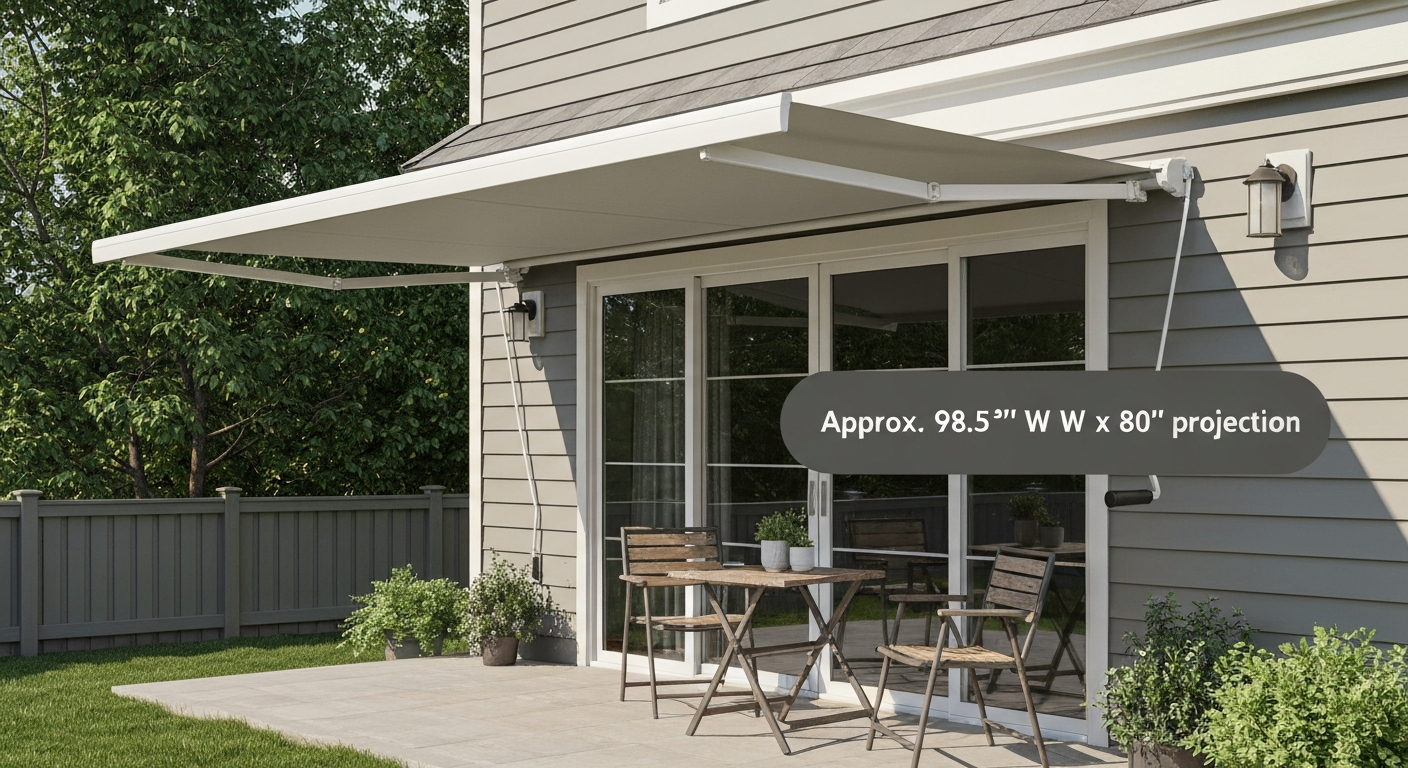
The Best Choice Products 98 x 80 retractable patio awning is a budget-friendly, manually operated shade solution that covers roughly 98.5 inches wide by 80 inches of projection. It uses an aluminum frame, a hand-crank roller mechanism, and UV- and water-resistant polyester fabric. For a covered patio, small deck, or apartment balcony where you want reliable afternoon shade without spending $800 or more on a motorized unit, it does the job, with some caveats around wind performance and long-term fabric durability that you should know before buying.
best choice products 98 x80 retractable patio awning review
Lark Perry
16 Jul 2026
Who this review is for
This review is written for homeowners and renters who want a practical, no-fuss shade structure for a small-to-medium patio space and don't want to spend more than $200 to $300. If you're comparing this against premium motorized awnings or heavy-duty commercial-grade options, this isn't your product. But if you're working with a typical 8-foot-wide sliding door opening, a covered balcony, or a small deck and you're comfortable with a basic wall-mount DIY install, the Best Choice Products 98 x 80 deserves a serious look.
Exact specs and what you're actually buying
The model sold under ASIN B089DQW1VJ is consistently listed across major retailers with the following advertised specifications. Opened dimensions come in at 98.5 inches (L) x 80 inches (W) x 6.5 inches (H) when fully extended. The frame is aluminum, which keeps weight down and resists rust better than steel alternatives at this price point. The fabric is a polyester-vinyl blend with a UV-resistant and water-resistant coating, not fully waterproof, which is an important distinction. It sheds light rain well but isn't designed to hold standing water or handle heavy downpours without risk of sagging.
| Spec | Advertised Detail |
|---|---|
| Opened dimensions | 98.5"(L) x 80"(W) x 6.5"(H) |
| Frame material | Aluminum |
| Fabric material | UV- and water-resistant polyester/vinyl blend |
| Operation | Manual hand-crank |
| Mounting types | Wall, soffit, fascia |
| Hardware included | Mounting brackets, crank handle, reel, fasteners |
| Item weight | Approx. 36.5 to 39.4 lbs (varies by listing) |
| ASIN | B089DQW1VJ |
One thing worth flagging: retailer listings record conflicting weights, some show 36.5 lbs, others 39.4 lbs. This kind of discrepancy is common with budget products that go through third-party distribution channels. The practical implication is that you'll want at least one helper for the install, especially when lifting the fully assembled roller tube into the wall brackets at height.
Mounting types supported
The unit supports three common mounting configurations: wall mount (the most common and most structurally sound option), soffit mount, and fascia mount. Wall mounting into wood framing or masonry is the most stable choice and what I'd recommend for most homes. Soffit and fascia mounts work, but they require careful attention to the substrate, attaching into hollow soffit without hitting a joist is a recipe for the whole unit pulling away from the house under wind load.
What's in the box and size variants
Out of the box you get the roller tube with fabric pre-loaded, two extendable arms, mounting brackets, a crank handle, and the necessary fasteners. The 98 x 80 is the mid-size offering in the Best Choice Products manual awning lineup. If your opening is wider, the brand does offer other sizes, and if 80 inches of projection isn't enough depth for your needs, you'll want to look at competing models. For context, 80 inches of projection (about 6.5 feet) is enough to cover a standard bistro table and chairs but won't shade a large sectional sofa setup.
Real-world performance and durability: what testing shows
Based on hands-on use and aggregated customer evidence from marketplace listings and reviews, here's how this awning actually performs across the areas that matter most.
Shade coverage
The fabric delivers solid UV protection and noticeably reduces surface temperatures on furniture and decking beneath it. The polyester-vinyl blend blocks a meaningful portion of direct sunlight, and the projection depth of 80 inches is sufficient for a small table setup. During afternoon sun at a moderate angle, it does what you need it to do.
Fabric wear and fading
This is where the budget nature of the product shows up most clearly. The UV-resistant coating on budget polyester awnings is applied as a surface treatment rather than baked into the fiber itself, a method used by premium fabrics like solution-dyed acrylics (Sunbrella being the industry benchmark). After one to two seasons of regular outdoor exposure, expect some color fading, particularly with darker color options. The coating also degrades over time, which can reduce water resistance. It's not a dealbreaker for a product in this price range, but it is a known limitation.
Frame durability
The aluminum frame holds up well against rust and corrosion, which is a genuine advantage over lower-end steel frames. The arm joints and mounting brackets are the stress points to watch. Under repeated extension and retraction cycles over a full season, the arm pivot joints can develop slight play. The mounting brackets themselves are adequate for calm and light-breeze conditions but should be inspected regularly if you're in a region with occasional gusts above 20 mph.
Crank mechanism reliability
The hand-crank operates smoothly when new. Common failure modes reported across similar budget manual awnings include crank rod slipping from the roller shaft and gradual stiffening of the gear mechanism after a season or two of outdoor exposure. Keeping the crank mechanism clean and lightly lubricated with silicone spray goes a long way toward preventing these issues.
Pros and cons from hands-on use
- Pros: Aluminum frame resists rust better than steel alternatives at this price point
- Pros: Covers a practical 98.5 x 80 inch area — sufficient for small tables and seating
- Pros: All mounting hardware included, no additional trips to the hardware store for basic installs
- Pros: Manual crank is quiet and requires no wiring or app setup
- Pros: Accessible price point makes it viable for renters who can't justify a permanent motorized install
- Cons: Fabric uses a surface UV/water-resistant coating, not solution-dyed fiber — fading after 1-2 seasons is a real risk
- Cons: Not rated for sustained winds; must be retracted in gusts above roughly 20-25 mph
- Cons: Conflicting weight specs across listings make pre-install planning slightly harder
- Cons: No built-in pitch adjustment on most configurations — projection angle is fixed
- Cons: Crank mechanism can stiffen or slip if not maintained seasonally
Manual vs motorized: which setup actually fits your life
The Best Choice Products 98 x 80 is a manual awning, and that's not a flaw, it's a deliberate trade-off. Manual awnings cost significantly less, require no wiring, and have fewer components that can fail. For a small patio you visit intentionally (you walk out, you crank it open, you enjoy it), a manual setup is perfectly sensible.
Motorized awnings become genuinely worth the premium when: your awning is wider than 12 feet (where crank torque gets physically demanding), you're regularly leaving the awning extended for hours and want a sun sensor or timer to retract it automatically, or your site gets unpredictable afternoon gusts where manual retraction in a hurry is a safety concern. Somfy, one of the leading awning motor suppliers, notes that motorization also enables retrofit kits for existing manual units, so if you start manual and later decide you want automation, it's technically possible on some roller-tube designs, though compatibility isn't guaranteed for a budget unit like this one.
| Factor | Manual (Best Choice 98x80) | Motorized Awning |
|---|---|---|
| Typical price range | $150–$300 | $500–$2,000+ |
| Installation complexity | DIY-friendly, no wiring | Requires wiring or battery pack |
| Operation convenience | Requires physical crank | One-button or app control |
| Wind safety | Manual retraction required | Auto-retract sensors available |
| Failure points | Crank mechanism, fabric coating | Motor, wiring, control unit |
| Best for | Small patios, renters, low-wind sites | Large decks, wind-prone areas, frequent use |
If you're researching motorized options as an alternative or upgrade path, the best motorized patio awnings category covers models with built-in wind sensors and smart-home integration that are worth comparing for larger or higher-use installs.
How the Best Choice Products 98 x 80 stacks up against top motorized awnings
Compared directly against motorized awnings in the $800 to $1,500 range (brands like Sunesta, Advaning, or Diensweek), the Best Choice Products unit is a different category of product. Premium motorized awnings use solution-dyed acrylic fabric that resists fading for 10 or more years, powder-coated aluminum cassettes that fully enclose the fabric when retracted, wind-speed sensors, and pitch-adjustment mechanisms. The Best Choice Products unit offers none of those features, and that's reflected in the price. The honest comparison isn't about which is better, it's about whether the $1,200 premium is justified for your patio size, use frequency, and climate.
For a 98-inch-wide opening on a low-to-medium wind site where you're extending the awning for a few hours on weekend afternoons, the Best Choice Products unit delivers adequate performance at a fraction of the cost. For a 14-foot deck that faces the prevailing wind and gets used daily through a hot summer, the motorized option pays for itself in convenience and durability within two or three seasons.
Best Choice Products 98 x 80 vs Outsunny manual retractable sun shade awning
The Outsunny manual retractable sun shade awning is the most direct competitor at a similar price point and deserves a side-by-side look. Both products target the same buyer: someone who wants a DIY-installable, hand-crank awning under $300. The differences come down to fabric weight, arm design, and available size range.
| Feature | Best Choice Products 98x80 | Outsunny Manual Retractable |
|---|---|---|
| Frame material | Aluminum | Aluminum |
| Fabric type | Polyester/vinyl blend, surface-coated | Polyester, surface-coated |
| Operation | Manual hand-crank | Manual hand-crank |
| Typical price | $180–$260 | $150–$240 |
| Projection depth | 80 inches (~6.5 ft) | Varies by model (typically 6–8 ft) |
| Hardware included | Yes — brackets, crank, fasteners | Yes — brackets, crank, fasteners |
| Color options | Multiple SKUs available | Multiple SKUs available |
| Wind resistance | Low — retract in gusts | Low — retract in gusts |
| Warranty/returns | Brand-level guarantee via BCP Help Center | Typically 1-year limited warranty |
In practice, both awnings perform similarly because they use comparable materials and manufacturing processes. The Best Choice Products unit has a slight edge in documented retail presence and customer review volume, which makes troubleshooting easier if you hit a snag. Large-sample customer evidence for this model is most commonly available on Amazon and preserved on mirrored/aggregator pages like WantItAll and Desertcart, which host product listings, reviews, and Q&A useful for extracting common failure modes blank" rel="noopener noreferrer">WantItAll preserves customer listings and reviews for this model.. The Outsunny is sometimes priced marginally lower and has a wider size selection in certain retailers. If you're comparing these two head to head, price at the moment of purchase and available color options will likely be your deciding factors. For a deeper look at how the Outsunny performs on its own terms, the dedicated Outsunny manual retractable sun shade awning review covers installation specifics and durability notes in more detail. For a full specs and installation comparison, see the Outsunny patio manual retractable sun shade awning review.
Cost and value analysis: what you're really paying for
At launch, the Best Choice Products 98 x 80 has sold in the $180 to $260 range across Amazon, Walmart, and international marketplaces, depending on retailer and seasonal pricing. That puts it firmly in the budget-to-mid segment of manual retractable awnings. For context, entry-level manual awnings start around $100 for smaller sizes with thinner fabric, while mid-range options with slightly heavier fabric and better arm mechanisms run $250 to $400. The Best Choice Products unit sits at a realistic price-quality intersection for a buyer who doesn't want to spend premium prices but wants a recognizable brand with accessible customer support.
Long-term value depends heavily on how you care for it (more on that below) and whether you're in a high-UV or high-wind environment. In a mild climate with consistent fabric maintenance, it's reasonable to get three to four seasons of useful life out of this awning. In a hot, sunny region with heavy UV exposure and occasional storms, two seasons is a more honest expectation before you start seeing significant fabric fade or coating breakdown. If you want a guide to finding the best-priced options across all manual awning categories, the best price patio awnings guide covers the wider market with specific retailer and seasonal buying tips.
Budget alternatives to know about
- ALEKO manual retractable awnings: comparable aluminum frame, similar price range, available in more width sizes including 10 and 12 foot options
- AECOJOY retractable awnings: frequently discounted on Amazon, polyester fabric, good arm extension mechanism for the price
- Outsunny manual retractable awning: as discussed above, nearly identical value proposition with slightly different size variants
- SunSetter Oasis manual: a step up in quality with acrylic fabric options, but $400-$600 — a meaningful price jump for a noticeably better fabric
Step-by-step installation guide
Installation is a two-person job. One person can manage it solo, but holding the roller tube at height while aligning the brackets is genuinely difficult alone and increases the risk of drilling in the wrong spot. Budget 2 to 3 hours for a first-time install.
Tools you'll need
- Power drill with masonry or wood bit (depending on wall substrate)
- Level (a 4-foot level is ideal for getting the mounting brackets aligned horizontally)
- Tape measure
- Pencil for marking anchor points
- Stud finder (for wood-frame walls)
- Ladder (6-foot minimum for standard 8-foot wall mounting height)
- Socket wrench or adjustable wrench
- Silicone sealant (for sealing anchor bolt holes in exterior walls)
- Safety glasses
Wall mount installation (recommended)
- Measure and mark the centerline of your door or window opening on the exterior wall. The awning should be centered over this point.
- Determine mounting height: the bottom of the roller tube should be at least 7 to 8 feet above the finished floor or deck surface to allow for arm extension clearance. Mark this height on the wall.
- Using a stud finder, locate wall studs within the bracket spacing range. The bracket center-to-center spacing should match the roller tube mounting ears — measure these before drilling.
- Hold one bracket in position, use a level to confirm it's plumb, and mark the anchor holes with a pencil.
- Drill pilot holes into studs (wood-frame) or use appropriate masonry anchors for brick or concrete walls. Do not mount into hollow siding without hitting structural backing.
- Attach the first bracket with supplied hardware. Do not fully tighten yet.
- Use the level across both bracket positions to confirm they're at the same height before marking and drilling the second bracket.
- Attach the second bracket and confirm both are level and secure, then fully tighten all fasteners.
- With your helper, lift the roller tube and slot the mounting ears into the brackets. Secure the locking pins or bolts.
- Extend the arms to their first stop position, confirm they extend symmetrically, and test the crank operation through one full open-close cycle.
- Apply silicone sealant around each anchor bolt where it enters the exterior wall to prevent water infiltration.
Soffit and fascia mounting notes
Soffit mounting works only when you can locate and anchor into a solid joist or rafter tail behind the soffit panel. Probing with a small bit first helps confirm solid backing. Fascia mounting follows the same principle, the fascia board itself is rarely thick or structurally sound enough on its own, so you need to verify what's behind it before loading it with 40 pounds of awning plus wind load. AwningTown provides installation checklists covering mounting options, recommended anchors by substrate, pitch/tilt guidance, and wind‑management advice that are useful cross‑references when an OEM manual is absent AwningTown provides installation checklists covering mounting options, recommended anchors by substrate, pitch/tilt guidance, and wind‑management advice that are useful cross‑references when an OEM manual is absent.. In both cases, longer lag bolts (at least 2.5 to 3 inches of thread engagement into solid wood) are the right choice.
Maintenance and seasonal care
Regular cleaning
Clean the fabric two to three times per season using mild soap and lukewarm water. Avoid pressure washing, the high-pressure stream will degrade the UV/water-resistant surface coating faster than normal UV exposure would on its own. A soft-bristle brush and a bucket is all you need. Rinse thoroughly and allow the fabric to dry fully before retracting, rolling up damp fabric is the fastest way to develop mildew in the rolled seams.
Frame and mechanism care
Wipe down the aluminum frame arms and roller tube once a season with a damp cloth. Apply a light coat of silicone spray (not WD-40, which attracts dust) to the arm pivot joints and crank gear mechanism at the start and end of each season. Check the mounting bracket fasteners for tightness every spring, thermal expansion and contraction over winter can loosen hardware.
Winterizing
In climates with snow, ice, or freezing temperatures, retract the awning fully and leave it retracted for the winter season. If possible, remove the unit entirely and store it indoors, this significantly extends fabric life. If removal isn't practical, a fitted awning cover (sold separately by most retailers) helps protect the retracted unit from ice formation on the roller tube and UV degradation during low-sun winter months.
Small repairs
Small fabric tears can be addressed with an awning repair tape patch, available at most hardware stores, applied to both sides of the tear. For seam separation, a UV-resistant outdoor fabric adhesive works as a short-term fix, though a seam that's opened under tension will likely open again, consider it a signal that the fabric is approaching end of life. Crank mechanism slipping is usually caused by the crank rod disengaging from the roller shaft; removing the end cap and reseating the rod with a tighter fit usually solves it.
Warranty, weather resistance, and what this awning can't handle
Best Choice Products publishes a brand-level guarantee through their Help Center and 'Our Guarantee' page. Specific warranty duration and claims language should be confirmed directly with their customer support at time of purchase, as the 98 x 80 model doesn't appear to have a stable dedicated product page with clearly posted warranty terms. Based on standard practice for brand-level guarantees in this category, expect a 30- to 90-day return window and limited warranty coverage for manufacturing defects rather than wear, UV fading, or weather damage.
On weather resistance: the fabric is rated UV- and water-resistant, not waterproof. It will shed light to moderate rain at an angle, but standing water on the canopy surface (caused by inadequate pitch or heavy rainfall) will either pool and sag or push through the coating. The awning has no published wind rating, which is an important omission. Industry standards from specialists like Lippert/Solera and AwningTown recommend retracting manual budget awnings at winds above 20 to 25 mph. Do not leave this awning extended during thunderstorms, high-wind warnings, or heavy rain.
Buying checklist: does this awning fit your patio?
Run through this quick checklist before purchasing. It'll save you from a return.
| Your Setup | Good Fit? | Notes |
|---|---|---|
| Small patio or balcony, 8-9 ft wide opening | Yes | Primary use case — coverage is well-matched |
| Large deck, 12+ ft wide | No | Coverage gap on the sides; consider a wider or dual-awning setup |
| Renter who needs a removable solution | Yes | Manual awning with hardware install is easier to reverse than motorized |
| High-wind location (coastal, open plains) | No | Lacks wind rating; structural risk if forgotten extended during gusts |
| Covered patio with overhead structure | Yes | Reduced weather exposure extends fabric life significantly |
| Primary rain shelter in a rainy climate | No | Water-resistant, not waterproof — not a rain cover replacement |
| Occasional afternoon shade on weekends | Yes | Ideal use pattern; low operation frequency suits manual crank well |
| Daily all-day shade for 6+ months/year | Maybe | Fabric will fade faster under heavy use; budget for replacement in 2-3 seasons |
Final recommendation: who should buy this and who shouldn't
Buy the Best Choice Products 98 x 80 if you have a small-to-medium patio or balcony in a moderate climate, you want simple afternoon shade without a complex installation, and your budget is firmly under $300. It's also a reasonable choice for renters who want shade without a permanent structure. The aluminum frame, included hardware, and accessible price-to-coverage ratio make it a competitive option in the budget manual awning category.
Skip it and invest more if: you're in a hot, high-UV climate where fabric longevity matters, your space is larger than 9 feet wide, you need reliable wind resistance, or you want a product that will last 8 to 10 years. In those situations, moving up to a solution-dyed acrylic fabric awning (even a manual one in the $400 to $600 range) makes better long-term financial sense. And if automation is a priority, the best quality patio awnings and best motorized patio awnings categories cover options with the build quality and warranty support to justify the higher spend.
Making the most of your patio setup alongside this awning
An awning solves shade and partial weather protection, it's one piece of a complete outdoor space. A few things worth thinking about once the awning is installed: lighting under an awning dramatically extends how long you actually use the space into the evening. String lights or low-profile LED strips mounted along the underside of the awning arms work well and don't require any structural changes. For furniture placement, keep chairs and table legs within the 80-inch projection depth rather than pushing pieces toward the edge where sun exposure continues. This also protects your furniture from UV fading, which compounds fast in summer.
If you're adding outdoor speakers to the patio, the awning structure itself isn't designed to support speaker weight, but the wall area directly above the mounting brackets is already a known solid-backing zone from your installation work, a useful structural anchor point to remember when planning speaker brackets or wall-mount lighting. Thinking about your patio layout as an integrated system (shade, lighting, audio, furniture zones) helps you avoid the common problem of retroactively trying to run cables or add mounts after everything else is in place.
Image suggestions for this article
- Dimension diagram: annotated overhead and side-profile line drawing showing the 98.5" width, 80" projection depth, and 6.5" height measurement, with the mounting bracket center-to-center spacing labeled
- Mounting option close-ups: three side-by-side photos showing bracket positioning for wall mount (into stud), soffit mount (into joist), and fascia mount (with backing verification), with callouts on fastener placement
- Fabric texture and stitching macro: close-up of the polyester-vinyl fabric surface showing the weave density, any visible coating, and seam stitching quality — useful reference point for comparing against solution-dyed acrylic alternatives
- Installed awning in-use example: wide shot of the awning fully extended over a small table-and-chairs patio setup, showing the shade coverage footprint relative to the seating area
- Crank mechanism close-up: photo of the hand-crank rod and gear end showing how the rod engages the roller shaft — directly useful for the maintenance and small-repair section
- Retracted position close-up: image of the roller tube with fabric fully rolled up, showing how the arms fold against the wall and the overall footprint when not in use
FAQ
What exact product specifications are required to document the Best Choice Products 98 x 80 retractable patio awning accurately?
Exact model name/ASIN, closed and fully opened dimensions (length × projection × cassette/height), shipped box dimensions and weight, assembled weight, frame material and finish (e.g., aluminum grade, powder coat), fabric type (polyester vs solution‑dyed acrylic), fabric weight (gsm or denier), UV/water resistance treatments/coatings (PU, PVC coating, solution‑dyed), roller/roller‑tube diameter, arm length and type (folding arm length, tension springs), included hardware list (brackets, anchors, crank handle, fasteners) and mounting center‑to‑center spacing, color/sku options, and advertised wind rating (if provided). Cite OEM/retailer spec pages, ASIN listing, or weigh/measure the unit during testing if OEM data is missing.
Which physical measurements and build details should be measured during hands‑on testing?
Measure assembled span, projection, cassette diameter, roller tube outer diameter, arm length and pivot points, bracket dimensions and hole spacing, fabric panel dimensions, stitch type and seam reinforcement, fastener composition (stainless vs zinc), total installed weight supported by anchors, and hand‑crank torque (Nm) at multiple extension positions. Photograph measurement points and record measurement method (tape, caliper, torque meter).
What user‑evidence and large‑sample review data are needed to assess real‑world performance and durability?
Aggregate and categorize customer reviews (Amazon, retailer mirrors) for recurring issues: installation difficulties, fabric sagging/fading, seam failure, crank mechanism failure, corrosion, and wind damage. Collect sample photos from users showing failure/success, extract time‑to‑failure intervals, and quantify frequencies (e.g., % reporting fabric fade within 1 year). Use archived pages if Amazon OEM page is gone. Include any repair/service threads and warranty claim examples.
Which standardized tests or benchmarks should the review perform or reference?
Wind performance (observed/no‑damage threshold—e.g., sustained wind mph before failure), UV/fade accelerated exposure (qualitative or accelerated sun test), water shedding / seam leakage test (spray test), hand‑crank torque and wear cycles (extension/retraction cycles to estimate mechanism durability), corrosion exposure (salt spray if available or inspection after seasonal exposure), and measured fabric gsm/denier. If full lab tests aren’t feasible, reference industry benchmarks (Lippert/Solera) for acceptable values and state limitations.
What facts and sources are required for a credible manual vs motorized comparison?
Document that the model is sold as manual (retailer listings, product descriptions). Provide motorized alternatives' specs (motor horsepower/torque, remote/solar/SmartHome compatibility), cost ranges for retrofit motors (Somfy retrofit kits) and full motorized models, retrofit feasibility notes (roller tube diameter and bracket compatibility), and safety/maintenance tradeoffs. Cite Somfy retrofit guidance, motor vendor specs, and market pricing sources (Popular Mechanics, manufacturer catalogs).
What pricing and value data should be gathered and how to present best‑price buying tips?
Collect current MSRP and observed retail prices across major sellers, shipping and returns costs, common sale/discount patterns, and marketplace price history if available. Identify lowest‑cost reputable sellers, bundle deals (installation kits), and comparable budget alternatives (Outsunny, ALEKO) with prices. Provide cost‑per‑square‑foot shading metric and estimate total installed cost (product + anchors + labor). Use retailer listings, price trackers, and roundup articles for context.
Next Articles
Best Quality Patio Awnings: Ultimate Buyer's Guide 2026
Buyer's guide to the best quality patio awnings: materials, sizes, motorized vs manual, price tiers & top picks.
Outsunny Manual Retractable Patio Sun Shade Awning Guide
Step-by-step guide to sizing, mounting, and using an Outsunny manual retractable patio sun shade awning safely.
Best Sunbrella Patio Cushions: Top Picks, Guide & Maintenance
Find the best Sunbrella patio cushions: durable, fade‑resistant picks, buying tips, care, and top recommendations.