
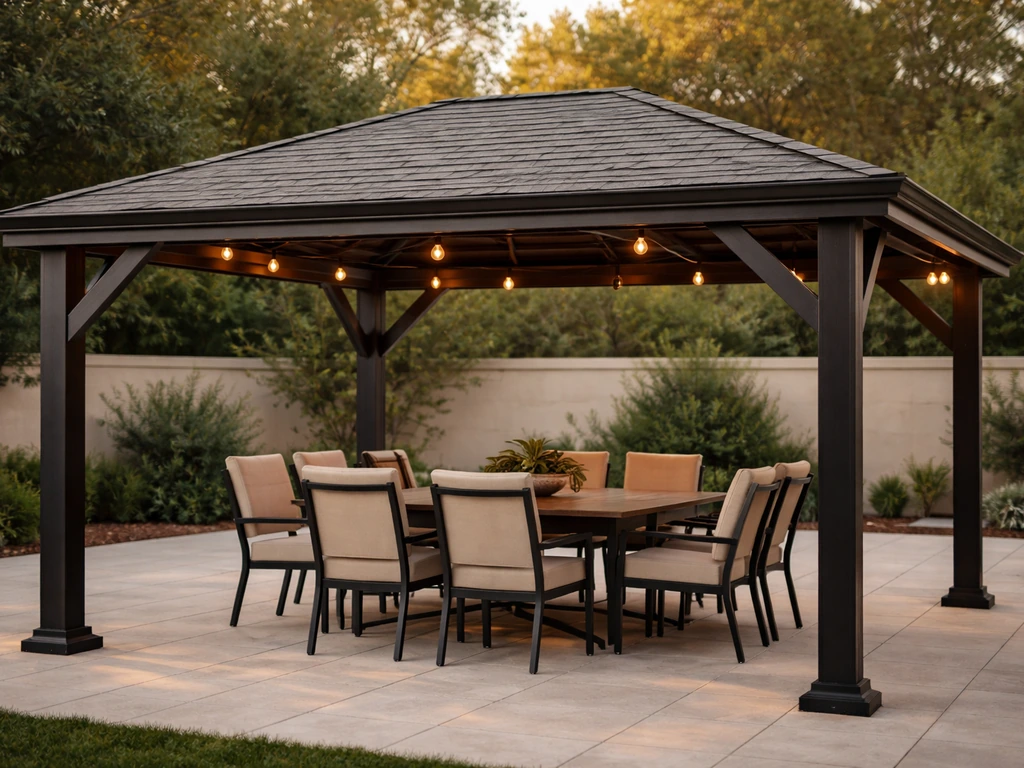
A black hard-top galvanized steel gazebo is one of the most durable permanent shade structures you can put on a patio. It combines a powder-coated galvanized steel frame with a rigid roof (either steel panels or twin-wall polycarbonate) that stays up year-round, handles real wind loads, and doesn't need to be swapped out every few seasons like a fabric canopy. If you want something you build once, anchor properly, and mostly forget about, this is the category to shop.
Outdoor Patio Black Hard Top Galvanized Steel Gazebo Guide
Lark Perry
17 Jul 2026
What a black hard-top galvanized steel gazebo actually is
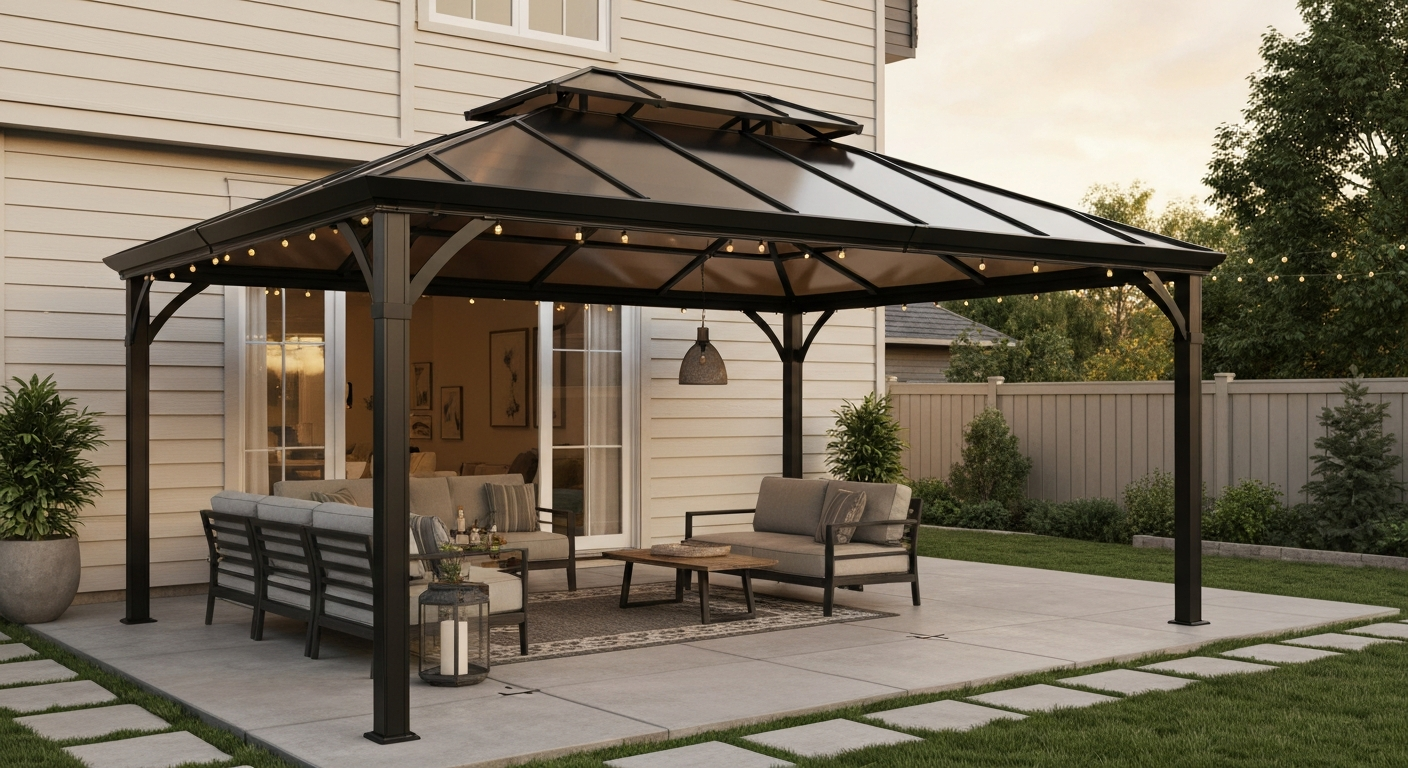
The name bundles several things together, so it's worth unpacking them. The frame is steel, typically hot-dip galvanized (zinc-coated through a metallurgical bonding process per ISO 1461 or ASTM A123) and then finished with a powder-coat topcoat in matte or semi-gloss black. The roof is rigid, not fabric. Depending on the model, the rigid roof panels are either double-layer galvanized steel (like the Outsunny 10x14 or the Sunjoy line) or twin-wall polycarbonate panels (like the Palram Canopia Martinique, which uses 6 mm twin-wall polycarbonate). Both count as 'hard tops,' but they behave differently in terms of UV transmission, weight, and long-term maintenance, which I'll cover in detail below.
You should choose this type over a soft-top or pop-up when you have a permanent patio footprint, you live somewhere with real weather (wind, snow, or heavy rain), or you want to mount accessories like ceiling fans, pendant lighting, outdoor speakers, or mosquito netting hardware without worrying about the frame flexing or the canopy tearing. Hard-top steel gazebos are also the right call if you want a structure that reads as a genuine outdoor room rather than a temporary tent.
Hard-top vs soft-top vs pop-up: which one actually fits your situation
I've used all three types on patios over the years, and the honest answer is that each one serves a genuinely different purpose. The problems start when people buy the wrong type for their situation because the price was right or the photos looked good.
| Feature | Black Hard-Top Steel Gazebo | Soft-Top Steel Gazebo (e.g., Laurel Canyon Beige) | Pop-Up Gazebo |
|---|---|---|---|
| Roof material | Steel panels or twin-wall polycarbonate | Polyester or solution-dyed fabric canopy | Polyester fabric on folding scissor frame |
| Frame material | Hot-dip galvanized/powder-coated steel | Steel or steel/metal hybrid | Lightweight steel or aluminum |
| Wind resistance (published) | Up to 50–56 mph (Sunjoy/Palram specs) | Lower; fabric creates more wind drag | Very low; not rated for sustained wind |
| Snow load (published) | ~15–16 psf / up to 3,500 lb full roof (Sunjoy) | Not rated; fabric must be removed | Not rated; frame collapses under load |
| Canopy replacement cost | None (rigid panels last with structure) | ~$80–$200 every 3–5 seasons | Frequent; frame also wears out faster |
| Expected service life | 8–15+ years with proper anchoring | Frame 8–12 yrs; canopy 3–5 yrs | 2–5 years light use; portable/temporary |
| Upfront cost (typical range) | $500–$2,500+ | $300–$900 | $100–$500 |
| Permanence | Semi-permanent to permanent | Semi-permanent | Portable/temporary |
| Speaker/fan mounting | Excellent; built-in ceiling hooks standard | Limited; fabric ceiling can't hold hardware | Not suitable |
| Assembly complexity | Moderate to high (2–4 people, 4–8 hrs) | Moderate (2 people, 2–4 hrs) | Low (1–2 people, 30–60 min) |
The Laurel Canyon beige soft-top steel/metal style is a solid middle-ground option if you're renting, moving in a year or two, or genuinely don't need all-season coverage. The steel frame holds up well, and the beige fabric reads cleanly on most patios. The tradeoff is real though: you will replace that canopy, and in any serious storm you'll wish you'd taken it down first. For a permanent setup where you want to run speaker wire, mount a ceiling fan, or hang outdoor lighting, the soft-top just doesn't give you the structural ceiling to work with.
Pop-up gazebos are a different tool entirely. They're great for weekend markets, camping, or a party where you need shade for one afternoon. Under sustained wind, even modest gusts above 30–35 mph, the scissor-frame legs and stake clips fail. I wouldn't put one on a permanent patio and expect it to last a season intact, let alone longer.
Durability, wind, and snow: what the specs actually mean in real life
Manufacturer wind ratings look reassuring on a product page, but they come with conditions. Sunjoy publishes a 50 mph wind rating for several of their hard-top steel models. Palram's Martinique line is tested to roughly 56 mph. Those numbers assume the gazebo is correctly assembled, fully anchored with anchor bolts through a concrete or paver slab, and operating in open terrain. If you skip the anchoring step or the structure is placed in a wind funnel between two buildings, those ratings mean nothing.
Snow load is where hard-tops genuinely separate from the field. Sunjoy's published full-roof snow capacity is 3,500 lb, and the Outsunny 10x14 rates at roughly 16.39 psf (about 80 kg/m²). That covers most residential ground snow loads in the continental U.S. outside of very high-elevation mountain zones. To find your site-specific design snow load, the ASCE 7 Hazard Tool is the authoritative resource: you put in your zip code and get the ground snow load and wind speed parameters engineers would use for that exact location. If you're in a heavy-snow zone (New England, the Rockies, the upper Midwest), compare your local ground snow load against the manufacturer's rated roof snow capacity before you commit to a model.
Common failure modes I've seen (and that show up consistently across editorial reviews) tell you more than the headline specs. For hard-tops, the primary failures are improper anchoring in high-wind events and localized corrosion at scratched powder-coat joints. For soft-tops, it's UV-degraded fabric and seam/grommet failure. For pop-ups, it's scissor-leg and stake-clip failure in even modest winds. Hard-top steel is the most resilient category, but only when anchored correctly.
Rust resistance, finishes, and corrosion protection
Not all galvanized steel is the same, and this matters more than most product listings let on. Hot-dip galvanizing (the process specified by ISO 1461 and ASTM A123) creates a metallurgically bonded zinc-iron alloy layer that is substantially thicker and more durable than electrogalvanized coatings. A common minimum specification for outdoor galvanized sheet is the G90 designation under ASTM A653, which equals about 0.90 oz/ft² of zinc coating on both sides combined (roughly 275 g/m² in EN units). Better consumer products spec G90 or higher; budget frames sometimes use lighter coatings.
Most consumer hard-top steel gazebos use a two-layer system: hot-dip galvanized or galvanized sheet as the base, then a powder-coat topcoat in black (or whatever color is specified). The powder coat handles UV protection and cosmetics; the zinc layer provides sacrificial corrosion protection if the topcoat gets scratched. The problem is that manufacturer warranties (Sunjoy's standard 1-year limited warranty, Outsunny's 1-year limited warranty) explicitly exclude corrosion from scratched paint. That exclusion isn't unfair, but it does mean you need to take scratches seriously: touch them up promptly with a zinc-rich primer and a color-matched topcoat. Any scratch that exposes bare steel without the zinc underneath will rust visibly within a single rainy season.
For coastal or high-humidity environments, the coating spec matters even more. In those conditions, I'd specifically look for models that describe hot-dip galvanizing rather than generic 'galvanized steel' and check whether the hardware (bolts, brackets, anchor plates) is stainless or hot-dip galvanized. A beautiful powder-coated frame can be undermined entirely by rusting fasteners at every joint.
UV protection, appearance, and how the structure ages
The UV story depends on which roof panel type your gazebo uses. Steel panel roofs provide full UV blockage since they're opaque, but they also run hotter underneath, especially in direct sun. Twin-wall polycarbonate roofs (like the 6 mm panels on the Palram Martinique, rated UPF 50+ by some retailers) allow diffused light through while blocking the majority of UV. Quality twin-wall polycarbonate uses a co-extruded UV protective layer on the outer surface. When installed correctly (UV side outward, panels allowed to expand/contract thermally, sealed with appropriate tape and not abrasive cleaners), quality panels are expected to last 10–15 years. Palram backs the Martinique with a 10-year limited warranty, which is a meaningful signal about expected longevity compared to the 1-year coverage standard on most steel-panel models.
Aesthetically, black powder coat holds up well outdoors compared to lighter colors that show chalking and oxidation more obviously. Over time, the matte or semi-gloss black will lose some sheen and may show micro-scratches from cleaning, but a light re-spray with a compatible outdoor powder-coat-matching aerosol paint every few years keeps it looking sharp. The black color also creates a strong visual anchor on a patio: it grounds furniture groupings and contrasts well against wood decking, stone pavers, or light-colored exterior walls.
One real-world appearance note: if you go with a steel panel roof rather than polycarbonate, expect the interior ceiling to show condensation drips in humid climates unless the panels have a condensation-channeling or drainage design. Several models address this with integrated gutter systems (Palram's Martinique includes gutter clips and channels). Check whether the model you're considering has this feature, because retrofitting gutters onto a gazebo without designed anchor points is a nuisance.
Cost, value, and the lifecycle math
Hard-top steel gazebos run $500 to $2,500 or more at retail depending on size, roof type, and brand. That's meaningfully more upfront than a soft-top (roughly $300 to $900) or a pop-up ($100 to $500). But the lifecycle economics favor the hard-top once you run the numbers honestly. Independent buyer guides reach the same conclusion, Gazebo Comparison, Types & Brands Ranked | GazeboAwnings shows lifecycle costs typically favor hard-top gazebos once canopy replacement and longevity are counted Gazebo Comparison — Types & Brands Ranked | GazeboAwnings.
A soft-top canopy replacement costs $80 to $200 per replacement, and most fabric canopies need replacing every 3 to 5 seasons, sometimes sooner in high-UV or high-wind areas. Over 10 years, that's two to three replacements on top of the original purchase, plus the hassle of finding a compatible replacement canopy for a model that may have been discontinued. A hard-top steel gazebo properly anchored and touched up for scratches can go 10 to 15 years without major material replacement costs. That changes the real comparison significantly.
For renters, the calculation is different. If you're not sure you'll be at the same address in two years, a $1,500 permanent structure is harder to justify than a $400 soft-top you can disassemble and move or abandon without much regret. Hard-tops aren't really portable. They're worth the investment when you're in a stable living situation and treating the patio as a long-term project.
How to pick the best model: what to evaluate before you buy
There's no single best black hard-top galvanized steel gazebo for every patio, but these are the criteria I use to evaluate models and that separate the ones worth buying from the ones that look good in photos and disappoint in person.
Frame and coating specs
- Look for 'hot-dip galvanized' or 'double galvanized' in the spec sheet, not just 'galvanized steel.' The Outsunny 10x14 explicitly lists a double galvanized steel roof, which is a positive signal.
- Powder-coat thickness should be at least 60–80 microns for outdoor durability. Most listings don't publish this, so use brand reputation and warranty length as proxies.
- Check that hardware (anchor bolts, brackets, screws) is stainless or galvanized, not bare zinc-plated. This is one of the most common weak points in budget models.
- Confirm the frame steel gauge. Heavier gauge (lower number, e.g., 14 gauge vs. 20 gauge) means a stiffer, heavier frame that handles wind loads better.
Roof panel type and load ratings
- Steel panels: heavier, fully opaque, run hotter inside but are extremely durable if the coating is intact. Better for areas with heavy snow or where you want maximum weather blocking.
- Twin-wall polycarbonate (6 mm typical): lighter, allows diffused light, UV-protective layer built in. Better for patios where you want some natural light and a less industrial feel.
- Check the published snow load (psf or total lb) and compare to your ground snow load via the ASCE 7 Hazard Tool if you're in a snowy region.
- Check for an integrated gutter system. It's a small feature that makes a meaningful quality-of-life difference in rain.
Sizing and siting
- Allow at least 2 feet of clearance on all sides of the gazebo footprint from walls, fences, or overhangs to avoid wind pressure buildup.
- Common sizes run 10x10, 10x12, 10x14, and 12x16 ft. Measure your patio and leave room for furniture to extend to the edges rather than cramming it under a too-small roof.
- For a full outdoor room feel (furniture grouping, side tables, speaker placement), a 10x12 is a workable minimum; 10x14 or larger gives you real flexibility.
- Check local zoning/HOA rules before ordering. Some jurisdictions require a permit for permanent shade structures above a certain size or height.
Anchoring and installation
- Virtually every hard-top steel gazebo ships with anchor plates or anchor bolts. Use them. This is non-negotiable if you're in a region with wind speeds above 30 mph.
- For concrete or paver slabs: use expansion anchor bolts through the supplied anchor plates into the slab. For wood decks: through-bolt with backing plates, not just screws.
- Plan for 2 to 4 people and 4 to 8 hours of assembly time for most 10x12 or 10x14 models. DIY is realistic with the right crew; solo assembly is not.
- Tools you'll typically need: power drill, socket set, rubber mallet, level, step ladder, and tape measure. Some models require a torque wrench for anchor bolts.
- If you're not comfortable with concrete anchoring or have a complex slab situation, hire a handyman or general contractor for the anchoring step specifically. The frame assembly is usually approachable DIY.
Warranty as a quality signal
Sunjoy and Outsunny both offer 1-year limited warranties covering materials and workmanship defects, excluding acts of nature, improper assembly, and corrosion from scratched coatings. Palram's Martinique carries a 10-year limited warranty. That gap is a real signal about expected product quality and company confidence. A longer warranty doesn't guarantee perfection, but it does mean the company expects to be on the hook for longer, which concentrates their minds on build quality.
Top model picks by use case
| Use Case | Recommended Model Type | Key Specs to Prioritize | What to Watch For |
|---|---|---|---|
| Budget-conscious, moderate climate | Sunjoy steel-panel hard-top (10x12 or 10x16) | Published wind rating ≥50 mph, anchor plates included, ceiling hook standard | 1-yr warranty; touch up scratches immediately |
| Larger patio, want natural light | Outsunny 10x14 double galvanized steel roof | 16.39 psf snow load, double galvanized roof, ceiling hooks, aluminum frame | Explicitly 'do not use in extreme weather'; anchor thoroughly |
| Longest warranty, polycarbonate roof | Palram Canopia Martinique (10x12 or similar) | 10-yr limited warranty, 6mm twin-wall polycarbonate, integrated gutter, ~56 mph wind test | Higher price; panels need UV side installed outward |
| Renter or semi-permanent setup | Soft-top steel/metal gazebo (e.g., Laurel Canyon beige style) | Removable canopy, steel frame, easy disassembly | Canopy replacement every 3–5 seasons; not for heavy snow |
| Occasional use / portable shade | Pop-up gazebo | Lightweight, fast setup, stakedown kit | Not suitable for permanent patio; low wind tolerance |
Maintenance and keeping rust at bay
The maintenance routine for a black hard-top galvanized steel gazebo is genuinely simple if you stay on top of it. The biggest mistake I see people make is ignoring small scratches and paint chips until they become rust spots that are much harder to address.
- Inspect the entire frame twice a year (spring and fall) for scratches, chips, and any discoloration that signals rust starting under the coating.
- Touch up any scratches immediately: clean the area with isopropyl alcohol, apply a zinc-rich primer, let it cure, then topcoat with a color-matched outdoor spray paint.
- Clean the frame with mild soap and water annually. Avoid abrasive pads or pressure washers aimed at joints, which can force water under panel edges and degrade seals.
- If you have polycarbonate panels: clean with a soft cloth and diluted mild soap only. Never use abrasive cleaners, which destroy the UV-protective co-extruded layer.
- Check all anchor bolts and hardware fasteners once a year and retorque any that have loosened.
- In very heavy snow regions: brush accumulated snow off the roof even if the rated load capacity appears adequate, because uneven loading (one side piled up, the other clear) creates lateral stress the structure isn't designed for.
- Lubricate any moving hardware (if your model has adjustable vents or louvers) with a silicone spray, not petroleum-based lubricants that attract grime.
Accessories, sidewalls, and turning your gazebo into a real outdoor room
A bare gazebo is a roof on posts. The accessories are what turn it into a space you actually want to spend time in. Most hard-top steel gazebo manufacturers offer brand-matched sidewall and curtain kits, mosquito netting panels, and privacy screens designed for their specific frame dimensions. Buying brand-matched accessories is worth it, not for brand loyalty reasons, but because the attachment points (velcro loops, curtain rods, grommets) align with the actual post dimensions. Generic curtains hung on clip hooks tend to sag and gap.
For mosquito netting: look for a full-perimeter kit with a zippered entry panel. Partial kits (three sides only) seem like a cost savings until you realize mosquitoes enter from the uncovered side. Netting should be fine enough to stop no-see-ums, not just standard mosquitoes, if you're in a humid or wetlands climate.
Outdoor speaker and wiring integration
This is where a hard-top steel gazebo genuinely outperforms every other category, and it's something worth thinking through before you order. The rigid ceiling and steel frame give you real mounting options that a soft-top or pop-up simply can't match.
Most hard-top models include at least one built-in ceiling hook rated for a ceiling fan or light fixture. Sunjoy's line explicitly includes this. For outdoor speakers, you have two good approaches: ceiling-mount satellite speakers directly to the inner roof framework using weatherproof speaker brackets (the steel frame accepts standard hardware store bolts), or mount compact outdoor speakers to the gazebo posts at ear height. Post mounting is acoustically preferable for most listening, since ear-level placement gives a more direct soundfield than ceiling bounce.
For wiring: plan your wire routing before assembly, not after. The hollow steel posts on most gazebo frames are not accessible once assembled, so surface routing is the practical solution. Use weatherproof in-wall rated cable (at minimum CL2-rated, ideally direct-burial if it runs in any exposed exterior section), secure it with low-profile cable clips rated for outdoor use, and route it along the inner frame where curtains or netting will partially conceal it. If you're running a subwoofer or a multi-zone audio setup, figure out your amplifier location and whether it needs to be weatherproofed or positioned indoors with long cable runs before you start anchoring equipment.
Acoustically, a steel hard-top roof is a reflective surface. High-frequency content bounces off the metal ceiling and can create a slightly harsh, echoey character depending on speaker placement. This is easy to manage: position speakers aimed slightly downward toward the seating area rather than straight horizontal, and if you have curtains or sidewalls up they act as acoustic absorption and significantly clean up the sound. Natural materials on the floor (rugs, wood furniture) help too. A well-tuned outdoor audio setup in a hard-top gazebo can sound genuinely impressive.
Where to find the best deals and when to buy
Pricing on patio gazebos follows a predictable seasonal curve that you can use to your advantage. The peak buying season runs from late March through June, when demand is high and retailers are restocked. Prices are at or near full retail during this window, and popular models sell out fast. The best deals consistently appear in two windows: late summer (August into September, when retailers start clearing floor inventory ahead of fall) and post-holiday winter sales (late November through January). For timing and retailer tips to find the best deals on patio gazebos, see our dedicated buying guide. In the off-season, it's not unusual to see 20 to 40 percent off retail on the previous season's models.
Where to shop: major home improvement retailers (Lowe's, Home Depot) carry multiple brands year-round and match competitors' prices in most cases. Warehouse clubs (Costco, Sam's Club) periodically carry gazebos in season at strong price-to-spec ratios, though selection is limited to one or two SKUs at a time. Amazon carries a wide range but the return process for large freight items is cumbersome, so verify dimensions and specs carefully before ordering. Direct-from-brand sales through manufacturers' websites occasionally offer bundle deals (gazebo plus sidewall kit) that work out better than buying separately. For a broader comparison of models and real-world performance, see our best patio gazebo reviews for head-to-head testing and long-term observations.
For open-box and clearance: big-box stores will often discount display models significantly, especially late in the season. These are worth asking about specifically at the customer service desk even if you don't see floor tags. The main risk is missing hardware, so always open-box inspect for a complete parts manifest against the assembly manual before you take it home.
On price negotiation: traditional retail doesn't offer much negotiation room, but you can stack advantages. Many retailers offer credit card sign-up discounts (10 to 20 percent off first purchase) that apply to large purchases. Price-match guarantees between Home Depot and Lowe's can be used strategically. And for very large orders (gazebo plus furniture plus accessories), it's worth asking a store manager directly about a package discount, especially at the end of a slow weekend. It doesn't always work, but it costs nothing to ask.
Your pre-purchase checklist
Before you pull the trigger on any model, run through these questions. They're the ones that save people from a return process on a 200-pound freight shipment.
- Measure your patio footprint and confirm the gazebo size leaves at least 2 feet of clearance on all sides.
- Check your local ground snow load (ASCE 7 Hazard Tool) and match it against the manufacturer's published roof snow load rating.
- Verify your surface type (concrete, pavers, wood deck) and confirm you have the right anchor hardware and any necessary tools.
- Look up local zoning rules or HOA guidelines for permanent shade structures before ordering.
- Confirm whether the model includes anchor plates, gutter system, and ceiling hooks, or whether these are sold separately.
- Compare the warranty: 1-year (Sunjoy/Outsunny standard) vs. 10-year (Palram Martinique) and decide whether the premium is worth it for your situation.
- Decide on your roof type: opaque steel panels (better for snow, hotter underneath) or twin-wall polycarbonate (natural light, longer UV warranty).
- Plan your accessory needs: sidewalls, netting, speakers, lighting, ceiling fan. Budget for these as part of the total project cost, not as afterthoughts.
- Confirm you have 2 to 4 people available for assembly day and at least a half day blocked off.
- For speaker integration: decide on mounting positions and cable routing path before assembly begins.
FAQ
What is a black hard‑top galvanized steel gazebo and how does it differ from soft‑top and pop‑up options?
A black hard‑top galvanized steel gazebo combines a galvanized steel structural frame with a rigid, weather‑resistant roof (metal panels or polycarbonate) finished in black powder coat. Versus soft‑top: hard‑tops provide permanent weather protection, better snow/wind resistance, longer service life and integrated gutters; soft‑tops (fabric canopies) cost less but need canopy replacement every few seasons and perform worse in wind/sun. Versus pop‑ups: pop‑ups are portable and temporary for events but are not rated for sustained wind/snow and use lightweight frames that bend or fail under load.
What real‑world tradeoffs should buyers weigh (durability, wind/snow, rust, UV, appearance, cost)?
Durability: hard‑tops last 8–15+ years; soft‑tops ~3–5 years for fabric. Wind/snow: properly rated hard‑tops (manufacturer wind speed, published snow load) handle higher loads—anchoring and site exposure matter. Rust resistance: hot‑dip galvanizing + powder coat is best; electrogalvanized is weaker. UV: polycarbonate or painted metal roofs block UV; fabric canopies degrade. Appearance: hard‑tops look more permanent and upscale. Cost: hard‑tops are higher upfront but lower lifetime replacement cost; soft‑tops are cheaper initially but need periodic canopy replacement.
Which hard‑top galvanized steel models or types do experts recommend (top picks and best‑deal tips)?
Look for established models with galvanized frames, powder coat, and solid roof panels: 1) Palram/Canopia Martinique series (polycarbonate panels, integrated gutters, multi‑year warranty) — strong value for all‑season use; 2) Sunjoy hard‑top models — budget‑friendly mass‑market pick with typical features (ceiling hooks, anchoring plates); 3) Outsunny hard‑tops — midrange with double galvanized roofs and ceiling hooks. Best‑deal tips: buy off‑season (fall/winter), watch retailer open‑box/clearance, bundle with retailer coupons, and prefer models that include anchors and decent warranties. Prioritize verified specs (wind/snow ratings, warranty length) over brand hype.
What specific features and specs should be on my checklist before buying?
Materials and finish: hot‑dip galvanized steel frame or G90/Z275‑equivalent galvanized sheet + durable powder coat. Roof panel types: steel/aluminum panels vs twin‑wall polycarbonate (6 mm common) — check UV co‑extrusion, orientation, and thermal expansion allowance. Gutters/drainage: integrated gutters or addable gutter kits. Anchors: included anchor plates/bolt hardware and recommended anchoring method for your substrate. Roof fasteners/seals: gasketing or sealed panels to prevent leaks. Ceiling fixtures: integrated ceiling hooks for lights/fans. Warranties: length and scope (structure vs panels vs fabric). Published ratings: wind speed, roof snow load (psf or total). Repairability: availability of spare panels/canopies and touch‑up paint.
How should I size and site a gazebo on my patio?
Size: base on intended use—dining for 6 needs ~10×12 ft; lounge/entertaining may need 12×16+ ft. Maintain access paths and codes—leave clearance for eaves/doors and local setback rules. Siting: pick a flat, well‑drained area with minimal exposure to prevailing wind or channeling between buildings. Avoid overhanging trees that drop sap/branches. Consider sun path for shade and speaker placement. Check local codes/HOA for attachments and required permits if anchoring to a permanent surface.
How do I choose anchors and prepare footing for different patio surfaces?
Concrete: use expansion or wedge anchors or through‑bolts into 4″+ slab; epoxy anchors for thin slab or increased load. Pavers/brick: use embedded concrete footings under pavers or reinforced anchor plates over a reinforced pad. Wood deck: install ledger‑style mounting with structural blocking under posts and use structural lag bolts or through‑bolts; consult engineer for decks not rated for point loads. Soil: use screw anchors with concrete footings or helical anchors sized by engineer. Follow manufacturer anchor specs and ASCE site parameters for wind/snow to size anchors.
Next Articles
Best Pop Up Gazebo for Patio: Buyer Guide and Picks
Find the best pop up gazebo for patio with size, materials, stability, ventilation, setup tips, and top picks by budget.
Best Deals on Patio Gazebos: How to Buy Smart Today
Find top deals on patio gazebos with smart criteria, pricing, materials, total costs, and timing to avoid cheap mistakes
Best Patio Gazebo Reviews: Buyer Guide and Top Picks
Best patio gazebo reviews with specs, stability, materials, weatherproofing, top picks by budget, and patio sizing check