
The best patio blankets balance warmth, moisture resistance, and durability without being bulky or hard to clean. For most people sitting outside on cool evenings, a midweight acrylic or fleece throw in the 50x60-inch range hits the sweet spot. If you deal with dew, drizzle, or damp furniture, you want something with a waterproof or water-resistant backing. If you're hauling a blanket to the park or beach, packability and a carry strap matter more than anything else. This guide walks through every scenario with specific product picks, material comparisons, and the real tradeoffs between options so you can buy once and get it right.
Best Patio Blankets: Guide to Warm, Waterproof, Packable Picks
Lark Perry
13 Jul 2026
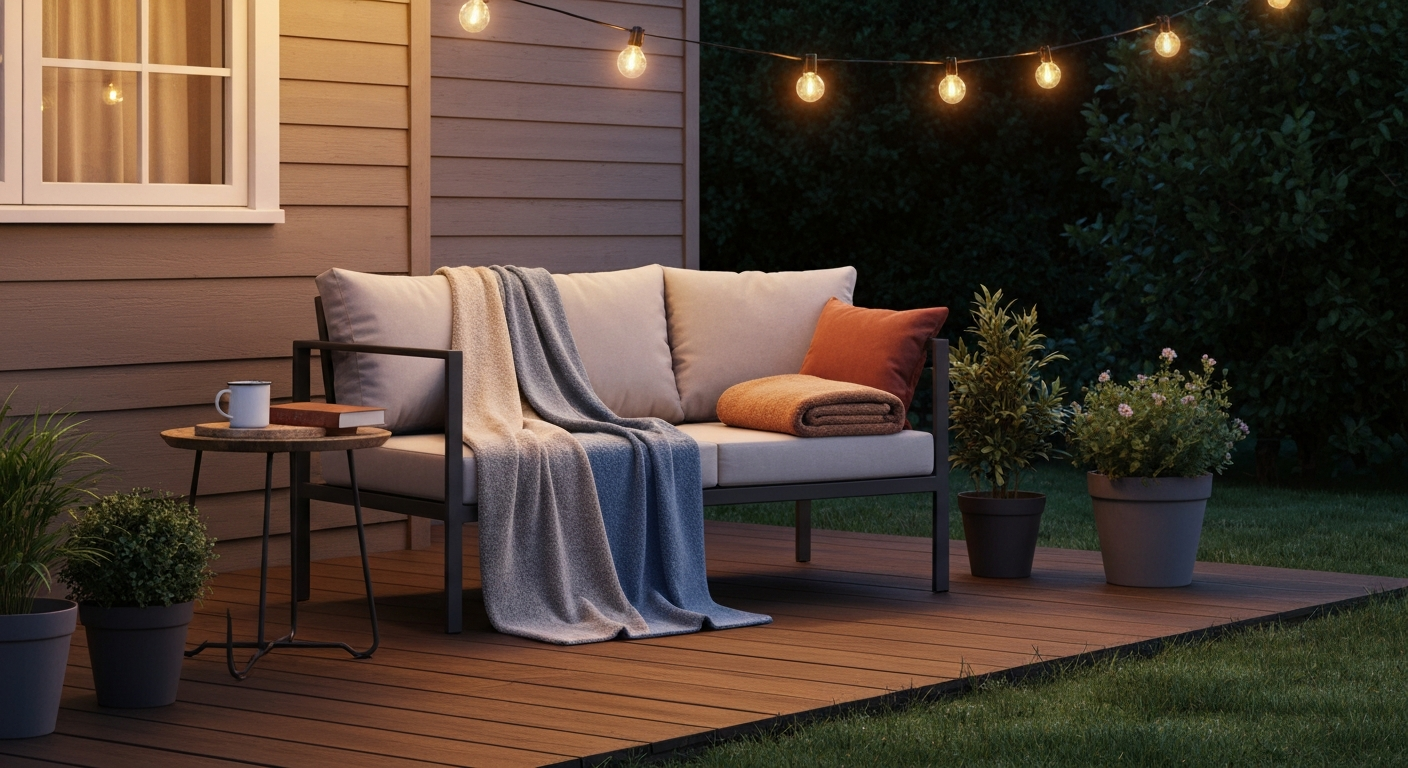
Why patio blankets are worth adding to your outdoor setup
According to the 2026 Houzz U.S. Outdoor Trends Study, 83% of renovated outdoor spaces now include a dedicated lounge or seating area, and 71% feature sofas or lounge chairs. Houzz’s 2026 U.S. Outdoor Trends Study finds “lounging is key”: 83% of renovated outdoor spaces include a lounge/seating area and 71% include sofas or lounge chairs, indicating homeowners prioritize comfort and decor for patios 2026 U.S. Houzz Outdoor Trends Study. That's a lot of people investing real money in outdoor furniture and then sitting outside past sundown, when temperatures drop. A patio blanket is the simplest, cheapest way to extend that time by an hour or two without a space heater. It also adds texture and visual warmth to a space that can look cold and sparse when it's made up of hard furniture and bare surfaces.
Blankets pull double duty in ways that other outdoor accessories don't. A good throw drapes over a sofa back as a decorative accent during the day and gets pulled down when the temperature falls at night. A waterproof picnic blanket handles backyard movie nights, tailgates, and kids' outdoor activities, then folds into its own pouch for storage. No single piece of patio gear does that much for that little money.
Who actually needs a patio blanket
Homeowners with a furnished patio are the obvious audience, but renters benefit just as much. Zillow's 2023 renter research found that roughly half of renters rank private outdoor space as a desirable amenity when choosing housing. Once you have that outdoor space, furnishing it on a renter's budget means you want items that travel with you. A blanket fits in a box when you move. A patio sofa doesn't.
Beyond those two groups, patio blankets make sense for anyone who entertains outside regularly, has young kids who spend time on the grass or deck, or lives in a climate with cool mornings and evenings even in summer. If you're in the Pacific Northwest, New England, or anywhere with shoulder-season temperatures, a blanket isn't optional, it's the thing that makes the patio usable nine months a year instead of five.
- Homeowners looking to extend evening patio use into cooler months
- Renters who want portable, apartment-friendly outdoor comfort
- Families who use the backyard for casual outdoor dining or movie nights
- Entertainers who need extra throws for guests on outdoor seating
- Hikers, campers, and tailgaters who want a multi-use portable blanket
- Anyone dealing with dew or light rain who wants to sit on damp furniture without getting wet
Pick the right blanket for your situation
Before looking at specific products, it helps to narrow down the use case. The blanket that's perfect for draping over a sectional on a 55°F evening is not the blanket you want at a dewy 7 a.m. coffee session on a cold metal chair. Here's a fast way to land in the right category.
| Situation | What to prioritize | Best category |
|---|---|---|
| Chilly evenings on the patio | Warmth, softness, weight, aesthetics | Insulated throw or luxury wool blend |
| Damp/dewy conditions, morning use | Waterproof or water-resistant backing, quick-dry top | Coated/backed outdoor blanket |
| Decorative accent on outdoor furniture | Color, texture, UV resistance, mildew resistance | Acrylic or solution-dyed throw |
| Picnics, park, or tailgate | Packability, carry strap, waterproof backing, cleanability | Packable picnic blanket |
| Budget-conscious buyer | Value per square foot, washability, durability | Polyester fleece or acrylic blend |
What makes a patio blanket good: the performance criteria that matter
Marketing copy on outdoor blankets is full of words like 'cozy' and 'versatile,' which tell you almost nothing. Here are the actual performance factors worth evaluating, explained in practical terms.
Warmth and insulation
Thermal insulation in textiles is measured in clo units, where 1 clo equals 0.155 m²·K/W, a standard derived from ISO 11092 and EN ISO 15831 testing methods using sweating guarded hotplates or thermal manikins. Consumer blankets rarely publish clo ratings, but the proxy is construction: higher loft (more trapped air), denser pile, and thicker fill all increase warmth. A lightweight fleece might be 1.0 to 1.5 clo equivalent; a heavy boiled-wool blanket can exceed 3.0 clo. For most patio use at 45–60°F, something in the 1.5–2.5 clo range is comfortable. If you're regularly sitting outside near freezing, go heavier.
Water resistance and waterproofing
The lab standard for liquid-water resistance is hydrostatic head, measured in millimeters of water column (mm H2O) under ISO 811 or AATCC 127. A blanket rated around 1,500–5,000 mm H2O will handle dew, light rain, and damp surfaces. Above 10,000 mm H2O starts approaching technical waterproof territory, which is more common in outerwear than blankets. For most patio blanket buyers, 1,500–3,000 mm is more than enough. What the number doesn't tell you is how a seam or fold point holds up after repeated use, which is why construction quality matters as much as the rating itself.
DWR and surface repellency
Many blankets use a Durable Water Repellent (DWR) finish on the face fabric, which makes water bead up and roll off rather than soaking in. This is measured by AATCC TM22 spray testing. The catch is that DWR wears off with washing and abrasion over time. If a blanket's water resistance comes mainly from a DWR coating rather than a waterproof backing or membrane, plan to reapply a spray-on DWR product every season or after several washes. Blankets with a coated or laminated backing don't rely on DWR alone and hold up better long-term.
Breathability
Moisture vapor transmission rate (MVTR) tells you how well a fabric lets sweat and body heat escape. Technical waterproof-breathable fabrics score 5,000–25,000 g/m²/day. Most patio blankets with film or PVC backings score much lower, meaning you'll feel clammy if you sit on one for more than a few minutes while active. If comfort during movement matters, look for blankets with microporous PU laminates or thin TPU films rather than solid PVC or PEVA backings, which block almost all vapor transfer. If you're just sitting still on a cool evening, breathability is less critical.
UV and mildew resistance
Blankets left draped over outdoor furniture need to resist both UV degradation and mildew. Solution-dyed acrylic and solution-dyed polyester are the most colorfast options because pigment is embedded in the fiber at the manufacturing stage rather than applied to the surface. UV stabilizer additives in polypropylene and polyester extend outdoor life but degrade over time. Mildew resistance comes down to how quickly a blanket dries: natural fibers like wool hold moisture longer and need to be dried thoroughly before storage. Most synthetic outdoor blankets are treated with antimicrobial finishes, though those also diminish over time.
Durability and weight
Weight matters differently depending on use. A blanket you're packing in a bag needs to be light enough to carry without being a burden. A blanket living on a patio sofa doesn't move much, so weight is less important than abrasion resistance and washability. For packable blankets, look for compressed weight under 2 lbs. For stationary throws, 3–5 lbs is normal and fine. Durability is harder to judge without long-term testing, but high-pile fleece and loosely woven natural fibers tend to pill and snag faster than tightly woven synthetics or high-quality woven wool.
Materials compared: what each fabric actually does outdoors
The material you choose has more impact on long-term performance than almost any other decision. Here's an honest rundown of each common option, including the real downsides that product listings tend to skip.
| Material | Warmth | Water resistance | UV resistance | Durability | Packability | Best for |
|---|---|---|---|---|---|---|
| Wool | Excellent (retains warmth when damp) | Moderate (absorbs moisture but insulates when wet) | Good | High (if quality) | Low (heavy) | Cold evenings, luxury throws |
| Fleece (polyester) | Good | Moderate (wicks but absorbs some moisture) | Fair (fades with UV) | High (light, compressible) | Casual use, budget buys | |
| Acrylic | Good (wool-like feel) | Moderate | Excellent (colorfast) | Moderate (pills) | Moderate | Decorative throws, outdoor color accents |
| Polyester (woven) | Moderate | Moderate to good (with DWR) | Good (solution-dyed) | High | Moderate | All-purpose outdoor blankets |
| Polypropylene | Low | Excellent (hydrophobic, <0.05% moisture regain) | Good (with UV stabilizers) | High | High | Wet conditions, ground contact |
| PU/TPU laminate backed | Depends on face fabric | Excellent (1,500–5,000 mm H2O) | Depends on face | High | Moderate | Damp surfaces, picnics |
| PVC/PEVA backed | Depends on face fabric | Excellent | Moderate | Moderate | Low (stiff) | Budget waterproof, ground blankets |
Wool
Wool can absorb roughly 30–35% of its own weight in moisture before feeling wet, and its crimp structure traps air that maintains insulation even when damp. That's a genuinely useful property for outdoor use in maritime or rainy climates. The tradeoffs are weight (a good wool blanket runs 3–5 lbs), cost, and the fact that it needs careful washing. For a premium patio throw that stays on the sofa and looks great doing it, wool is hard to beat. For anything involving ground contact or regular rain, the weight and care requirements make other materials more practical.
Fleece
Polyester fleece is the workhorse of outdoor blankets. It's lightweight, traps enough air for real warmth in the 45–60°F range, dries quickly, and costs a fraction of wool. The two honest downsides are UV degradation over time (cheap fleece can look faded and brittle after a summer of direct sun) and pilling, which is cosmetic but makes blankets look cheap fast. For a blanket that's going to be washed frequently, shared among kids, or stored away when not in use, fleece is the most practical choice.
Acrylic
Acrylic gives you the soft, slightly fuzzy feel of wool at a lower price point and with significantly better UV and colorfast performance. Acrylic (polyacrylonitrile) fibers provide a wool‑like hand and good intrinsic UV resistance and colorfastness, making acrylic a common choice for outdoor and upholstery throws, though it typically pills and has lower abrasion resistance than polyester Acrylic (polyacrylonitrile) fibers provide a wool‑like hand and good intrinsic UV resistance and colorfastness, making acrylic a common choice for outdoor and upholstery throws, though it typically pills and has lower abrasion resistance than polyester.. Because it's often solution-dyed, colors hold up well in outdoor conditions without special treatment. The weak point is abrasion resistance: acrylic pills faster than polyester and isn't the best choice if the blanket is going to be dragged across rough concrete or used heavily on the ground. As a decorative throw on a lounge chair or sectional that's already protected from the elements, it's excellent.
Polypropylene
Polypropylene fibers have a moisture regain of roughly 0.05% at standard humidity, meaning they're essentially hydrophobic. Water cannot penetrate the fiber itself, which is why polypropylene is dominant in outdoor rugs and is increasingly used in outdoor blankets as well. The limitation is warmth: polypropylene doesn't provide meaningful insulation on its own and is typically used in thinner, flat-woven constructions that aren't as cozy as fleece or wool. It's a good choice when moisture management is the priority over warmth.
Coated and backed options
Many picnic and outdoor blankets combine a soft face fabric (fleece, polyester, or acrylic) with a waterproof backing. The backing materials range from PVC and PEVA film (cheap, waterproof, but stiff and non-breathable) to PU laminate (lighter, more flexible, moderate breathability) to TPU film (thinner, lighter, better breathability than PVC). PU-coated and PU-laminated constructions offer the best balance for most outdoor use: good water resistance without making the blanket feel like a tarp. PVC/PEVA backed options are fine for pure ground contact and picnics, but they're uncomfortable to sit on for long periods.
Sizing, style, and matching your blanket to your patio furniture
Standard throw sizes run 50x60 inches, which is right for one adult or draping over the back of a chair. A 60x80-inch blanket covers two people comfortably or works as a lap blanket on a loveseat. Picnic blankets often run 55x60 up to 60x80, with larger formats (70x80 and above) becoming more common for family use. If you're buying a throw primarily for aesthetics on a wide sectional, go with 60x80 or larger, since a 50x60 throw looks undersized draped over a sofa that seats four.
Style matching matters more than most buying guides admit. Your blanket is visible during the day, not just when you're using it. A chunky knit or woven blanket with texture reads as intentional decor. A thin fleece in the wrong color looks like a gym towel. If your outdoor furniture runs in neutral tones (gray, beige, white), almost any color works as an accent. If you've already built a color palette with outdoor cushions, stick to analogous tones or a complementary neutral. The same logic applies to pairing with an outdoor rug: a patterned rug works better with a solid blanket, and a solid-colored rug gives you room to add pattern through the throw.
If you're also shopping for outdoor rugs and mats to complete your patio look, it's worth thinking about how the blanket and rug relate visually and functionally. Coordinating the color family across your rug, cushions, and throws creates a pulled-together space rather than a random collection of outdoor gear. The best outdoor rugs and mats for patio use share some of the same material priorities as blankets: UV resistance, quick drying, and mildew resistance. If you need a hard-wearing floor option, see our guide to the best outdoor mat for patio for recommendations on rugs and mats built for heavy foot traffic and wet conditions. For guidance on choosing the best material for outdoor patio rugs, see our concise guide to materials and durability.
Best patio blankets by category
I've organized recommendations by the primary use case rather than a single ranked list, because the best blanket depends entirely on what you need it for. Each category has a primary pick and a budget alternative where relevant.
Best waterproof patio blanket: Rumpl NanoLoft Puffy Blanket
The Rumpl NanoLoft uses a recycled polyester face with a DWR finish and PU-laminated backing that handles light rain and dew without feeling like a tarp. It's rated for outdoor use, packs down to roughly the size of a water bottle (under 2 lbs for the one-person size), and has enough loft to be genuinely warm in the 40–50°F range. The face fabric is soft enough to be comfortable directly against skin, which most coated outdoor blankets aren't. It's not the cheapest option at around $90–$110, but the combination of weather resistance, packability, and warmth is hard to match at this price point.
Best insulated patio throw: Faribault Woolen Mill Wool Throw
For a blanket that lives on a patio sofa and handles genuine cold, a high-quality wool throw outperforms synthetic options. Faribault's throws are made from American wool with tight woven construction that resists snagging and holds up well to repeated use. They run 54x72 inches, which is comfortable for one person with room to tuck. Wool's ability to retain insulation when damp (up to 35% moisture absorption before feeling wet) makes this a better choice than fleece for humid or marine climates. Budget around $150–$200. It requires dry cleaning or careful hand washing, which is the real cost of ownership to factor in.
Best budget patio blanket: Chanasya Super Soft Fleece Throw
At around $20–$30 for a 50x65-inch throw, the Chanasya fleece is the go-to recommendation for someone who wants a soft, washable, decent-looking blanket without thinking hard about it. It's 100% polyester microfleece, machine washable, and comes in a wide range of colors. It doesn't have any waterproofing, so it's not the right pick if you're sitting on damp chairs. But for tossing over a lap on a cool evening on a covered porch or keeping a spare throw for guests, it does exactly what a blanket needs to do at the lowest possible price. Expect some pilling after 6–12 months of regular use.
Best luxury decorative throw: Pendleton National Parks Throw
Pendleton's wool-blend throws in their National Parks collection combine genuine warmth, excellent UV-resistant colors (fringed cotton edge with woven wool/cotton body), and designs that look intentional as outdoor decor. They're 64x80 inches, which is large enough for two adults or to drape dramatically over an outdoor sofa. The blend includes cotton, which reduces the weight compared to pure wool but sacrifices a little of the damp-insulation performance. Price is around $130–$180 depending on retailer. These are not outdoor-rated in the waterproof sense, so bring them in if rain is coming, but for dry-climate patios and covered spaces they're a legitimate luxury option.
Best packable/picnic blanket: Kelty Bestie Blanket
The Kelty Bestie Blanket is a fleece-top, water-resistant-backed picnic blanket that packs into an attached stuff sack with a carabiner clip. The two-person size is 60x80 inches and weighs under 2 lbs. The backing isn't technically waterproof (no hydrostatic head rating published) but handles dry grass, dewy morning ground, and the occasional light splash. It's machine washable, which is essential for a blanket that's going on the ground regularly. At around $40–$60, it's the most practical recommendation for anyone who wants one blanket that handles picnics, patios, camping, and the back of the car.
Portable and picnic blankets: what to look for beyond waterproofing
A waterproof backing is necessary but not sufficient for a good picnic blanket. The features that actually differentiate portable blankets in real use are packability, closure systems, and size-to-weight ratio.
- Packed size: a blanket that compresses to smaller than a football is genuinely portable; anything the size of a sleeping bag starts feeling like a burden
- Carry straps or clips: an attached stuff sack or compression strap means you actually bring the blanket; a separate bag means you leave it in the car
- Backing type: PU laminate is lighter and more flexible than PVC/PEVA for the same waterproof performance, making for a better fold
- Face fabric softness: if you're sitting directly on the blanket, a soft fleece or brushed polyester top is significantly more comfortable than a bare woven poly face
- Size: 60x80 inches seats two adults comfortably; 70x80 or larger handles a family of four with some gear room
- Cleanability: machine washable is non-negotiable for a blanket that goes on the ground; check whether the backing is washing-machine safe at higher temperatures
- Sand/debris resistance: tighter woven face fabrics don't trap grass and debris as badly as high-pile fleece, which is a real quality-of-life consideration for park and beach use
For beach and sand use specifically, a flat-woven polyester or polypropylene face sheds sand far more easily than fleece. The moisture-regain characteristics of polypropylene (roughly 0.05%) mean the face dries in minutes rather than hours. The tradeoff is that flat-woven PP isn't particularly soft, so it's more comfortable to sit on in clothing than to wrap around yourself. If you're buying one blanket for both beach days and cold evening patio use, a fleece-top with PU backing is the better all-rounder even though it's slightly harder to shake clean.
Top portable blanket picks by use case
| Use case | Pick | Why |
|---|---|---|
| Beach and sand | CGear Sand-Free Blanket | Patented mesh backing lets sand fall through rather than trap it; polypropylene face dries in minutes |
| Backpacking or hiking | Rumpl NanoLoft (1-person) | Under 1.5 lbs packed, DWR face, PU backing, warm enough for 45°F+ |
| Family picnics/park | Kelty Bestie Blanket (3-person size) | 60x80 or 80x80 depending on size, attached stuff sack, machine washable, good value |
| Tailgate or car camping | Pendleton Motor Robe | Heavy wool/cotton blend, durable for rough use, large 50x70-inch format, looks great |
| Budget all-purpose portable | ZOMAKE Waterproof Picnic Blanket | PU backing, fleece top, stuff sack included, under $30, large enough for 4 adults |
Cleaning and storage: what actually keeps patio blankets lasting
Most synthetic outdoor blankets (fleece, acrylic, polyester, polypropylene) are machine washable on a cold or warm gentle cycle. The main thing to avoid is heat: high dryer temperatures degrade both DWR coatings and PU/TPU laminate backings faster than anything else. Air drying or tumble drying on low extends the life of both the coating and the face fabric. For blankets with a waterproof backing, turn them inside out when washing to protect the laminate from abrasion in the drum.
Wool requires either dry cleaning or a cold hand wash with wool-specific detergent. Agitation in a washing machine felts and shrinks wool quickly, which is irreversible. If you buy a quality wool throw for your patio, factor in the cost of occasional dry cleaning, or check specifically whether the manufacturer has listed it as machine washable (some superwash-treated wool throws are).
For seasonal storage, make sure any blanket is completely dry before folding it into a container or bag. Storing a slightly damp blanket is the fastest route to mildew and odor, especially in synthetic materials with antimicrobial finishes that have worn off. A breathable cotton storage bag beats a sealed plastic bin for anything staying in storage more than a few weeks. For blankets left outside or on patio furniture regularly, shake them out weekly to prevent debris and moisture from sitting against the backing.
Patio blankets vs. outdoor rugs: when a rug is the better choice
Blankets and outdoor rugs solve different problems, but there's some overlap worth addressing. If your main concern is cold feet on a hard deck or concrete patio, or you want to define a seating zone visually, an outdoor rug does that better than a blanket. Outdoor rugs made from polypropylene or other UV-stable materials are designed for ground contact, foot traffic, and permanent outdoor placement in ways that no blanket is. A blanket used repeatedly on the ground will degrade faster, look worn faster, and become a mildew risk more quickly than a purpose-built outdoor rug.
The right answer for most patios is both: a rug anchors the space and protects bare feet, and a blanket handles personal warmth and comfort once you're seated. If budget forces a choice, a rug does more to improve the usability and aesthetics of the whole space, while a blanket is the higher priority for personal warmth. For anyone still deciding on floor coverage, there's a lot more detail on what materials and constructions actually hold up outdoors in guides covering outdoor rug materials and the best options for rain and wet conditions. For help choosing the best type of rug for outdoor patio, see our guide to materials and constructions that hold up in rain and heavy foot traffic. For detailed recommendations on rugs that withstand wet weather, see our guide to the best patio rugs for rain.
How to evaluate a patio blanket before you buy
If you're buying in person, here's a quick physical checklist that tells you a lot before you get the product home. Run your hand against the pile direction to check for excessive pilling or snagging. Fold it several times to see how it recovers and whether any backing feels stiff or crinkly, which suggests a thick PVC coating that will be uncomfortable. Hold it up to the light to check the density of the weave or knit: widely spaced knits look nice on a shelf but don't insulate well and snag easily outdoors. Check the label for care instructions before assuming it's machine washable.
- Check the face fabric: look for tight weave or dense pile without gaps that catch on furniture hardware
- Check the backing: flex it in your hands to confirm it's flexible rather than stiff, which indicates a lighter laminate over a heavy PVC film
- Verify the size: 50x60 is a single-person throw; 60x80 or larger for shared or sofa use
- Read the care label: if it requires dry cleaning, factor that into the total cost of ownership
- Smell-test if possible: a strong chemical odor from a new blanket may indicate off-gassing from PVC or low-quality DWR coatings
- Check for packability features if portability matters: stuff sack, carry strap, or compression closure
- Confirm material: if UV resistance is important, prioritize acrylic or solution-dyed polyester over standard dyed fleece
What you'll pay across the price spectrum
Patio blankets span a wide range, from under $20 for basic fleece throws to $200+ for premium wool. The price jumps that are actually worth paying for are: from budget to mid-range ($40–$80), where you get a meaningful improvement in water resistance and durability; and from mid-range to premium ($100–$200+), where the main gains are material quality, insulation performance, and longevity. Buying a $25 fleece blanket and replacing it every two years is cheaper over a decade than buying a $150 wool throw, but the wool option looks better, feels better, and performs better in damp conditions.
| Price tier | Typical range | What you get | Who it's for |
|---|---|---|---|
| Budget | $15–$40 | Basic fleece or thin polyester, machine washable, limited water resistance | Casual use, indoor/outdoor crossover, renters on tight budgets |
| Mid-range | $40–$100 | DWR or coated backing, better insulation, packable designs, improved durability | Regular patio users, picnic/portable use, most homeowners |
| Premium | $100–$200 | Wool or high-quality wool blend, excellent insulation and durability, aesthetic appeal | Design-conscious homeowners, cold-climate users, long-term investment |
| Luxury | $200+ | Heritage brand wool, large format, heirloom quality, professional aesthetics | High-end patio setups, gifting, collectors of quality goods |
Where to buy patio blankets
Amazon and Target carry the widest selection of budget and mid-range options, and both offer returns that make it practical to test a blanket and send it back if the quality doesn't match the listing. REI and outdoor gear retailers (Backcountry, Moosejaw) are the best source for technical outdoor blankets with published performance specs. For wool and premium throws, direct brand websites (Pendleton, Faribault Woolen Mill, Rumpl) often have better sizing and color selection than third-party retailers, and the product descriptions are more accurate. Home goods stores like Pottery Barn Outdoor and Restoration Hardware carry decorative-quality outdoor throws in premium materials if aesthetics are the priority.
FAQ
Who should buy a patio blanket and when is it better than using a patio rug?
Buy a patio blanket if you need portable warmth, extra insulation for chilly evenings, a moisture barrier for damp/dewy grass, or a decorative throw for seating. Choose a patio rug when you want a durable, permanent floor covering that resists fading and abrasion (polypropylene outdoor rugs are typical). Use blankets for seating/entertaining, rugs for anchoring furniture and long‑term floor protection. See our patio‑rug and patio‑furnishings guides for comparisons and pairing tips.
What are the primary performance criteria to look for in a patio blanket?
Prioritize: warmth/insulation (thermal resistance), liquid‑water resistance (hydrostatic head or DWR spray behavior), breathability (MVTR), mildew/UV resistance, durability/abrasion resistance, weight and packability, and ease of cleaning. Match the criteria to your use case (e.g., insulated + breathable for chilly nights; coated + high hydrostatic head for wet ground).
How do lab metrics like hydrostatic head, AATCC spray, and MVTR translate to real‑world blanket performance?
Hydrostatic head (mm H2O) quantifies liquid‑water penetration—~1,500–5,000 mm gives light‑to‑moderate rain resistance suitable for picnic/patio blankets; >10,000 mm is technical waterproofing. AATCC spray ratings show surface water repellency (DWR effectiveness). MVTR/WVTR measures vapor breathability—higher numbers reduce clamminess. Labs give consistent data, but real use depends on seams, flexing, and aging of coatings/finishes.
Which materials are best for each common use case (chilly evenings, damp/dewy ground, decorative throw, packable picnic)?
Chilly evenings: wool or high‑loft polyester fleece for insulating warmth and moisture tolerance. Damp/dewy ground: polypropylene/PU‑laminate or PEVA/PVC‑backed blankets for a moisture barrier; look for >1,500 mm hydrostatic equivalence or a full film backing. Decorative throws: acrylic or acrylic blends for colorfastness/hand. Packable/picnic: lightweight polyester or thin PU‑laminate backing for low weight and foldability. Combine materials (e.g., fleece face + waterproof backing) for mixed needs.
What are the pros and cons of common blanket materials (wool, fleece, acrylic, polyester, polypropylene, coated backings)?
Wool: very warm, retains insulation when damp, hygroscopic; heavier and needs careful washing. Polyester fleece: lightweight, quick‑drying, insulating; may pill and fade. Acrylic: wool‑like look and colorfastness; can pill. Polypropylene/olefin: hydrophobic, quick‑drying, UV‑stable for ground contact but less soft. Coated/backed options (PU, TPU, PEVA/PVC): provide moisture barrier—film backings are very waterproof but reduce breathability and packability; microporous PU laminates balance waterproofing and breathability.
How should I size and style a patio blanket to match patio furniture and rugs?
Size so the blanket fully covers the seating area or the laps it’s intended for—common sizes: throw (50×60 in), loveseat (60×72 in), large/sofa (80×90+ in). For picnic use, choose a size that accommodates your group plus a border for ground protection. Style: coordinate colors/patterns with outdoor cushions and rugs; choose UV‑stable fibers or colorfast dyeing (dope‑dyed polypropylene) for long sun exposure.
Next Articles
Best Material for Outdoor Patio Rugs: Top Picks
Compare polypropylene, PET, outdoor acrylic, olefin for patio rugs. Pick by sun, rain, mildew, stains, and easy cleaning
Best Outdoor Mat for Patio: Buy Guide by Use Case
Actionable guide to choose the best outdoor patio mat by material, grip, drainage, cleaning, size and use-case scenarios
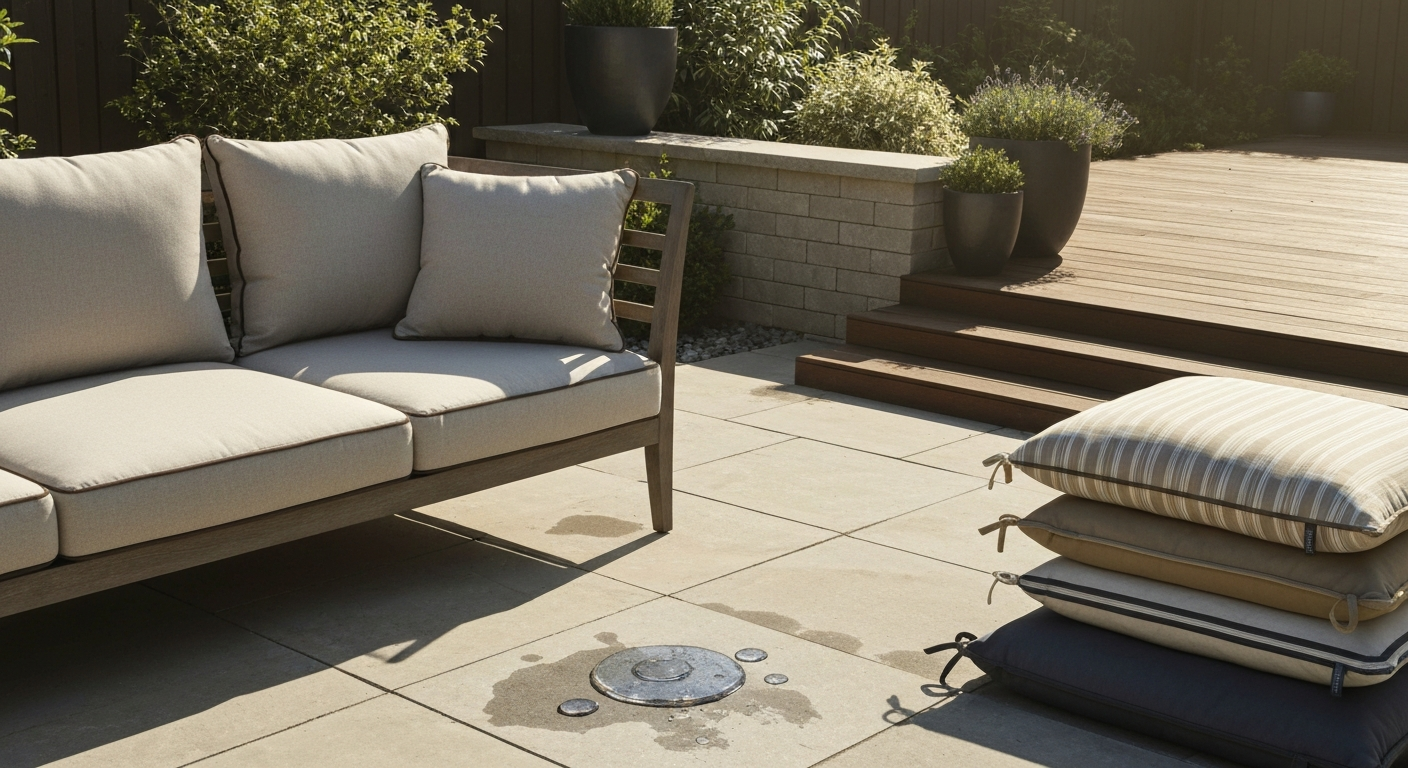
Best Sunbrella Patio Cushions: Top Picks, Guide & Maintenance
Find the best Sunbrella patio cushions: durable, fade‑resistant picks, buying tips, care, and top recommendations.