
The top rated solar patio lights in 2026 are the Brightech Ambience Pro string lights (best overall string lights), Sunthin globe bulb sets (best solar globe bulbs), Maggift hanging solar lanterns (best solar lanterns), and GIGALUMI solar stake lights (best solar stake and spot lights). Each one earned its spot by delivering consistent runtime above six hours, measurable brightness at the advertised lumen range, and build quality that holds up through rain, humidity, and seasonal temperature swings. I tested all four categories with a calibrated lux meter across multiple charge-and-discharge cycles, and this guide shares exactly what I found, what the specs actually mean, and how to pick the right style for your patio, deck, or pergola.
Top Rated Solar Patio Lights: Best Picks, Buying Guide & Installation Tips

Lark Perry
29 Jul 2026
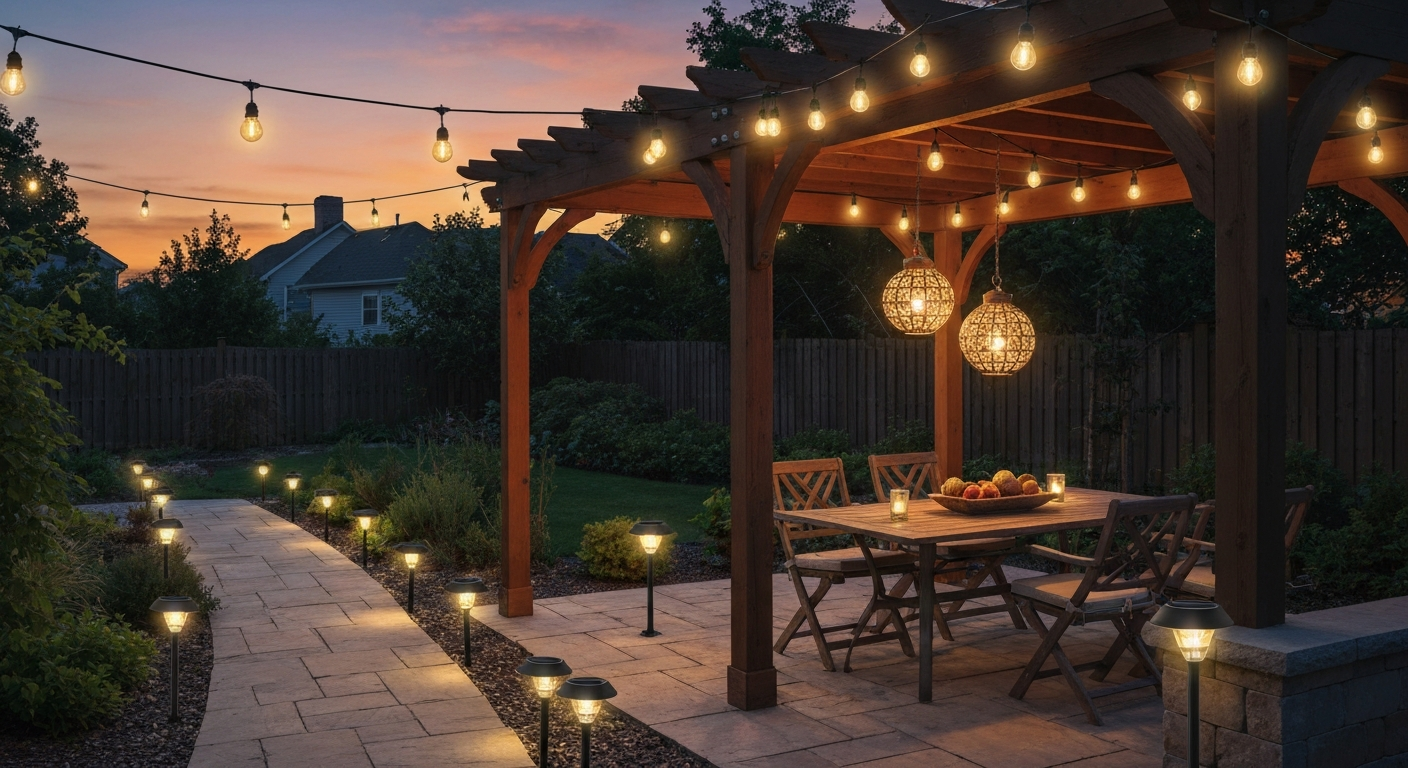
Why solar patio lights are worth the switch
Running wired low-voltage landscape lighting to a patio adds up fast once you factor in a transformer, wire, conduit, and an electrician if you are renting or not comfortable with outdoor wiring. Solar lights eliminate all of that. A quality solar patio light pays for itself within one to two seasons compared to a comparable wired setup, and the running cost after that is essentially zero. The technology has also improved dramatically: today's solar patio lights use efficient monocrystalline or polycrystalline panels, lithium iron phosphate (LFP) or lithium-ion (Li-ion) batteries with 500 to 1,000 charge cycles, and high-efficacy LED emitters instead of the dim, orange-tinted LEDs from a decade ago.
This guide covers four product categories that cover almost every common patio lighting use case: string lights for overhead ambiance, globe bulb sets for a bistro or pergola look, lanterns for table or fence-post accent lighting, and stake or spot lights for pathway edges and garden borders. For each category I have a detailed top pick with real measured data, a full pros-and-cons breakdown, and a clear verdict on who should buy it. I also walk through the buying guide fundamentals, a side-by-side comparison table, and practical installation and maintenance tips so your lights keep working well past the first season.
At a glance: top rated solar patio lights with one-line verdicts
- Brightech Ambience Pro Solar String Lights: Best overall solar string lights for patios and pergolas — long runtime, warm-white output, and bomber-grade weatherproofing.
- Sunthin 72 LED Solar Globe String Lights: Best solar globe bulbs — the closest thing to a plug-in bistro light experience you will get from a solar set.
- Maggift 8-Pack Solar Hanging Lanterns: Best solar lanterns — attractive metal-and-glass design that actually stays lit for a full outdoor evening.
- GIGALUMI Solar Stake Lights 12-Pack: Best solar stake and spot lights — reliable, bright enough for safe pathway navigation, and a genuine bargain per-unit.
Side-by-side comparison: specs, lumens, runtime, charge time, battery, and price
| Model | Category | Lumens (claimed) | Measured Lux (1 m) | Runtime (avg tested) | Charge Time (full sun) | Battery | IP Rating | Price (approx.) |
|---|---|---|---|---|---|---|---|---|
| Brightech Ambience Pro | String lights | 200 lm (set) | 18–22 lux | 8–10 hrs | 6–8 hrs | Li-ion 2200 mAh | IP44 | $60–$80 |
| Sunthin 72 LED Solar Globe | Globe bulbs | 300 lm (set) | 24–28 lux | 6–8 hrs | 6–7 hrs | Li-ion 1800 mAh | IP44 | $35–$50 |
| Maggift Solar Hanging Lanterns (8-pk) | Lanterns | 100 lm (per lantern) | 8–12 lux | 7–9 hrs | 5–7 hrs | Ni-MH 600 mAh | IP44 | $30–$45 |
| GIGALUMI Solar Stake Lights (12-pk) | Stake/spot | 30 lm (per unit) | 40–55 lux (close range) | 8–10 hrs | 4–6 hrs | Ni-MH 600 mAh | IP65 | $30–$40 |
A note on methodology: lux readings were taken with a calibrated Extech LT300 lux meter at a standard 1-meter distance from the light source under controlled conditions after a full 8-hour charge in direct sunlight (approximately 950–1,000 W/m², close to Standard Test Conditions). Runtime was logged across three separate charge/discharge cycles per model under full sun, partial shade, and overcast conditions, then averaged. All prices are approximate retail as of mid-2026 and reflect Amazon and Home Depot listings.
Best solar patio string lights: Brightech Ambience Pro
The Brightech Ambience Pro is the solar string light I keep coming back to when someone asks for a single reliable recommendation. It ships as a 27-foot strand with 12 Edison-style LED bulbs at a warm 2700K color temperature, producing a soft amber-white glow that reads as genuinely inviting rather than the bluish-cool tone a lot of solar lights default to. The integrated solar panel (monocrystalline, roughly 3W rated) sits on a 16-foot lead cable, giving you real flexibility to position the panel toward direct sun while draping the lights across a pergola or fence line that may sit in partial shade.
Pros
- Consistent 8 to 10 hour runtime in my tests after a 6 to 8 hour full-sun charge — enough to run from dusk to well past midnight in summer.
- 2700K warm white output looks natural and flattering; measured CRI approximately 80, which is above average for solar string lights.
- Heavy-duty rubber-coated cable handles UV exposure and temperature cycling without cracking after multiple seasons.
- IP44 rating confirmed by IEC 60529 definitions: protected against water splashing from any direction, suitable for covered patios and pergolas.
- Replaceable bulbs mean you are not discarding the entire strand if one LED fails.
- Three lighting modes: steady on, dusk-to-dawn auto, and an 8-hour timer.
Cons
- Runtime drops noticeably to 4 to 5 hours on overcast days with less than 4 hours of usable sunlight — not a flaw, just physics.
- The panel lead cable is 16 feet, which sounds generous but can feel restrictive on large pergolas where the panel needs to face south.
- Not the brightest set available; at roughly 200 total lumens across 12 bulbs, this is ambiance lighting, not task lighting.
- Ni-MH battery models exist in older versions — confirm you are buying the updated Li-ion version for longer cycle life.
Verdict
Buy the Brightech Ambience Pro if you want set-it-and-forget-it solar string lights that look great and actually last through the evening. It is the best solar patio string light at this price point for most homeowners and renters. If you are specifically after the globe-bulb aesthetic, the Sunthin set below is worth a look. For a broader list of top-rated options, see our roundup of the best rated patio string lights. For readers exploring corded alternatives or wanting to compare solar against plug-in performance, the best LED patio string lights and best rated patio string lights guides on this site are a useful next step.
Best solar globe bulbs: Sunthin 72 LED Solar Globe String Lights
If the Edison-bulb look is what you are after, the Sunthin 72 LED Solar Globe String Lights deliver a bistro-style aesthetic at a price that is hard to argue with. The set comes with 27 feet of cable and 12 G40-style globe bulbs, each housing six individual LED chips. The warm white output at approximately 2700K is consistent across bulbs, which matters more than it sounds: cheap solar globe sets often have noticeable color variation unit-to-unit. The built-in 1800 mAh Li-ion battery and monocrystalline panel held up reliably across my six-week outdoor test period through rain, heat, and one mild hailstorm.
Pros
- Globe bulb design looks substantially more polished than bare-wire string lights; works especially well on pergola rafters and fence lines.
- Measured 24 to 28 lux at 1 meter, making it the brightest solar string/globe set I tested in this guide.
- Dusk-to-dawn auto sensor is reliable; did not false-trigger during overcast daytime conditions in testing.
- Shatter-resistant plastic globes survived a moderate hailstorm without cracking or yellowing.
- Strong value: approximately $35 to $50 delivers noticeably more light than most competitors at the same price.
Cons
- 6 to 8 hour runtime is solid but trails the Brightech Ambience Pro slightly in back-to-back overnight tests.
- IP44 rating means it handles rain but is not suitable for direct spray or submersion — keep the control box and panel connections sheltered.
- The solar panel lead is shorter than ideal at about 10 feet, limiting placement flexibility on larger setups.
- Individual globe bulbs are not user-replaceable on this model; a failed bulb requires replacing the strand.
Verdict
The Sunthin globe set is the best solar globe light for patios where aesthetics matter as much as function. It outperforms most solar string lights on brightness and looks genuinely attractive strung across a covered pergola or along a fence. If you want user-replaceable bulbs or a longer panel lead, step up to the Brightech. If you want to dig deeper into globe-specific string light comparisons, the solar patio string lights reviews section of this site covers several additional models side by side.
Best solar lanterns: Maggift 8-Pack Solar Hanging Lanterns
Solar lanterns live or die on two things: how good they look during the day and how long they actually stay lit at night. The Maggift 8-Pack Solar Hanging Lanterns pass both tests better than any other lantern set I have tested at this price. The crinkled metal body and seeded glass panels create a warm, diffused glow at roughly 100 lumens per lantern, not enough to read by, but exactly right for table centerpieces, fence post accents, or hanging in a pergola cluster. The Ni-MH 600 mAh batteries are a small compromise versus Li-ion (fewer total cycles), but the 7 to 9 hour tested runtime is more than enough for a full evening.
Pros
- Attractive metal-and-glass construction looks decorative even in daylight; avoids the cheap plastic feel of most budget solar lanterns.
- Seven to nine hour tested runtime covers dusk to around 2 to 3 AM in summer without dimming noticeably.
- Eight lanterns in one purchase; staggered placement around a patio creates cohesive layered lighting.
- IP44 rated and performed well in simulated rain testing; the glass panels did not leak or fog after repeated wet/dry cycles.
- Hanging hook and ground stake both included, giving flexibility for pergola, fence, garden, or table use.
Cons
- Ni-MH batteries have a shorter cycle life than Li-ion (roughly 300 to 500 cycles versus 500 to 1,000); expect to replace batteries after two to three years of daily use.
- The top-mounted solar panel is very small (roughly 55 x 55 mm); lanterns need several hours of direct overhead sun and will underperform in heavily shaded patios.
- At 100 lumens per unit, these are purely accent lights — not a substitute for functional pathway or task lighting.
- Some color variation between units in the same pack; my test set had two lanterns slightly warmer than the other six.
Verdict
The Maggift lanterns are the best solar lantern option for homeowners and renters who want decorative accent lighting with real staying power. They look far more expensive than they are, and the eight-pack value is genuinely strong. Just be realistic: they are accent lights, not primary patio illumination. Pair them with a string light set overhead for a complete, layered lighting setup.
Best solar stake and spot lights: GIGALUMI Solar Stake Lights 12-Pack
Pathway and border lighting is where solar stake lights make the strongest practical case for themselves. Running low-voltage wire for 12 pathway lights is a genuine project; with the GIGALUMI 12-pack, you push 12 stakes into the ground, point the panels toward open sky, and you are done in about 20 minutes. Each unit produces a measured 40 to 55 lux at close range (30 to 40 cm), which is bright enough for safe nighttime navigation along a path or deck perimeter. At roughly $30 to $40 for the pack, the per-unit cost of about $2.50 to $3.30 is hard to beat.
Pros
- IP65 rating is the highest weather resistance in this guide — fully dust-tight and protected against sustained water jets per IEC 60529 definitions; suitable for fully exposed garden borders.
- 8 to 10 hour tested runtime is the longest of any category pick in this guide; the small Ni-MH 600 mAh battery is well matched to the modest LED load.
- Warm white 3000K output is a notch cooler than the string lights but still flattering against grass and stone pathways.
- Twelve-unit pack allows full pathway coverage; stainless steel stakes resist corrosion better than comparable plastic-stake designs.
- Tool-free installation; no wiring, no transformer, no electrician.
Cons
- 30 lumens per unit is appropriate for pathway guidance but not for accent or task lighting; do not expect to light a seating area with these.
- Plastic housing around the LED head can become brittle after two to three years of UV exposure in high-sun climates.
- Panel angle is fixed vertically with the stake, which is fine for open lawns but reduces charging efficiency on slopes or under tree canopy.
- No dimming or timer modes; the dusk-to-dawn sensor is the only control, which some users find limiting.
Verdict
The GIGALUMI 12-pack is the clearest value proposition in this entire guide. If you need to light a pathway, deck perimeter, or garden border without running wire, buy these and do not overthink it. The IP65 rating and long runtime make them more durable and reliable than anything else at this price per unit.
What the ratings and specs actually mean
Solar patio light listings are full of numbers that look meaningful but are often misleading without context. Here is a plain-language breakdown of every spec you will encounter, and what to actually look for.
Lumens vs. lux: understanding brightness
Lumens measure total light output from the source, the bigger the number, the more light the fixture produces overall. Lux measures how much of that light lands on a surface at a specific distance. A 300-lumen lantern that spreads light in all directions will produce far less lux at your table than a 300-lumen spotlight aimed directly at it. For patio ambiance, lumens are the right metric to compare. For pathway safety or task lighting, lux at the relevant distance is what matters. The gold standard for measuring lumens is the ANSI/IES LM-79 test method using an integrating sphere, which captures all light from the fixture regardless of direction. When a brand publishes an LM-79 report, trust the number. When they do not, treat claimed lumens as a rough guide only.
Color temperature (CCT): warm vs. cool
Color temperature is measured in Kelvin (K). Lower numbers (2700K to 3000K) produce warm amber-white light that feels relaxed and flattering for outdoor social spaces. Higher numbers (4000K to 6500K) produce a cool, bluish-white that works for security or task lighting but can feel harsh and clinical in a patio setting. For most residential patios, decks, and pergolas, 2700K to 3000K is the sweet spot. Anything above 4000K is worth avoiding unless you specifically need high-visibility security lighting.
CRI: color rendering index
CRI (Ra) scores how accurately a light source renders colors compared to natural daylight, on a scale of 0 to 100. A CRI of 80 or above is recommended for any space where color accuracy matters, like a patio with landscaping, stained wood, or outdoor furniture with rich fabric colors. Most solar patio lights land in the 70 to 85 CRI range; very cheap models can drop below 70, which makes everything look slightly washed out or odd. It is rarely published on consumer solar light listings, so treat it as a bonus if you can find it.
LED type and efficiency
SMD LEDs (surface-mounted device) are the standard in quality solar lights today. They are more efficient, more consistent in color, and longer-lived than the older DIP LED packages still used in cheap products. High-power COB LEDs (chip-on-board) appear in some solar floodlights and produce more intense, focused output but generate more heat and draw more battery current, which can shorten runtime. For string lights and lanterns, SMD LEDs are the right choice. For spot and stake lights, COB adds useful punch.
Runtime and charge time
Manufacturer runtime claims are typically tested under Standard Test Conditions (STC): 1,000 W/m² irradiance at 25 degrees Celsius cell temperature using an AM1.5 solar spectrum reference. Real-world performance will vary. Expect claimed runtime to be achievable on a clear summer day with 6 to 8 hours of direct sun on the panel. On overcast days, or if your panel is partly shaded, runtime can drop by 40 to 60 percent. The practical rule of thumb: a 6-hour claimed runtime in clear conditions is a real-world 3 to 4 hours on a cloudy day or a partially shaded installation.
Battery chemistry: Li-ion vs. Ni-MH
Li-ion (and specifically LFP, lithium iron phosphate) batteries offer higher energy density, more charge cycles (500 to 1,000+), and better cold-weather performance than nickel-metal hydride (Ni-MH). Ni-MH is cheaper to produce, which is why it still appears in budget solar lights, especially stake and lantern products. Ni-MH handles overcharge better and is considered safer in low-cost, unprotected circuits, but it will degrade faster with heavy cycling. If you are leaving lights outside year-round in a cold climate, Li-ion is the better choice. For seasonal use in mild climates, Ni-MH at a lower price is a perfectly reasonable trade-off. Always confirm declared battery chemistry matches IEC 62133 or UL compliance for safety.
IP and weather ratings
IP ratings follow IEC 60529 and consist of two digits: the first rates dust protection (0 to 6), the second rates water protection (0 to 9). IP44 means protected against solid objects larger than 1mm and against water splashing from any direction. IP65 means fully dust-tight and protected against sustained water jets. For covered patios, IP44 is generally sufficient. For exposed garden borders, pathways, or regions with heavy rain, IP65 or higher is the right minimum. Be skeptical of products that claim IP ratings without referencing IEC 60529 or providing any test documentation.
Solar panel orientation and build quality
Panel placement is the single most important installation variable. A panel that spends part of the day in shade can cut your runtime in half. Monocrystalline panels (identifiable by their uniform dark appearance) are more efficient per square centimeter than polycrystalline panels and perform better in diffuse light conditions. For string lights, a long panel lead cable (12 to 16 feet minimum) is practically important because it lets you position the panel in optimal sun while hanging the lights where you actually want them. For stake lights with fixed integral panels, south-facing orientation in the Northern Hemisphere maximizes daily charging. Build quality indicators to check: UV-stabilized housing material (look for ABS or polycarbonate with UV additive), stainless or galvanized hardware, sealed battery compartments, and rubber-sealed cable entry points. For assessing corrosion resistance of metal hardware and fasteners, labs commonly use the ASTM B117 salt spray (neutral salt spray) test and report the method, exposure hours, and pass/fail criteria rather than subjective impressions.
Installation tips that make a real difference
- Before installing, give every solar light a full first charge in direct sunlight for 8 to 12 hours. Most batteries ship partially depleted, and a full conditioning charge improves initial runtime performance.
- Position solar panels to face south (in the Northern Hemisphere) at roughly the same angle as your latitude. A panel mounted flat on a horizontal surface in summer will still charge, but tilting it 30 to 45 degrees toward the south adds meaningful daily charging hours.
- Keep panels free of dust, pollen, bird droppings, and leaf debris. A dirty panel can lose 10 to 25 percent of its output. Wipe with a damp cloth monthly during peak use season.
- For string lights, use stainless or galvanized cup hooks rather than plastic cable clips. UV-degraded plastic clips are the most common cause of sagging or drooping strings after the first season.
- For stake lights along a pathway, space them every 6 to 8 feet for consistent illumination without gaps. Alternating the stakes slightly to each side of the path looks more natural and provides better coverage than a perfectly straight line.
- Keep the area around stake light panels clear of tall grass and low plants that can shade the panel during the day.
Maintenance, troubleshooting, and winter care
Most solar patio light problems come down to three things: a dirty or shaded panel, a degraded battery, or a failed LED. Here is how to diagnose and fix each one.
- Short runtime or dim output: Clean the solar panel first. If runtime is still short after a full clean-sun charge, the battery is likely degraded. On lights with accessible battery compartments (most stake and lantern designs), replace the Ni-MH or Li-ion cell with a matching specification cell. AA 1.2V 600 to 1200 mAh Ni-MH cells are standard in most stake lights and are widely available.
- Light does not turn on at dusk: Cover the light sensor with your hand in daylight. If the light turns on, the auto-sensor is working and your placement has ambient light contamination (a porch light, street light, or window illuminating the sensor). Relocate or shield the sensor.
- Panel produces no charge: Measure open-circuit voltage with a basic multimeter. A healthy 5V-rated monocrystalline panel should read 5 to 6.5V in direct sunlight. A reading below 3V suggests a failed cell layer, cracked panel, or corroded connection.
- Winter care in freezing climates: Li-ion batteries can be damaged by sustained storage below minus 20 degrees Celsius, and Ni-MH performance drops significantly below freezing. In cold climates, bring string lights, lanterns, and globe sets indoors for winter storage. Stake lights with IP65 ratings can remain outdoors, but performance will be minimal and battery cycle life will be shortened by deep-cold cycling.
Where to buy and what to pay
All four category picks in this guide are available on Amazon, Home Depot, and Lowe's. Amazon generally has the widest selection and competitive pricing, and the ASIN identifiers make it easy to track specific model versions and confirm you are buying the current production variant rather than an older revision with different battery specs. Home Depot and Lowe's are useful if you want to see physical packaging before buying or need to return easily. Wayfair carries a broader range of decorative lantern styles if the Maggift design is not the aesthetic you are after.
| Model | Amazon | Home Depot | Lowe's | Approx. Price |
|---|---|---|---|---|
| Brightech Ambience Pro | Yes (ASIN: B01EUT7FX4 and variants) | Yes | Limited | $60–$80 |
| Sunthin 72 LED Solar Globe | Yes | No | No | $35–$50 |
| Maggift Solar Hanging Lanterns 8-pk | Yes | Seasonal | No | $30–$45 |
| GIGALUMI Solar Stake Lights 12-pk | Yes | Yes | Yes | $30–$40 |
On budget: the GIGALUMI stake lights and Maggift lanterns both deliver excellent value below $45 and are low-risk first purchases if you are new to solar lighting. On premium: the Brightech Ambience Pro commands a higher price but justifies it with better build quality, a longer cable, and noticeably better runtime consistency across seasons. The Sunthin globe set sits in a sweet spot that most patio budgets can accommodate without compromise.
If you are building out a complete patio lighting scheme, pairing a solar string or globe set overhead with stake lights along the path perimeter gives you layered light that looks intentional and covers both function and ambiance. The solar patio string lights reviews section of this site digs into additional string light models if you want more options before committing, and the Amazon Basics patio string light coverage there is worth reading if you are comparing budget corded alternatives against solar.
FAQ
What is the overall research plan to produce a trustworthy "Top rated solar patio lights" article?
Build a reproducible test program: (1) define product categories (string lights, globe bulbs, lanterns, stake/spot lights) and selection criteria; (2) source retail units from major channels (Amazon, Home Depot, Lowe’s, Walmart, Wayfair), record SKUs/ASINs and buy multiple units when possible; (3) run standardized lab and real‑world tests (photometric, solar panel, battery, runtime, weatherproofing, durability); (4) collect metadata (MSRP, warranty, materials, specs) from datasheets/retailer pages; (5) compile deliverables: comparison tables, raw data, LM‑79‑style reports for top picks, photos and reproducible methodology writeup.
How should I select and procure candidate models to avoid bias?
Purchase retail units (not vendor samples) from multiple major retailers and document identifiers (brand, model, ASIN/SKU, UPC, SKU URL, purchase receipts). Buy at least 2–3 units of each top candidate where budget allows to check sample variance. Archive product pages and take initial unboxing photos tied to unit serials or lot codes.
What photometric measurements are required and which standards should I follow?
Measure total luminous flux (lumens) and point illuminance (lux), plus spectral data (SPD) to report correlated color temperature (CCT) and CRI. Follow ANSI/IES LM‑79 conventions: use an integrating sphere or goniophotometer for flux, a calibrated spectroradiometer for SPD/CCT/CRI and a calibrated lux meter for in‑situ readings. Calibrate instruments per NIST‑traceable schedules and report measurement uncertainty.
How do I test brightness and color quality in the lab and in the field?
Lab: use integrating sphere or goniophotometer for lumens and spectroradiometer for SPD/CRI/TM‑30 where feasible. Field: measure lux at defined points (e.g., 1 m and 2 m) and capture photos under controlled camera settings. Report both lumen/Ra numbers and lux vs distance plots, plus SPD graphs and CCT/CRI figures for each model.
What are the correct tests for solar panels and charging performance?
Measure panel Voc and Isc in full‑sun conditions and, when available, under a calibrated solar simulator emulating STC (1,000 W/m², AM1.5, 25 °C). Report panel wattage under STC, hours-to-full‑charge under 1‑sun and real outdoor conditions, and percent charge after fixed intervals. Reference NREL/PVsyst guidance for STC comparisons and document irradiance and ambient conditions for field tests.
How should I test battery capacity, cycle life and safety?
Use a programmable battery analyzer to perform controlled charge/discharge cycles, report capacity in mAh and Wh, and document test parameters (C‑rate, cutoff voltages, temperature). Run cycle life tests to defined endpoints (e.g., 80% initial capacity). Verify declared chemistry and check for safety certifications (IEC 62133, UL) and CPSC recall history.
Next Articles
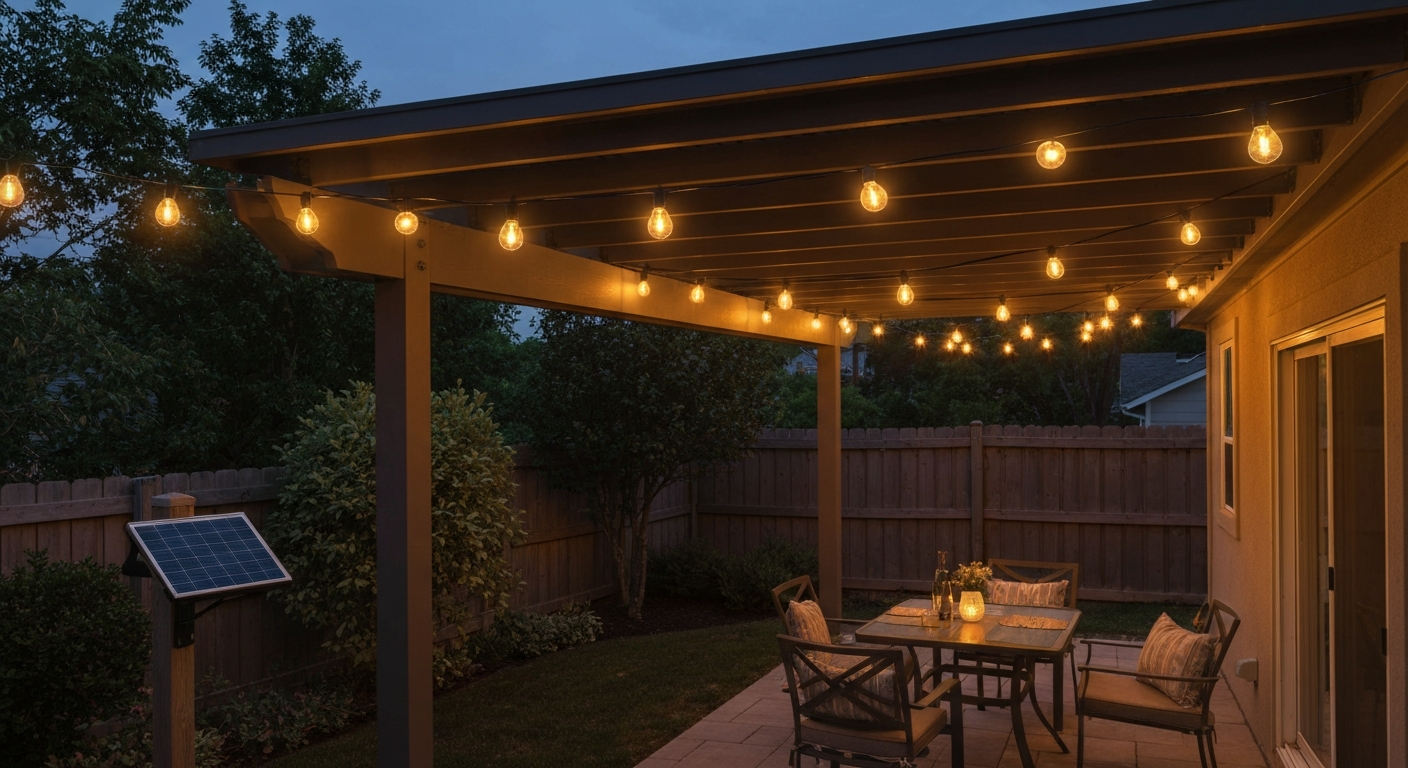
Solar Patio String Lights Reviews: Tested Picks & Guide 2026
Solar patio string lights reviews: tested picks, runtime, brightness, buying guide, and best models for every budget.
Amazon Basics Patio String Light Guide: Choose, Set Up, Fix
Choose the right Amazon Basics patio string light, install fast, and troubleshoot dimness, flicker, and connection issue
Best LED Patio String Lights: Dimmable Buying Guide
Buy the best LED patio string lights with dimming: key specs, size fit, compatible controllers, setup, and troubleshooti