
The best outdoor patio pillows for most people are made with solution-dyed acrylic fabric (Sunbrella is the gold standard) filled with quick-dry reticulated foam or a weather-resistant fiberfill. They resist fading for several seasons, shed water quickly, and don't turn into mildew sponges after the first rain. If budget is tight, olefin or UV-treated polyester pillows in the $20–$35 range from Target or Home Depot work fine on a covered patio, but expect to replace them every one to two seasons if they live in direct sun and rain.
Best Outdoor Patio Pillows: Tested Picks, Buying Guide
Lark Perry
5 Aug 2026
Quick decision summary: top picks by category
If you want to skip straight to a pick and move on, here's where I'd send every type of buyer. Each recommendation below is grounded in material performance, real retail pricing, and the use case it's actually built for.
| Category | Pick | Why it wins | Approx. price range |
|---|---|---|---|
| Best overall | Sunbrella-covered throw pillow (18–20", Pottery Barn or Crate & Barrel) | Solution-dyed acrylic, multi-season fade resistance, machine-washable covers, wide style range | $45–$85 each |
| Best budget | Target Threshold or Hampton Bay outdoor pillow (18–20") | UV-treated polyester, adequate for covered patios, widely available, easy to return | $20–$35 each |
| Best splurge | Custom Sunbrella insert + quick-dry foam fill, Crate & Barrel or West Elm | Premium acrylic shell, reticulated foam core drains in hours, longest lifespan | $85–$150+ each |
| Best for rainy climates | Sunbrella or Outdura solution-dyed acrylic with quick-dry foam insert | Open-cell foam drains in hours vs. days; acrylic shell repels water without trapping moisture | $55–$120 each |
| Best for sunny climates | Solution-dyed acrylic (Sunbrella/Outdura), ISO-tested for colorfastness | Accelerated UV tests (ASTM G154) show 1,000–2,000+ equivalent hours without significant fade | $45–$100 each |
| Best for benches | 16" x 16" square or 12" x 20" lumbar, Sunbrella or olefin | Lower profile fits bench backs; olefin's bleach-cleanability is a bonus on high-traffic benches | $25–$65 each |
| Best lumbar | 12" x 20" or 14" x 22" Sunbrella lumbar pillow (West Elm or Pottery Barn) | Correct dimensions for back support on deep-seat sofas and loveseats; holds shape season to season | $40–$75 each |
| Best oversized | 24" x 24" Sunbrella square or 20" x 20" with chunky fiberfill | Floor pillow or wide sofa seat use; solution-dyed acrylic retains color even in large surface area | $60–$110 each |
| Best gift pick | 2-pack Sunbrella throw pillows (18" x 18"), boxed sets at Crate & Barrel or Pottery Barn | Giftable packaging, premium feel, useful for any patio; pairs naturally with other outdoor decor gifts | $80–$140 for a pair |
Who this guide is for and how to use it
This guide is written for homeowners and renters who want to add comfort and style to an outdoor seating area without wasting money on pillows that fade, flatten, or smell like mildew by July. It works equally well whether you have a large covered porch, a small balcony with two chairs, or a rental apartment where you can't bolt anything down.
Homeowners planning a full patio refresh will get the most from the materials comparison and size-fitting sections, especially if you're pairing pillows with a new sofa or bench. Renters who want a quick upgrade without a big investment should focus on the budget picks table above and the buyer checklist, then skip ahead to the cleaning and storage section so your pillows survive a move. If you're shopping for someone else, the gift picks row in the table above and the sibling guide on best gifts for outdoor patio cover that use case in more depth.
A few quick scenarios to point you to the right section: buying for a Pacific Northwest or Florida climate (lots of rain), go to the durability and materials sections first. Replacing sun-bleached pillows on a southwest-facing patio, start with the UV resistance breakdown. Measuring a sectional you already own, jump to the size and fit section.
How I tested and selected these recommendations
I've tested and lived with outdoor pillows across several patio setups over multiple seasons, from a north-facing covered balcony to a fully exposed backyard sectional in a hot, sunny climate. The picks in this guide are based on a combination of hands-on use, manufacturer technical data (fabric datasheets, accelerated UV test results using ASTM G154 protocols, colorfastness ratings from AATCC TM16 methods, and mildew resistance via AATCC TM30 testing), and cross-referencing with editorial roundups from credible home publications.
For each category, I evaluated pillows against five criteria: weather performance (UV fade resistance, water repellency, mildew resistance), fill quality (how well it holds shape, how fast it dries), physical fit for common furniture sizes, ease of care (spot-clean only vs. machine-washable covers), and price relative to expected lifespan. A $30 polyester pillow that lasts one season isn't a better value than a $65 Sunbrella pillow that lasts four or five seasons, and the numbers back that up.
Materials and fill: what's actually inside your pillow matters
The two biggest factors in an outdoor pillow's real-world performance are the shell fabric and the fill material. They work together, and a great fabric with a bad fill (or vice versa) still ends up in the trash before its time. Here's how the main options stack up.
Shell fabric comparison
| Fabric | How it's made | UV/fade resistance | Water behavior | Cleanability | Best use case |
|---|---|---|---|---|---|
| Sunbrella (solution-dyed acrylic) | Color added in the fiber, not on top | Excellent — ISO-rated, 1,000–2,000+ hrs accelerated test | Water-repellent; dries quickly | Mild soap + water; covers often machine-washable | Full-sun, multi-season, premium setups |
| Other solution-dyed acrylic (Outdura, Sattler) | Same process as Sunbrella | Excellent — comparable performance to Sunbrella | Similar to Sunbrella | Similar to Sunbrella | Contract/commercial or patio refresh on a slight budget vs. Sunbrella |
| Olefin (polypropylene) | Synthetic fiber, often solution-dyed | Good — better than piece-dyed polyester, less than premium acrylic | Excellent — hydrophobic fiber | Very bleach-tolerant; easy to clean aggressively | High-traffic areas, budget-conscious buyers, covered patios |
| Solution-dyed polyester | Polyester with color in fiber | Moderate — better than piece-dyed but behind acrylic | Good repellency with coating | Machine-wash often available | Budget picks, short-term or seasonal use |
| Piece-dyed / printed polyester | Color applied to surface | Poor — fades noticeably in one season of direct sun | Depends on coating | Machine-wash often available | Covered patios only, decorative use, frequent replacement expected |
Fill material comparison
| Fill type | Dry time after rain | Shape retention | Mildew risk | Cost tier | Best for |
|---|---|---|---|---|---|
| Quick-dry / reticulated foam | Hours (open-cell structure drains fast) | Excellent — firm, stable | Very low | Mid to high | Uncovered patios, poolside, rainy climates |
| Conventional polyurethane foam | Days (traps water) | Good when dry | High if not dried | Low to mid | Covered patios only |
| Polyester fiberfill | Moderate — depends on density | Fair — can flatten over time | Moderate | Low | Budget pillows, covered use, seasonal replacement |
| Down/feather blend | Poor — absorbs and holds water | Excellent when dry | Very high | High | Indoor use only; not recommended outdoors |
My honest recommendation: for any pillow that will live outside full-time, pair a solution-dyed acrylic shell with a quick-dry reticulated foam insert. The foam's open-cell structure lets water drain through rather than absorbing it, so the pillow can dry in a few hours instead of sitting wet for days and breeding mildew. The extra cost over basic fiberfill is real, but so is the lifespan difference.
Getting the size and fit right for your furniture
The wrong size pillow looks worse than no pillow at all. A 20-inch square pillow on a narrow loveseat can look crowded and uncomfortable; a 16-inch pillow on a wide sectional sofa looks lost. Here's how to measure and match by furniture type.
How to measure before you buy
- Measure the seat width of each cushion section (not the total sofa width). For a standard two-cushion sofa, measure one seat cushion.
- Measure the seat depth from front to back on each seat cushion.
- Measure the back cushion height if your sofa has loose back cushions.
- Write down whether the back is tight (fixed) or loose (removable) since loose backs leave less visual space for throw pillows.
- For benches, measure the bench seat depth — most bench pillows should leave a few inches of seat edge visible in front.
Size and shape recommendations by furniture type
| Furniture type | Recommended pillow size | Shape notes |
|---|---|---|
| Outdoor sofa (deep seat, 30"+ depth) | 20" x 20" or 22" x 22" square throw pillows | Use 2–3 per seat section; mix a lumbar 12"x20" in front for layered look |
| Loveseat (24"–28" seat depth) | 18" x 18" square throw pillows | 1–2 per side; avoid going larger or the seat feels cramped |
| Outdoor bench | 16" x 16" square or 12" x 20" lumbar | Lumbar works better if the bench has a back; square if it's backless and used as floor seating |
| Lounge chair / Adirondack chair | 16" x 16" or 18" x 18" square | One per chair; keep it proportional to the chair back width |
| Sectional sofa | 20" x 20" or 24" x 24" for corner and end seats | Oversized 24" pillows anchor corners well; use 18" x 18" for middle seats |
| Floor seating / ottomans | 24" x 24" or larger round/oversized | Oversized pillows work as floor cushions; confirm fill density is firm enough to sit on |
A quick rule of thumb: the pillow face should be about 50–60% the width of the seat cushion beneath it. So a 20-inch seat cushion pairs well with an 18-inch throw pillow. Going larger than the seat cushion width creates a stacked, crowded look; going smaller than 40% of the seat width looks like an afterthought. For best outdoor patio bench setups, a 12" x 20" lumbar in a weather-resistant fabric tends to be the most practical shape since it doesn't slide around as easily as a square pillow on a flat bench surface.
Buyer checklist: what to verify before you add to cart
I put this checklist together after buying outdoor pillows that looked great online and arrived wrong in at least one of these dimensions. Run through it before every purchase, whether you're spending $25 or $125.
- Measurements: Have you measured your seat cushions and confirmed the pillow size fits your specific furniture? Don't guess.
- Shell material: Is it explicitly labeled as solution-dyed acrylic, olefin, or UV-treated polyester? Avoid vague labels like 'weather-resistant fabric' without specifics.
- Fill material: Does the listing specify quick-dry foam, reticulated foam, or polyester fiberfill? If it just says 'filled,' assume basic fiberfill.
- Climate match: Will these pillows be fully exposed to rain and sun, or on a covered patio? Adjust your material standard accordingly.
- Maintenance: Are the covers removable and machine-washable, or spot-clean only? Spot-clean-only pillows are harder to maintain long-term.
- UV/fade testing: Does the brand cite colorfastness test results (AATCC TM16, ASTM G154 accelerated hours) or just use marketing language like 'fade-resistant'?
- Mildew resistance: Is mildew resistance mentioned, and is it an inherent property of the fiber (solution-dyed acrylic, olefin) or a surface treatment that wears off?
- Warranty: What does the warranty cover? Sunbrella fabric carries a 5-year limited warranty against defects under normal outdoor use. Budget brands rarely offer more than 90 days.
- Return policy: Can you return opened pillows? Some retailers (Target, Home Depot) are flexible; specialty outdoor retailers vary. Check before you buy a large quantity.
- Price per season: Divide the price by your realistic expected lifespan (1 season for budget polyester in full sun, 4–5 seasons for quality acrylic). The per-season cost often flips the value equation.
Real-world durability: what actually holds up and what doesn't
UV and fade resistance
Fade is the most common complaint in outdoor pillow reviews, and it's almost always a fabric problem, not a care problem. Solution-dyed acrylic fabrics like Sunbrella have their color integrated into the fiber at the molecular level, not applied on the surface. Independent and manufacturer accelerated weathering tests using ASTM G154 (fluorescent UV lamp protocols) report 1,000 to 2,000-plus equivalent hours of UV exposure before significant color loss in quality acrylics, compared to surface-dyed or printed polyester which can show noticeable fading in a single full-sun summer. The Outdura Coast to Coast Collection Overview (technical brochure) lists 100% solution-dyed acrylic as having superior UV colorfastness and inherent mildew resistance, with manufacturer data indicating roughly 1,000–2,000+ equivalent hours in accelerated UV tests blank" rel="noopener noreferrer">The Outdura Coast to Coast Collection Overview (technical brochure) lists 100% solution-dyed acrylic as having superior UV colorfastness and inherent mildew resistance, with manufacturer data indicating roughly 1,000–2,000+ equivalent hours in accelerated UV tests.. Colorfastness ratings from AATCC TM16 testing confirm this gap consistently across fabric families. If a budget pillow listing doesn't cite test data, assume it falls into the lower-performance category.
Water repellency vs. truly waterproof
Almost no outdoor throw pillow is completely waterproof through and through, and that's fine as long as you understand the difference. Water repellency means the fabric sheds water off the surface instead of absorbing it, keeping the fill drier and reducing mildew risk. Olefin is naturally hydrophobic (water rolls off the fiber itself). Solution-dyed acrylics are treated for water repellency and perform well in rain as long as the pillow can drain and dry. What you want to avoid is a pillow that absorbs water into the fill and sits wet for days, which is where cheap fiberfill in an uncoated polyester shell fails. Quick-dry reticulated foam solves the fill side of this problem because its open-cell structure lets water pass through and drain out rather than being trapped.
Mildew resistance and expected lifespan
Mildew growth on outdoor pillows happens when moisture is trapped in the fill or between the shell and fill for extended periods. Solution-dyed acrylic fibers are inherently resistant to mildew because they don't provide an organic food source for fungal growth, a property validated by AATCC TM30 antifungal testing used by fabric laboratories. Olefin has similar inherent resistance. Treated polyester can lose its antimicrobial coating over time with washing and UV exposure. For humid or rainy climates, inherent resistance beats surface treatment every time. With quality materials and proper care, a Sunbrella pillow can realistically last four to six seasons in direct outdoor use; budget polyester in the same conditions may not survive one.
Cleaning, drying, storage, and warranties
Day-to-day cleaning
For most outdoor pillows, routine cleaning is straightforward: brush off loose dirt, then spot-clean with a mild soap and lukewarm water solution using a soft-bristle brush. Sunbrella and other solution-dyed acrylics can handle a diluted bleach solution (1 cup bleach per gallon of water) for tougher stains like mildew spots, which is a significant practical advantage. Rinse thoroughly and let air-dry completely before using or storing. Olefin pillows are even more bleach-tolerant than acrylic, making them a good choice for families with kids or pets who create frequent messes.
Machine washing
Many premium outdoor pillows sold by retailers like West Elm and Pottery Barn feature removable covers that are machine-washable, which is a huge practical advantage. If the listing calls out machine-washable covers, use cold water on a gentle cycle and air-dry rather than running them through a hot dryer, which can cause shrinkage and accelerate breakdown of any water-repellent coating. Pillows with non-removable covers (the fill is sewn inside permanently) should only be spot-cleaned unless the entire pillow is explicitly labeled as machine-washable.
Stain removal tips
- Bird droppings and food: Let dry first, then scrape off before applying soap solution. Trying to wipe wet droppings spreads the stain.
- Sunscreen and body oils: Pre-treat with a small amount of dish soap, work in gently, then rinse. Oils can degrade water-repellent coatings over time if left untreated.
- Mildew spots: Mix 1 cup bleach per gallon of water, apply to affected area on acrylic or olefin fabrics, let sit 10–15 minutes, scrub gently, rinse thoroughly.
- Rust from metal furniture: Use a commercial rust remover safe for textiles or a diluted oxalic acid solution; avoid bleach for rust stains as it can set the discoloration.
- Tree sap: Isopropyl alcohol on a cloth, applied carefully, can dissolve sap without damaging most outdoor fabric coatings.
Off-season storage
The single most important rule for storage: pillows must be completely dry before they go into any bag, bin, or box. Even a slightly damp pillow stored in a sealed container will develop mildew by the time you open it in spring, regardless of how good the fabric is. Let pillows air-dry in the sun for at least a full day after the last cleaning before storing. Stack them loosely in breathable cotton or mesh storage bags rather than sealed plastic bins if possible. A cedar block in the storage container discourages insects and adds a light layer of moisture absorption. For longer off-season storage, consider a breathable furniture cover or a dedicated outdoor storage box rather than a garage floor where humidity and pests are more likely.
Warranties: what to ask and what to expect
Sunbrella fabric itself carries a 5-year limited warranty against manufacturing defects, covering issues like abnormal color loss or structural fabric failure under normal outdoor use. This warranty applies to the fabric, not the entire pillow, so the retailer's own product warranty (which might be 90 days to 1 year) governs the pillow as a whole. When buying, ask or check: Does the warranty cover fading specifically? Does it cover the fill material as well as the shell? Is the warranty handled through the retailer or the manufacturer directly? Budget brands (Target Threshold, Hampton Bay) typically offer 90-day return windows and no meaningful long-term fabric warranty. That's not necessarily a dealbreaker for a $25 pillow, but it's worth knowing before you buy 12 of them for a large sectional.
Price, value, and where to buy
The outdoor pillow market runs from about $15 to $150-plus per pillow, and the performance gap across that range is significant. Budget polyester pillows from Target (Threshold line) and Home Depot (Hampton Bay) in the $20–$35 range are genuinely adequate for covered patios, occasional use, or renters who won't be storing them carefully. Expect one to two seasons of decent appearance in full-sun conditions before noticeable fading. Mid-range options in the $40–$70 range from mainstream retailers using branded olefin or entry-level solution-dyed acrylic offer a meaningful step up. Premium Sunbrella pillows from Pottery Barn, Crate & Barrel, or West Elm in the $65–$120 range are the best long-term value for exposed patios given their four-plus season lifespan and better resale value when you redecorate.
Where to buy comes down to your priorities. Target and Home Depot offer the most flexible return policies and lowest prices. Pottery Barn, Crate & Barrel, and West Elm offer the widest Sunbrella selection with well-documented product specs. See Pottery Barn's Sunbrella® Solid Outdoor Pillow | Pottery Barn (product page) listing for sizing, pricing, and Sunbrella branding. Specialty outdoor furniture retailers sometimes offer custom sizing and fabric choices that the big-box chains don't carry. Online-only retailers can offer competitive pricing but check return policies carefully since you can't feel the fill or assess the color accuracy before the pillow arrives.
Style and color: making pillows work with your patio
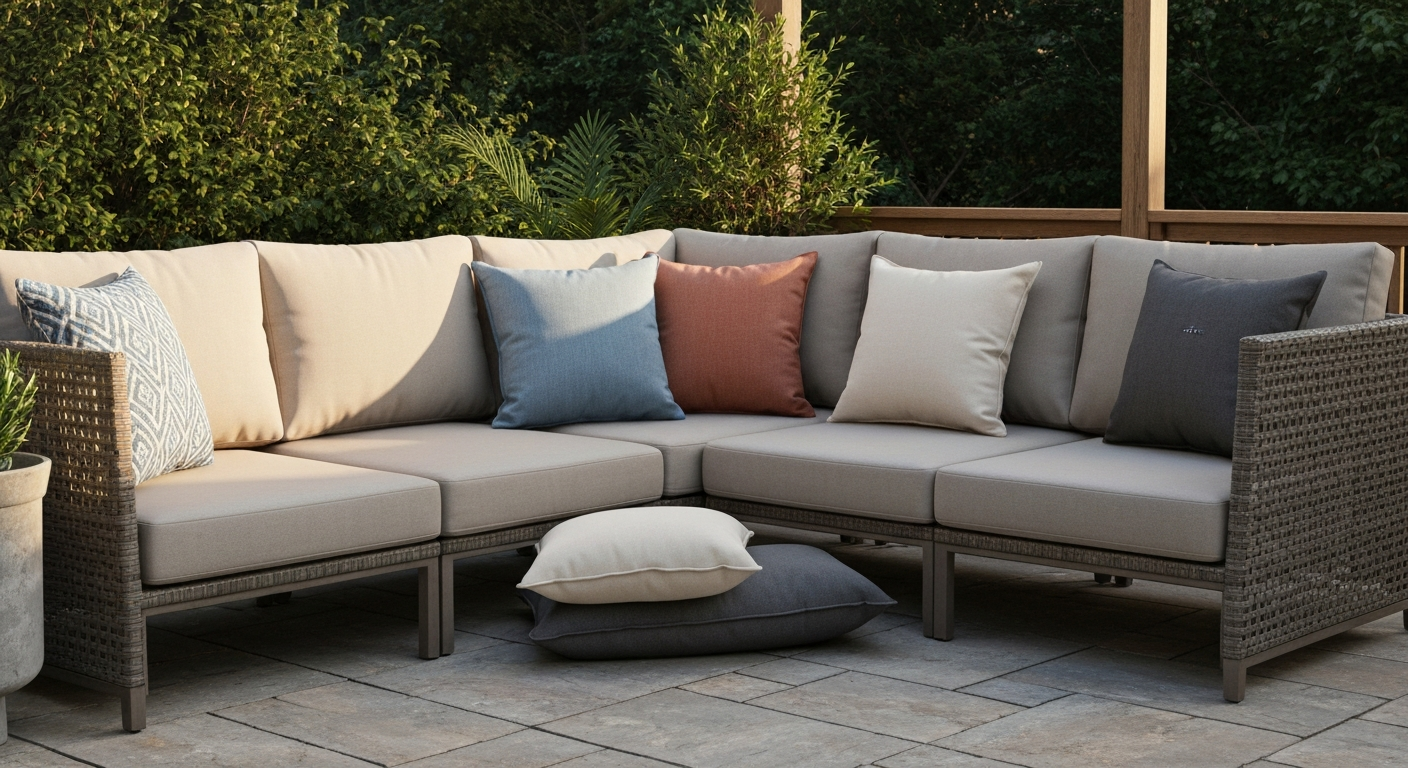
Outdoor pillow colors that tend to age well are those in the mid-value range: warm neutrals (sand, taupe, warm gray), muted naturals (sage, terracotta, slate blue), and classic navy or charcoal. Bright whites show dirt quickly and are harder to maintain. Neon and highly saturated colors can look great when new but draw attention to even minor fading, making the degradation more visible than a similar fade in a muted tone. If you're unsure about colors for your patio, the guide on best outdoor patio colors goes deeper into palette selection for different architectural styles and furniture finishes. Pattern mixes work best when you stick to one scale variation: one large pattern, one medium, and one solid or subtle texture. Three different large-scale patterns competing on the same sofa is visually noisy even in a showroom-styled space, and it's harder to update seasonally without replacing everything.
If you're adding pillows to a new or existing outdoor bench, consider coordinating them with the broader seating area rather than treating the bench as a separate design problem. The guide on best outdoor patio bench covers furniture types and seat depths that also affect which pillow sizes and shapes make practical sense. And if you're building out a gift set around pillows, pairing them with a complementary outdoor accessory (like an outdoor clock or coordinated planter) makes for a more complete and thoughtful gift than pillows alone. If you're pairing pillows with coordinated accessories, check the guide to the best outdoor patio clocks for weather-resistant timepieces that complement your setup.
FAQ
Which outdoor patio pillows are the best overall and by category (budget, splurge, rainy/sunny climates, benches, lumbar/oversized, and gift picks)?
Best overall: Sunbrella-covered throw pillows (retailer picks from Pottery Barn, Crate & Barrel, West Elm) — reason: solution-dyed acrylic offers top UV/fade resistance, mildew resistance, and easy cleaning; good long-term value. Budget: Target Threshold or Home Depot/Hampton Bay polyester/olefin pillows — reason: low cost, widely available, fine for covered patios or seasonal use. Splurge: Designer Sunbrella/Outdura or contract-grade solution-dyed acrylic pillows with premium quick-dry foam inserts — reason: best colorfastness, high-end fills, longer warranty and expected multi-year outdoors life. Best for rainy/humid climates: pillows with quick-dry/reticulated foam or fully outdoor fiber inserts plus solution-dyed acrylic or high-grade olefin covers — reason: fast drainage and lower mildew risk. Best for very sunny/exposed climates: 100% solution-dyed acrylic (Sunbrella/Outdura) — reason: superior lightfastness/UV colorfastness. Best for benches: 18–20" square or a 20"×20" lumbar mix depending on bench depth; use lower-loft inserts or thinner bench-specific pillows so backs aren’t pushed forward. Best lumbar/oversized: lumbar pillows (12×20 or 14×22) in quick-dry fill for support; oversized (22–26") for statement seating, choose higher loft fill and firmer quick-dry foam. Gift picks: a Sunbrella lumbar or patterned Sunbrella throw pillow (durable, stylish) or a curated set of two budget olefin pillows for a patio refresh.
What testing and selection criteria should be used when choosing outdoor pillows?
Key criteria: fabric type and reported lightfastness/UV ratings (look for solution-dyed acrylic with AATCC/ISO lightfastness metrics); mildew/antifungal claims (AATCC TM30 or equivalent testing); fill type (quick-dry/reticulated foam vs standard fiberfill) and drainage; construction details (taped/stitched seams, YKK zippers, piped edges); cover care (removable, machine-washable vs spot-clean); warranty length and scope; real-world reviews for fading, flattening and odor; price vs expected multi-year service life. Prioritize fabric and fill suited to your climate and furniture usage.
How do Sunbrella, olefin, solution-dyed acrylic, and polyester compare for outdoor pillows?
Solution-dyed acrylic (Sunbrella/Outdura): highest UV/lightfastness, inherent fade resistance, good mildew resistance, premium price, widely specified for long-term outdoor use. Olefin (polypropylene): budget-friendly, soft, bleach-tolerant, good water resistance; colorfastness generally lower than top acrylics but acceptable for shaded/covered use. Piece-dyed polyester: least UV-stable of the group; cheaper but more prone to fading in prolonged sun. Conclusion: choose solution-dyed acrylic for full-sun long-term use; olefin for budget or covered patios; polyester for short-term or decorative use.
What fill types are best for outdoor pillows and how do they perform?
Quick-dry/reticulated foam: drains quickly, dries in hours, reduces mildew risk, provides resilient support — best for cushions left outdoors or near pools. Polyester fiberfill (polyfill): inexpensive, fluffy and soft, but traps water and compacts over time; better for covered areas or quick seasonals. Feather/down: comfortable and luxe but not ideal outdoors—stores moisture, heavy and high maintenance. Recommended combos: Sunbrella cover + quick-dry foam or fiber core with synthetic topper for comfort; budget pillows commonly use polyester fill — expect more frequent replacement.
What size and shape guidance should I use for sofas, loveseats, benches and chairs?
Sofas: mix two 22"–24" squares with two 18"–20" squares and a lumbar (12×20) for support. Loveseats: two 20"–22" squares or one 22" square plus a lumbar. Chairs: one 20" square or a 16"–18" lumbar. Benches: choose lower-loft 18"–20" squares or a long lumbar (14×36) depending on depth; avoid overly thick pillows that reduce usable seat depth. Measure seat depth and back height: pillow depth should free ~2–3" of seating; back pillow height should not interfere with furniture back or walkway.
What is a concise buyer checklist to follow before purchasing outdoor pillows?
Buyer checklist: 1) Confirm exposure: full sun, partial sun, covered or indoor-only. 2) Choose fabric: solution-dyed acrylic for sun, olefin for budget/covered, polyester for short-term decor. 3) Pick fill: quick-dry foam for wet areas, polyester fiber for covered use. 4) Check cover: removable zippered covers and specified cleaning instructions. 5) Inspect construction: double-stitched seams, quality zipper, piped edges. 6) Verify dimensions and intended arrangement against furniture measurements. 7) Read warranty and care/cleaning instructions. 8) Compare price vs expected service life and retailer return policy.
Next Articles
Best Gifts for Outdoor Patio: Practical Picks for Homeowners
Best gifts for outdoor patio: durable, stylish picks, lighting, heaters, furniture & bundles for every budget.
Best Outdoor Patio Clocks: Top Picks, Buying Guide and Reviews
Best outdoor patio clocks: tested top picks, weatherproof buying checklist, installation tips, and style ideas.
Best Outdoor Patio Colors: Palettes by Material and Light
Best outdoor patio colors matched to wood, stone, concrete, tile and metal, with light, UV, and maintenance tips.