
The best patio fan for most people is a UL wet-rated pedestal or wall-mount oscillating fan in the 9,000+ CFM range for open decks, or a weatherproof ceiling fan sized to your square footage for covered porches. What separates a good pick from a frustrating one is matching three things: the fan's airflow output (measured in CFM) to your patio's square footage, the weatherproofing rating to how exposed the fan will actually be, and the power type to whether you have an outlet nearby. Get those three right and you'll be comfortable outside even on a 95-degree afternoon.
Best Patio Fans: How to Choose and Best Picks by Size

Lark Perry
30 Apr 2026
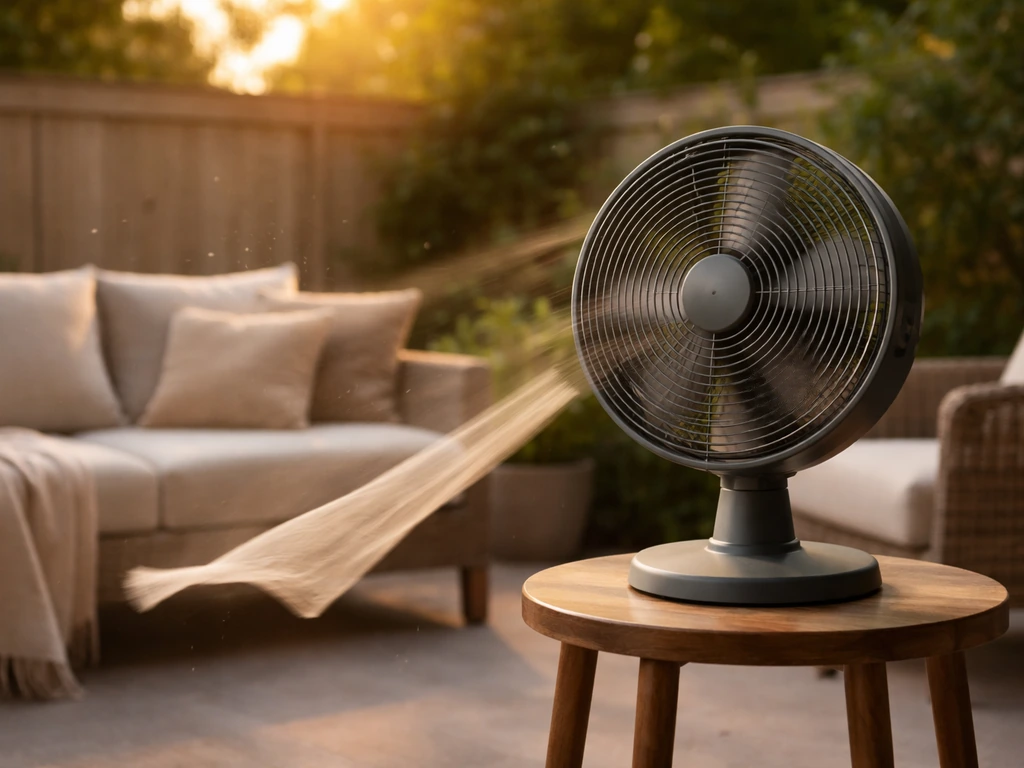
How to choose the right patio fan

Start with CFM, which stands for cubic feet per minute and tells you how much air a fan moves. To size it against your space, divide the fan's rated CFM by your patio's square footage. You want a meaningful number there, not a thin trickle. A simple rule: aim for at least 50 CFM per square foot of patio for noticeable airflow on a hot day, and closer to 100 CFM per square foot if you live somewhere consistently above 90°F in summer. A fan rated at 9,450 CFM can serve roughly 150 to 190 square feet well; a smaller 600 CFM portable misting fan is really a personal-space tool for one or two people.
Energy efficiency matters too, especially if the fan runs for hours daily. The gap between a 100 CFM-per-watt fan and a 50 CFM-per-watt fan is roughly double the electricity cost for the same airflow. That difference adds up over a summer. Look for the wattage spec on the product sheet and divide CFM by watts to compare models honestly.
Finally, decide on power type early. Corded fans need a GFCI outlet within reach, which limits placement on many patios. Battery-powered or rechargeable fans give you total flexibility but cap out at lower CFM. Solar-assisted fans exist but are mostly niche products. If you have access to power, corded wins for sustained high airflow. If you want to set a fan anywhere on the patio without running an extension cord, a rechargeable model is worth the trade-off.
Types of patio fans and when each makes sense
Stand and pedestal fans
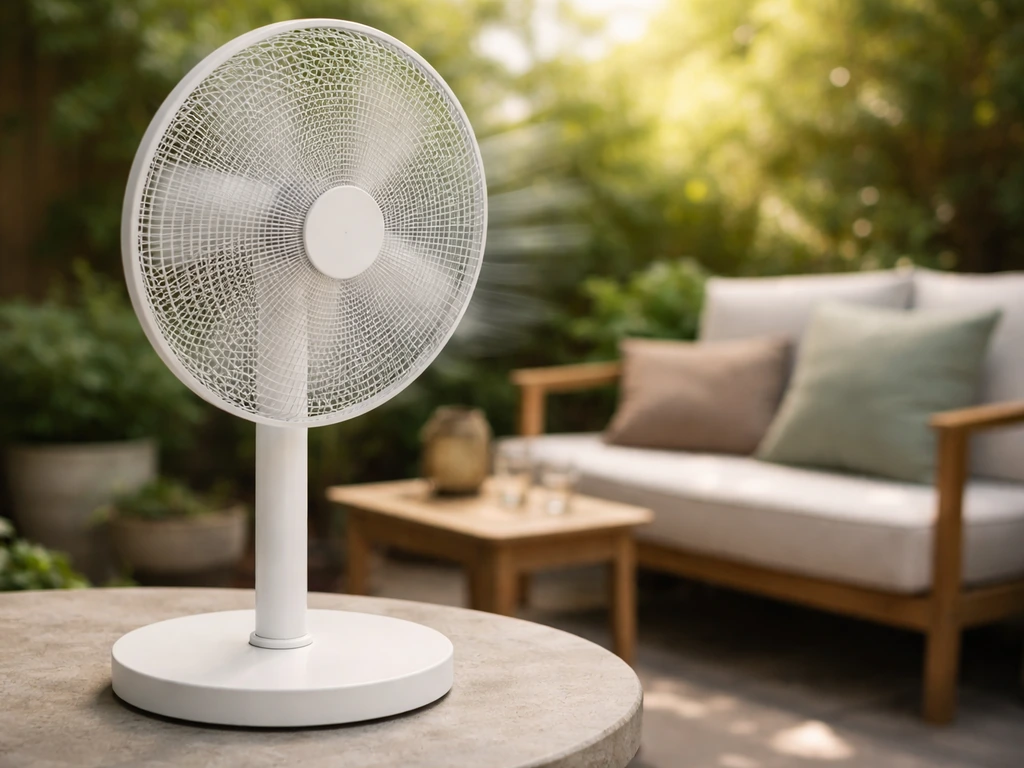
Pedestal fans are the most versatile outdoor option. You can reposition them in minutes, aim them exactly where people are sitting, and find models with oscillation arcs up to 130 degrees that cover a whole seating area. Look for ones specifically rated UL 507 for wet or damp locations, with corrosion-resistant finishes like epoxy-coated housings and balanced aluminum blades. A 24-inch industrial-grade outdoor pedestal fan can push 9,450 CFM, which is more than enough for a medium-sized deck or patio. These are the ones I'd suggest for most people as a first fan.
Wall-mount oscillating fans
Wall-mount fans free up floor space and work great on screened porches, garages, or any covered area with a wall to mount them on. The best ones are UL 507 wet-location rated and sealed industrial motors, making them tough enough for direct outdoor mounting. Oscillation is a huge plus here since the fan sweeps air across a wider zone without you having to move it. Mounting height matters a lot, which I'll cover in the placement section.
Outdoor ceiling fans
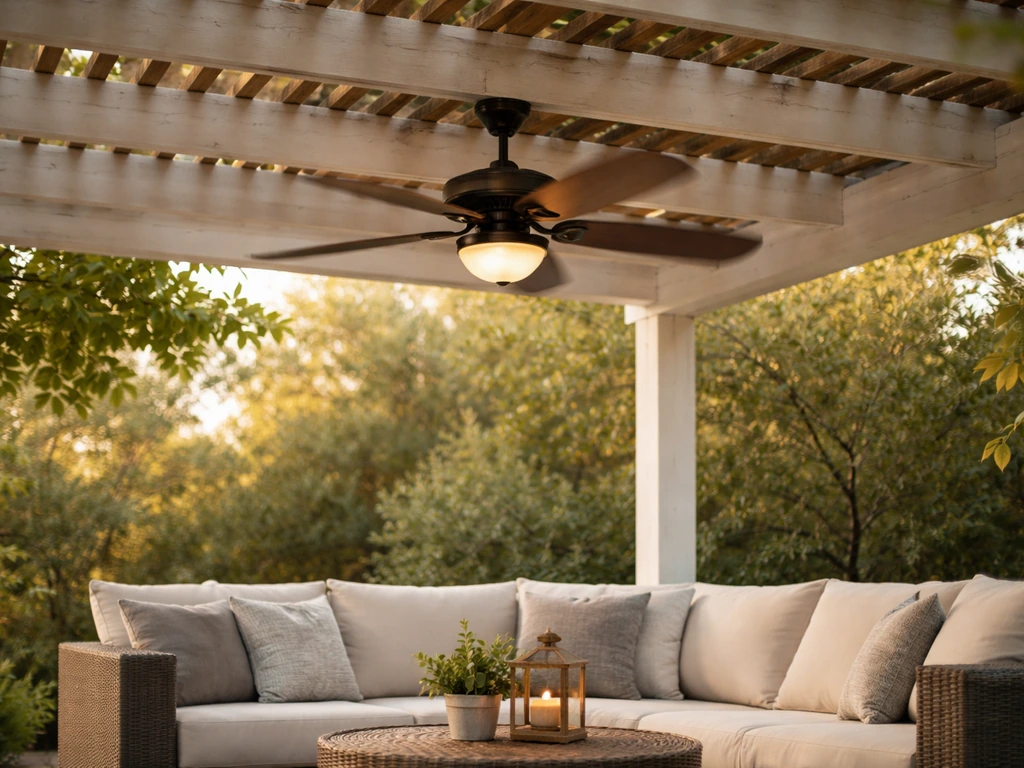
Ceiling fans are the best choice for covered patios, pergolas, and screened porches where you have overhead structure to mount them. They stay out of the way, look good, and push a consistent column of air downward over the whole seating area. Blade span sizing matters: a space up to about 75 square feet works with a 29 to 36-inch fan; 145 to 225 square feet needs a 44 to 50-inch fan; anything over 225 square feet calls for a 52 to 54-inch fan or two smaller fans for even coverage.
Tower fans
Tower fans have a slim profile and look cleaner than pedestal models, but most consumer tower fans are not truly rated for wet outdoor locations. They work on covered, protected patios where rain never reaches them, but I'd be cautious placing a standard tower fan anywhere it could get splashed. If you go this route, look explicitly for outdoor-rated models with a damp or wet location certification.
Misting fans
Misting fans combine a fan with a fine water mist that evaporates and drops the perceived temperature around you by 10 to 20 degrees in dry climates. They're less effective in high humidity (above 60 to 65%) because the mist can't evaporate quickly. A portable misting fan like the XPOWER FM-68 moves 1,000 CFM, uses just 65 watts, and has a 130-degree oscillation sweep, which is a solid spec for a personal outdoor cooling device. Larger units like the FM-48 at 600 CFM are better as personal-zone coolers than whole-patio solutions. Rechargeable misting fans like the Geek Aire 12-inch model (rated up to 1,500 CFM max, IPX4) give you portability without needing a nearby outlet, though they'll need recharging every few hours on high.
Bladeless fans
Bladeless fans use Air Multiplier technology and are genuinely quieter and safer around kids, but they're expensive and generally not rated for wet outdoor locations. They're best in a protected, covered patio where they won't face rain or blowing debris. For most outdoor setups, the cost-to-airflow ratio doesn't favor bladeless models compared to a quality pedestal or ceiling fan.
Weatherproofing: what the ratings actually mean
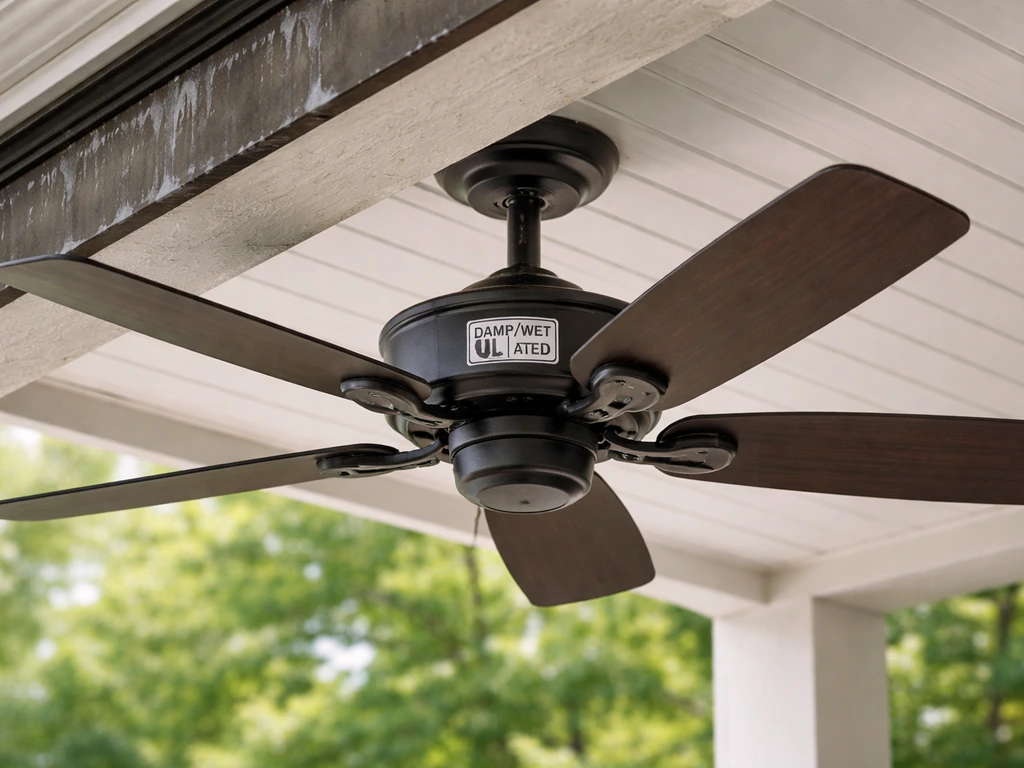
This is where a lot of people get burned. Buying a fan that isn't rated for outdoor use and having it fail after one rainy season is a frustrating and avoidable mistake. Here's what the ratings mean in plain terms.
| Rating | What it means | Best for |
|---|---|---|
| UL Damp Location | Condensation-resistant near electrical parts; no direct water contact | Covered patio, screened porch, pergola with full roof |
| UL Wet Location | Can handle water dripping, splashing, or flowing on/against the unit | Open deck, patio with partial overhead cover, areas exposed to rain |
| IPX4 | Splash-resistant from any direction | Light outdoor use, covered areas, misting fans with water spray nearby |
| IPX5 | Resistant to low-pressure water jets from any direction | More exposed outdoor locations, occasional direct spray |
| IPX6 | Resistant to powerful water jets from any direction | Highly exposed locations, pressure washing nearby |
| UL 507 | Safety standard for electric fans (validates performance and safety) | Look for this on any outdoor corded fan |
For an open, uncovered deck or patio, you want at minimum a UL wet-location rating. For a covered porch or screened enclosure, UL damp-location is acceptable. Material matters too: look for rust-resistant powder-coated steel, UV-stabilized plastic, or epoxy-coated aluminum on blades and housings. Avoid anything with untreated steel parts or exposed raw metal, especially in coastal environments where salt air accelerates corrosion.
Best patio fan picks by situation
Small patio (under 144 sq ft)
A single high-quality pedestal or wall-mount fan in the 9,000+ CFM range with oscillation is enough for a small patio. A 24-inch outdoor wet-rated oscillating pedestal fan covers this space easily and costs significantly less than a ceiling fan installation. If you want supplemental evaporative cooling and your climate is dry, a misting fan like the XPOWER FM-68 (1,000 CFM, 65W) is a great addition. Don't overcomplicate it with multiple fans here, one well-placed unit does the job.
Large patio (over 225 sq ft)
One fan won't cut it for a large open space. The research backs this up clearly: for even airflow coverage, you're better off with two or three medium fans strategically placed than one oversized unit that leaves dead spots. If it's a covered space, pair a 52 to 54-inch outdoor ceiling fan with one or two pedestal fans aimed at seating areas farther from the ceiling fan's column. For an open deck, two wall-mount or pedestal oscillating fans placed on opposite corners angling inward create a cross-breeze pattern that's noticeably more comfortable.
Screened porch
A screened porch is the ideal environment for a ceiling fan. You have overhead structure, protection from direct rain, and a contained airspace where a ceiling fan's downward airflow is most effective. A UL damp-rated ceiling fan is sufficient here since you're not getting direct water exposure. Size the blade span to your square footage: 44 to 50 inches for most standard screened porches (roughly 150 to 225 square feet). If the ceiling height is above 9 feet, use a ceiling fan with a longer downrod to bring the blades closer to the living zone.
Open, windy areas
Wind is both your friend and your enemy with patio fans. Natural breeze helps, but consistent strong wind can make a lightweight tower fan or pedestal fan tip over or wobble enough to annoy you. In consistently windy spots, mount the fan to a wall or structure so it can't tip. Heavy-base industrial pedestal fans with wide tripod legs are more stable than cheap consumer stands. Look for motor housings that are fully sealed so gust-driven debris can't get inside. Aim fans to work with prevailing wind direction, not against it, to maximize the airflow you feel.
Setup, placement, and airflow tips
Placement is where a lot of people leave airflow performance on the table. A fan in the wrong spot moves air where no one is sitting.
- Mount ceiling fans so blades are 8 to 9 feet above the floor. Above 9 feet, use a longer downrod to pull blades back into the effective zone. Above 10 feet, you'll lose significant felt airflow.
- For pedestal fans, set the head height so airflow hits your seated body, usually around 3 to 4 feet. Don't aim the fan over people's heads.
- Wall-mount fans work best between 6 and 8 feet high, angled downward toward the seating area, not parallel to the floor.
- Turn on oscillation whenever you're not using the fan to cool a single fixed seat. The sweeping arc covers more area and prevents one person from hogging all the breeze.
- Avoid placing fans behind large furniture, structural columns, or planters that block airflow before it reaches people. Even a 12-inch obstruction directly in front of the fan can cut effective CFM delivery significantly.
- Create a cross-breeze on open patios by placing two fans on opposite sides angling toward each other rather than both pointing the same direction.
- In summer (counterclockwise blade rotation for ceiling fans), the fan pushes air straight down. In winter, reverse it to pull cool air up and push warm air down from the ceiling.
Energy use, noise, and staying comfortable
Noise is a real consideration if you spend evenings on the patio and like conversation or quiet. Most quality outdoor fans in the 50 to 65 dB range are background-level noise at a distance, similar to a normal conversation at medium volume. The Shark FlexBreeze HydroGo, as a reference point, runs from the low 50s dB on low speed up to the high 70s dB on high. Shark's own spec sheet puts its sound power level at 62 dB(A), which is the kind of number you want to look for when comparing fans. Industrial-grade outdoor fans tend to run louder at max speeds but most people don't run them at max. Outdoor misting systems like Hydrobreeze document noise in the 50 to 60 dB range, which is on the quieter end.
For nighttime use, run fans on medium speed where possible. You're not fighting peak heat, so you don't need maximum CFM, and the lower noise is noticeably more pleasant. Fans use modest energy: a 65-watt misting fan running 6 hours a day costs roughly $0.08 to $0.12 per day depending on your electricity rate. A 144-watt unit running the same time doubles that. Choosing a fan with 100 CFM per watt rather than 50 CFM per watt cuts your cooling cost roughly in half over the season, a meaningful difference if you're running it daily from May through September.
If your goal is serious cooling, not just airflow, consider whether a misting fan, a swamp cooler, or a dedicated outdoor air cooler is a better fit for your climate. Misting fans work best where humidity stays below 60 to 65%. In humid Southern climates, they add moisture without much cooling effect. In those situations, maximizing fan CFM and shade is a better strategy than adding water to the air. Patio air conditioners are a separate category worth exploring for extreme heat situations. If you want something stronger than a fan or misting unit, a best outdoor patio air cooler can keep you comfortable during the hottest hours. Patio air conditioners are a separate category worth exploring for extreme heat situations, especially when you need actual cooling rather than just moving air.
Keeping your fan running season after season
Outdoor fans take more abuse than indoor ones, so a little maintenance goes a long way. Here's what to do and when.
- Wipe down blades and housing every 4 to 6 weeks during active use. Pollen, dust, and moisture combine into a gummy film that throws blade balance off and reduces airflow. A damp cloth is usually enough; avoid soaking the motor housing.
- Check blade balance every season. An unbalanced blade wobbles, stresses the motor bearings, and gets louder over time. Most ceiling fans come with a blade balancing kit; use it if you notice wobble.
- Inspect motor vents and any grille openings for insect nests, especially in spring. Wasps love enclosed fan housings. Clear any blockages before running the motor.
- For misting fans, flush the water lines at the end of the season and dry them out to prevent mineral buildup and mold in the tubing.
- If storing for winter, cover pedestal and wall-mount fans with an outdoor furniture cover or bring them inside. Even weatherproof fans last longer when not sitting in snow or ice for months.
- For outdoor ceiling fans left up year-round, wipe down the motor housing and blade surfaces before first use each spring and check that all mounting hardware is still tight after winter temperature swings.
- Lubricate motor bearings annually if the fan's design allows access (check your manual). Dry bearings are the most common cause of early motor failure in outdoor fans.
One practical note on storage: if you have a high-quality industrial-grade outdoor fan that's genuinely wet-location rated, you can leave it outside through mild winters in most climates without damage. But in areas with heavy snowfall, ice storms, or sustained freezing temperatures, covering or storing the fan extends its life meaningfully, regardless of its IP or UL rating. Those ratings are about water resistance, not freeze-thaw cycle durability.
FAQ
How do I interpret CFM for an oscillating patio fan so I buy the right airflow for my seating?
If you see both CFM and a max airflow number, prioritize the airflow at the speed you’ll actually use most (often medium). Also check whether CFM is listed for the same direction (straight-through vs oscillating). Oscillation can spread airflow, so a model with slightly lower peak CFM may still feel stronger across the seating area.
My patio is covered, do I still need a wet-rated fan or is damp-rated enough?
For open patios, use a UL wet-location rating minimum. If the fan sits under a roof but still gets spray from wind-driven rain, choose UL wet-rated anyway. UL damp-rated is mainly for indirect moisture exposure, like a sheltered screened porch where the fan is not in the rain path.
What construction details matter most for outdoor fans in coastal or high-salt air areas?
Look for corrosion-resistant, fully sealed construction, not just water resistance. Specifically, check for sealed motor housings, corrosion-resistant blades (like epoxy-coated aluminum or stainless components), and powder-coated or UV-stabilized exterior parts. If the description mentions “rust-resistant” without naming the material or coating, treat it as a weaker claim.
For a ceiling patio fan, how do I decide downrod length if my ceiling is high?
Measure the ceiling height and your desired blade-to-people clearance. If the fan blades are too high, you get airflow above your seating, and if they are too low, you risk comfort and safety issues. In practice, use a longer downrod only when needed to bring the airflow into the living zone, then recheck that clearance still meets local safety norms.
Is it better to buy two smaller best patio fans or one bigger unit for a large outdoor area?
Yes, but placement matters more than pairing brands. Two smaller fans can outperform one large fan when they face each other or cover the room in parallel without fighting airflow directions. Use a staggered plan, aim one fan slightly inward from one side, and the other to avoid “dead spots” behind furniture.
How do I plan power for a rechargeable or battery patio fan if I want all-evening cooling?
Battery and rechargeable models usually drop in airflow as the battery drains, so plan for your typical session length. If you need 6 to 8 hours nightly use, rechargeable often requires charging breaks, or you may need a corded model with a safe, correctly rated power setup.
What’s the safest way to run a corded patio fan, and when should I avoid extension cords?
Use an outdoor-rated GFCI outlet and keep cord connections elevated and protected from splash, not lying on the ground where they can get wet. Also confirm the fan’s cord gauge and plug rating match the product instructions, and avoid running an extension cord unless the manual explicitly allows it.
Why does my pedestal fan wobble in gusty weather, and how can I stop it?
If the fan tips or wobbles, it’s usually base stability, airflow imbalance, or wind interaction. Fix it by mounting to a structure (wall or post) when possible, choosing a heavier base industrial pedestal, and setting the fan so it works with prevailing wind direction rather than directly against gusts.
How do I choose the right speed setting to reduce noise without losing too much cooling?
Choose the fan speed based on comfort, not the highest CFM. For nighttime, medium often delivers most of the perceived cooling with lower noise and lower power use. If noise is a priority, compare published sound power level or dB(A) range, and expect industrial units to be louder at max speed even if they cool faster.
When should I avoid a misting patio fan because humidity will make it ineffective?
Start by checking humidity. If outdoor humidity is above roughly 60 to 65%, misting may feel humid rather than refreshing. In those climates, prioritize airflow and shade, and treat misting as a targeted option for dry days only, rather than a primary cooling system.
Can a misting fan cool an entire patio, or is it only for one seating area?
A “one comfort zone” misting or tower style device can be great for an individual seating spot. But for whole-patio cooling, misting CFM is usually not enough, and coverage can be uneven. If you want the entire deck to feel cooler, consider a wet-rated pedestal or wall fan plan, or a covered-patio ceiling fan sized to the space.
What’s the most common mistake people make when sizing best patio fans?
Typically you do not have to run a fan at maximum to feel a meaningful difference. If your goal is comfort, aim for the earlier CFM-per-square-foot targets and then optimize placement, oscillation angle, and speed. You’ll usually get more benefit from better positioning than from chasing the highest CFM sticker.
Can I leave a wet-rated patio fan outside all winter, or should I store it?
Yes, but do it in a way that matches outdoor ratings. Wet-rated fans can often stay outside through mild winters, yet freeze-thaw damage is still possible in heavy-snow regions. For sustained freezing or ice, covering or storing is recommended regardless of UL or IP claims.
Next Articles
Best Rated Patio Furniture Covers: Buying Guide and Tips
Choose best rated patio furniture covers with fit, materials, waterproofing, UV and wind features, plus measuring and ca

Best Outdoor Patio Rug: Buying Guide by Materials, Size, Care
Choose the best outdoor patio rug fast with material, size, layout, and care tips for sun, mildew, stains, and storms.
Best Size TV for Outdoor Patio: Sizing, Brightness, and Fit
Choose the right outdoor patio TV size with distance math, brightness tips, weather ratings, mounting and glare planning